
Autofocus Points Compared: Canon 90D vs Nikon D7500 vs Sony A6400
Compare the Canon 90D, Nikon D7500, and Sony A6400 autofocus systems, including focus points, tracking, low-light focusing, live view performance, and practical shooting differences.

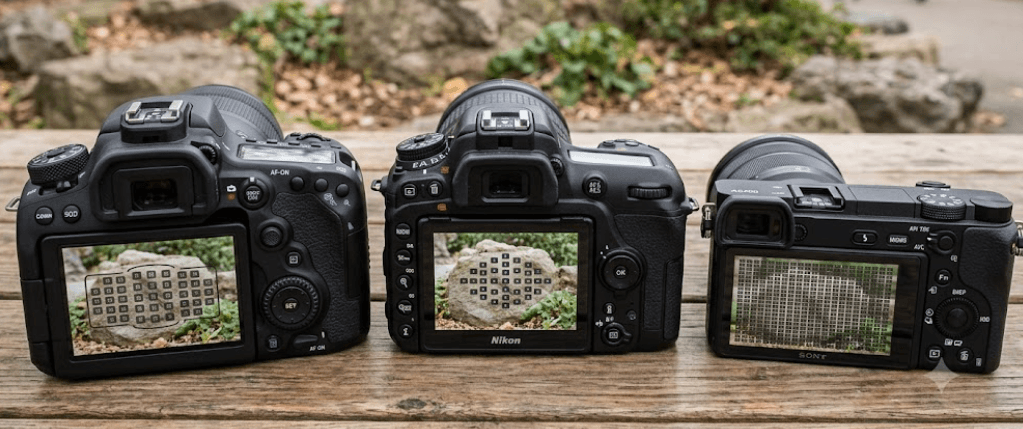
TL;DR The Canon 90D, Nikon D7500, and Sony A6400 take very different approaches to autofocus. The Canon 90D has 45 cross-type AF points through its optical viewfinder and uses Dual Pixel CMOS AF in Live View. The Nikon D7500 uses a 51-point phase-detection system with 15 cross-type sensors through its optical viewfinder, along with 3D tracking and dynamic-area AF modes. The Sony A6400 uses a Fast Hybrid AF system with 425 phase-detection and 425 contrast-detection points spread across the image area, plus Eye AF and real-time tracking features. That means the raw point count alone does not tell the whole story. The way those points are distributed, how the camera tracks moving subjects, and whether you are shooting through the viewfinder or screen all have a major effect on focusing performance.
Understanding Autofocus Points
Autofocus points are the areas used by a camera's focusing system to detect and maintain focus on a subject. A higher number can give the camera more information to work with, but it does not automatically mean better autofocus. The type of AF point, its placement across the frame, the focusing algorithm, and the available tracking modes all matter. This is particularly important when comparing the Canon 90D, Nikon D7500, and Sony A6400 because they are built around different camera architectures. The 90D and D7500 are DSLRs, while the A6400 is a mirrorless camera, so their autofocus systems operate differently depending on the shooting mode.
The Canon EOS 90D provides up to 45 cross-type AF points when shooting through its optical viewfinder. Canon specifies that all 45 can be cross-type, although the exact available points can vary depending on the lens. The centre point can also use dual cross-type focusing with compatible lenses. The Nikon D7500 has 51 focus points, including 15 cross-type sensors, and uses Nikon's Advanced Multi-CAM 3500 II autofocus module with TTL phase detection. Both systems are therefore designed around dedicated phase-detection AF hardware for viewfinder shooting.
The Sony A6400 works differently because its autofocus points are located on the imaging sensor. Sony specifies 425 phase-detection AF points and 425 contrast-detection AF points as part of its Fast Hybrid AF system. These points cover approximately 84% of the image area, according to Sony's launch information. The camera also offers tracking and Eye AF features, giving it a broader sensor-area approach than the traditional DSLR viewfinder systems used by the Canon and Nikon models.
Autofocus System At A Glance
| Camera | Autofocus System | AF Points | Cross-Type Points | Key AF Features |
|---|---|---|---|---|
| Canon EOS 90D | Dedicated phase-detection AF | 45 | Up to 45 | One-Shot AF, AI Servo, Zone AF, Large Zone AF |
| Nikon D7500 | TTL phase-detection AF | 51 | 15 | 3D Tracking, Dynamic-Area AF, Group-Area AF |
| Sony A6400 | Fast Hybrid AF | 425 phase + 425 contrast | Not specified in DSLR terms | Real-Time Tracking, Eye AF, Flexible Spot |
The important point is that these figures are not directly interchangeable. A DSLR's dedicated viewfinder AF points and a mirrorless camera's sensor-based phase and contrast detection points represent different implementations. Therefore, comparing only 45 versus 51 versus 425 can create a misleading impression of how these cameras actually focus.
Canon 90D Autofocus Performance
The Canon 90D uses a 45-point all-cross-type autofocus system when shooting through its optical viewfinder. Canon lists One-Shot AF and AI Servo AF modes, along with single-point, spot, zone, and large-zone AF selection. The centre point can provide dual cross-type focusing with compatible lenses, giving the camera additional focusing sensitivity at the centre. For photographers who primarily compose through the optical viewfinder, this makes the 90D a flexible DSLR autofocus system rather than simply a camera with a fixed number of points.
The 90D becomes more interesting when you switch to Live View. Instead of relying on the 45-point dedicated AF sensor used for viewfinder photography, the camera uses Canon's Dual Pixel CMOS AF system on the imaging sensor. Canon describes this as phase-detection pixels built into the imaging sensor. This means the focusing experience changes substantially when you use the rear screen for still photography or video. It also helps explain why the 90D cannot be judged purely from its 45-point viewfinder specification.
For everyday photography, the 90D's autofocus setup is particularly relevant if you want one DSLR that can handle portraits, action, wildlife, and general photography while giving you different AF-area options. AI Servo is designed for continuous autofocus, while the different point and zone configurations allow you to decide how much control you want over the focusing area. The camera's AF working range for viewfinder focusing extends from EV -3 to EV 18 under Canon's stated testing conditions, although actual performance depends on the lens and shooting environment.
Where The Canon 90D Fits
The 90D makes sense for photographers who enjoy the optical viewfinder experience but also want a capable Live View autofocus system. Its 45 cross-type points are not the highest numerical count in this comparison, but the system provides useful point selection and zone modes. The main thing to remember is that the 90D effectively gives you two different autofocus approaches depending on whether you shoot through the viewfinder or Live View.
Nikon D7500 Autofocus Performance
The Nikon D7500 uses a 51-point autofocus system, with 15 of those points being cross-type sensors. It uses Nikon's Advanced Multi-CAM 3500 II autofocus sensor module with TTL phase detection. Nikon also specifies an autofocus detection range of -3 to +19 EV under its stated conditions. That gives the D7500 a dedicated DSLR focusing system designed for viewfinder photography, with a strong emphasis on subject tracking and selectable AF-area modes.
One of the D7500's biggest autofocus strengths is the range of tracking modes available. Nikon provides single-point AF, 9-, 21-, or 51-point dynamic-area AF, 3D tracking, group-area AF, and auto-area AF. Dynamic-area AF is particularly useful when a moving subject briefly leaves the selected focus point because the surrounding points can assist with maintaining focus. Nikon specifically describes the 9-, 21-, and 51-point modes for different types of predictable and unpredictable movement.
The D7500 is therefore less about having the largest possible number of AF points and more about giving photographers control over how those points behave. For sports, wildlife, or other moving subjects, the combination of continuous AF, dynamic-area options, 3D tracking, and group-area AF gives the camera several ways to approach a difficult focusing situation. The system also supports AF fine-tuning, which can be useful for calibrating compatible lenses.
Where The Nikon D7500 Fits
The D7500 is particularly well suited to photographers who prefer shooting through a DSLR optical viewfinder and want extensive control over tracking modes. Its 51-point system includes fewer cross-type points than the Canon 90D has, but Nikon gives you several dynamic-area and tracking options. In practice, that makes the D7500's autofocus specification more about flexibility than the headline number of 51.
Sony A6400 Autofocus Performance
The Sony A6400 takes a much more modern approach to autofocus. Its Fast Hybrid AF system combines phase-detection and contrast-detection autofocus directly on the imaging sensor. Sony lists 425 phase-detection points and 425 contrast-detection points, with multiple focus-area options including Wide, Zone, Centre, Flexible Spot, Expanded Flexible Spot, and Tracking. This gives the camera a large sensor-based focusing area rather than concentrating autofocus points in a smaller central region like a traditional DSLR viewfinder system.
Sony also equipped the A6400 with Real-Time Tracking and advanced Eye AF capabilities. At launch, Sony stated that the camera could acquire focus in as little as 0.02 seconds under its testing conditions and that the AF points covered approximately 84% of the image area. These features are especially useful when the subject moves around the frame because the camera has a large focusing area to work with rather than requiring the photographer to keep the subject close to a limited central AF region.
The A6400's focus sensitivity is specified from EV -2 to EV 20 with an f/2.0 lens at ISO 100 equivalent. It also supports AF-S, AF-C, AF-A, DMF, and manual focus modes. For photographers who regularly use continuous autofocus, people photography, video, or subjects that move unpredictably across the frame, the combination of sensor-based phase detection, contrast detection, tracking, and Eye AF gives the A6400 a very different focusing experience from the two DSLRs.
Where The Sony A6400 Fits
The A6400 is the most fundamentally different camera in this comparison because its autofocus points are built into the imaging sensor. Instead of judging it against the 90D and D7500 only by AF-point count, it makes more sense to consider its coverage, tracking features, and Eye AF capabilities. This is particularly relevant if you shoot moving subjects or frequently compose using the rear screen.
Canon 90D vs Nikon D7500 vs Sony A6400
When the three systems are placed side by side, the differences become easier to understand. The Canon 90D provides 45 cross-type AF points through its optical viewfinder and adds Dual Pixel CMOS AF for Live View. The Nikon D7500 has 51 viewfinder AF points, including 15 cross-type sensors, and offers several dynamic-area and tracking modes. The Sony A6400 has 425 phase-detection and 425 contrast-detection points on its imaging sensor, along with tracking and Eye AF functions.
For moving subjects, the D7500's 3D tracking and dynamic-area modes give photographers considerable control over how the camera responds when a subject moves away from the selected point. The Canon 90D also provides AI Servo and multiple AF-area choices. The Sony A6400 approaches the problem differently, using its sensor-wide AF system and tracking functions to follow subjects across a much larger portion of the frame.
The most important distinction is therefore not simply which camera has more autofocus points. The Canon and Nikon systems are built around DSLR viewfinder autofocus, while the Sony uses a sensor-based hybrid system. If you mostly use an optical viewfinder, the Canon and Nikon specifications are directly relevant. If you rely heavily on Live View, tracking, Eye AF, or mirrorless-style focusing, the Sony's system becomes much more important to consider.
Autofocus Comparison
| Autofocus Feature | Canon EOS 90D | Nikon D7500 | Sony A6400 |
|---|---|---|---|
| Main viewfinder AF system | Dedicated phase detection | Dedicated phase detection | Sensor-based hybrid AF |
| AF points | 45 | 51 | 425 phase + 425 contrast |
| Cross-type AF | Up to 45 | 15 | Not specified as cross-type |
| Continuous AF | AI Servo | AF-C | AF-C |
| Tracking modes | Zone and Large Zone AF | 3D Tracking, Dynamic-Area AF | Tracking, Real-Time Tracking |
| Eye AF | Available through its Live View AF system, depending on implementation | Face-priority AF in Live View | Advanced Eye AF |
| Live View AF | Dual Pixel CMOS AF | Contrast-detection Live View AF | Fast Hybrid AF |
| Low-light AF range | EV -3 to +18, viewfinder conditions | EV -3 to +19 | EV -2 to +20 with stated lens conditions |
The table shows why a simple AF-point ranking would not accurately describe these cameras. Each manufacturer defines and uses autofocus points differently, and the cameras provide different ways of selecting and tracking subjects.
Which Autofocus System Suits Different Photography Styles
For sports and wildlife, autofocus tracking is more important than the headline number of points. The Nikon D7500's 3D tracking and dynamic-area modes are designed specifically for moving subjects, including situations where the subject can briefly leave the selected focus point. The Canon 90D's AI Servo and zone-based AF options also provide a useful approach for action photography. The Sony A6400 adds sensor-wide tracking and Eye AF, which can be particularly useful when the subject moves around the frame.
For portraits, the Sony A6400's Eye AF is an important part of its autofocus system because it can help maintain focus on the subject's eye rather than simply focusing on the nearest object. The Canon 90D's Live View Dual Pixel CMOS AF also changes the experience compared with its optical-viewfinder AF system. The Nikon D7500 offers face-priority AF in Live View, while its optical viewfinder system remains centred around its dedicated 51-point phase-detection module.
For general photography, the choice can come down to how you prefer to operate the camera. A photographer who likes an optical viewfinder and traditional DSLR controls may find the Canon 90D or Nikon D7500 more natural. Someone who prefers a compact mirrorless body, rear-screen composition, and automated subject tracking may find the A6400's autofocus approach more convenient. The right system depends on whether you value direct control, tracking assistance, or the way the camera fits into your existing shooting habits.
Autofocus By Shooting Style
| Shooting Style | Relevant Autofocus Features |
|---|---|
| Sports | Nikon 3D Tracking, Dynamic-Area AF, Canon AI Servo, Sony Tracking |
| Wildlife | Nikon 51-point system and tracking modes, Canon AI Servo, Sony Tracking |
| Portraits | Sony Eye AF, Canon Live View Dual Pixel AF, Nikon Face-Priority Live View AF |
| Street Photography | Sony sensor-wide AF areas, Canon Zone AF, Nikon Single-Point or Dynamic-Area AF |
| Video | Canon Dual Pixel CMOS AF, Sony Fast Hybrid AF, Nikon Live View AF |
| General Photography | All three offer single and continuous AF modes with different control systems |
Common Autofocus Mistakes To Avoid
One common mistake is assuming that the Sony A6400 has simply “more autofocus points” and is therefore automatically better. Sony's specification actually lists 425 phase-detection points and 425 contrast-detection points. These are two parts of the camera's hybrid autofocus system, not 850 identical phase-detection points. The same caution applies when comparing the Canon's 45 points and Nikon's 51 points. The technology behind those points and how the camera uses them matters just as much as the number printed on the specification sheet.
Another mistake is comparing DSLR viewfinder autofocus directly with Live View autofocus without mentioning the shooting mode. The Canon 90D uses its dedicated 45-point phase-detection AF system through the optical viewfinder but switches to Dual Pixel CMOS AF in Live View. The Nikon D7500 also uses a dedicated 51-point phase-detection system through the viewfinder, while its Live View focusing works differently. Therefore, a fair comparison needs to specify how the camera is being used.
It is also easy to assume that autofocus performance is determined entirely by the camera body. The lens matters too. Canon explicitly notes that the number and type of available AF points can vary depending on the lens, while Nikon specifies certain focusing capabilities based on lens aperture and the D7500's AF system. Lighting, subject contrast, movement, camera settings, and the selected AF area can all influence the final result.
Frequently Asked Questions
Q. How many autofocus points does the Canon 90D have?
The Canon EOS 90D has up to 45 AF points when shooting through its optical viewfinder, and Canon specifies that these can all be cross-type depending on the lens. The camera also uses Dual Pixel CMOS AF in Live View.
Q. How many autofocus points does the Nikon D7500 have?
The Nikon D7500 has 51 autofocus points, including 15 cross-type sensors. Its system also includes 9-, 21-, and 51-point Dynamic-Area AF, 3D Tracking, Group-Area AF, and Auto-Area AF.
Q. How many autofocus points does the Sony A6400 have?
Sony specifies 425 phase-detection AF points and 425 contrast-detection AF points for the A6400. These form part of its Fast Hybrid AF system and are distributed across the imaging sensor.
Q. Does more autofocus points mean better autofocus?
Not necessarily. AF-point count is only one part of autofocus performance. Coverage, tracking algorithms, AF modes, subject recognition, lens compatibility, and shooting conditions also influence how effectively a camera focuses.
Q. Which camera has cross-type autofocus points?
The Canon 90D has up to 45 cross-type AF points through its optical viewfinder, while the Nikon D7500 has 15 cross-type sensors among its 51 AF points. Sony describes the A6400 using phase-detection and contrast-detection points rather than a DSLR-style cross-type AF specification.
Q. Does the Canon 90D use the same autofocus system in Live View?
No. Through the optical viewfinder, it uses its dedicated 45-point phase-detection AF system. In Live View, it uses Canon's Dual Pixel CMOS AF system, with phase-detection pixels built into the imaging sensor.
Q. Does the Nikon D7500 have 3D Tracking?
Yes. The D7500 provides 3D Tracking as one of its autofocus-area modes, along with single-point AF, Dynamic-Area AF, Group-Area AF, and Auto-Area AF.
Q. Does the Sony A6400 have Eye AF?
Yes. Sony lists Eye AF among the A6400's autofocus features and also provides tracking modes including Wide, Zone, Centre, Flexible Spot, and Expanded Flexible Spot.
Q. Which autofocus system is better for moving subjects?
The answer depends on the type of movement and shooting method. The Nikon D7500 provides 3D Tracking and Dynamic-Area AF, the Canon 90D offers AI Servo with several AF-area options, and the Sony A6400 combines sensor-based phase detection with tracking and Eye AF features.
Q. Are the Sony A6400's 425 phase and 425 contrast points counted as 850 AF points?
Sony lists them as separate phase-detection and contrast-detection point counts within its Fast Hybrid AF system. It is more accurate to describe the camera as having 425 phase-detection and 425 contrast-detection AF points rather than simply calling it an 850-point system.
Final Recommendation
The Canon 90D, Nikon D7500, and Sony A6400 demonstrate three different approaches to autofocus rather than three versions of the same system. The Canon 90D offers up to 45 cross-type AF points through its optical viewfinder and adds Dual Pixel CMOS AF for Live View. The Nikon D7500 provides 51 dedicated viewfinder AF points, including 15 cross-type sensors, with useful Dynamic-Area and 3D Tracking modes. The Sony A6400 moves to sensor-based Fast Hybrid AF with 425 phase-detection and 425 contrast-detection points, along with tracking and Eye AF.
For buyers choosing between these three cameras, the autofocus point count should therefore be only one part of the decision. Look at how you normally compose photographs, whether you use the optical viewfinder or Live View, the kind of subjects you photograph, and how much control you want over tracking. The lens you pair with the camera also matters, particularly when comparing autofocus behaviour across different systems.
The most useful way to compare these cameras is to match their autofocus design with your shooting style rather than treating one specification as the deciding factor. The 90D, D7500, and A6400 can all provide capable autofocus, but they achieve it through different hardware and focusing approaches. That distinction is what matters when moving from a specification sheet to actual photography.






