ARM vs x86 Laptops in 2026: Which Should You Buy?
Confused between ARM and x86 laptops in 2026? Compare performance, battery life, gaming, software compatibility, AI features, and value to find the right laptop for your needs.

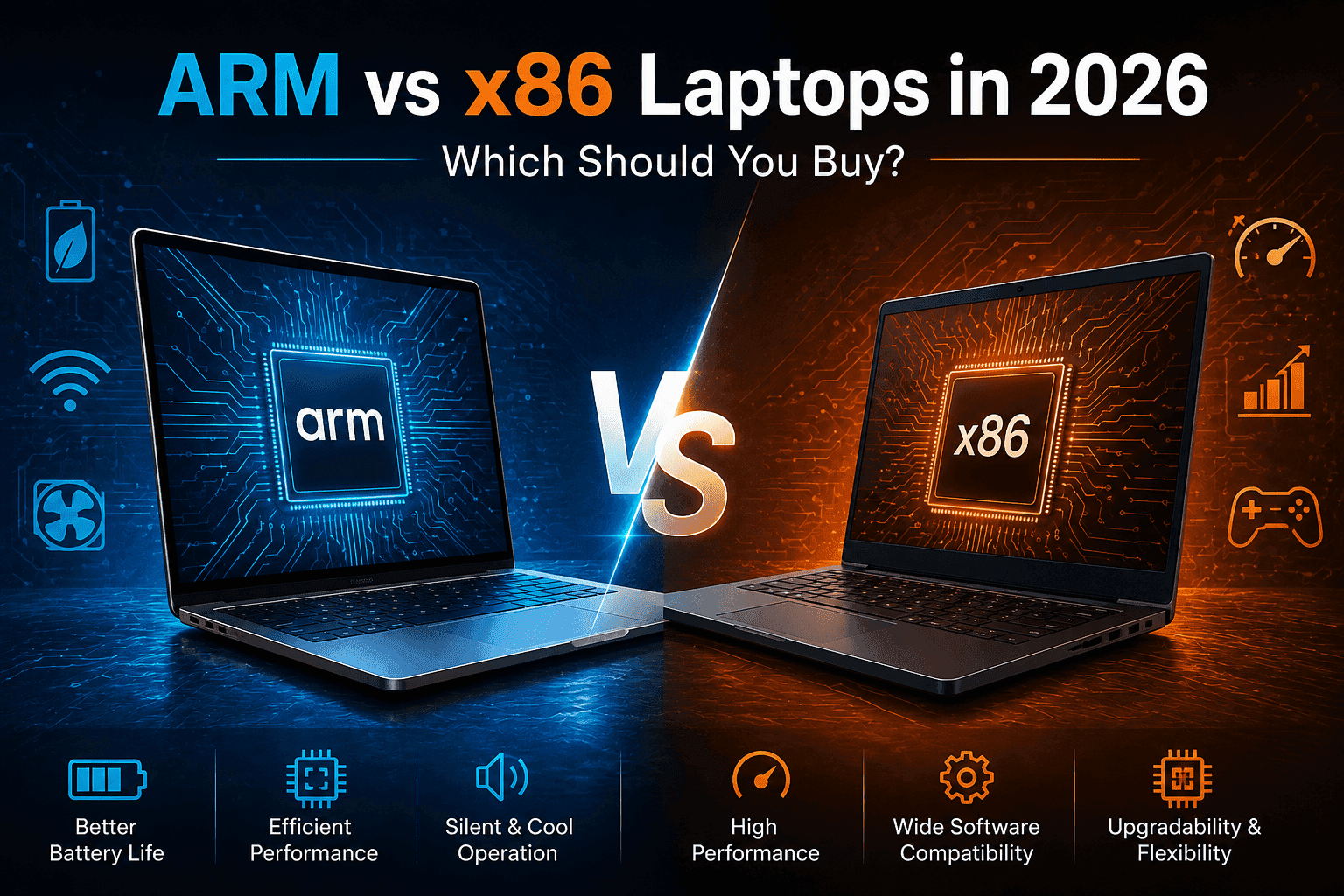
TL;DR Choosing between an ARM and an x86 laptop in 2026 depends less on benchmarks and more on how you use your laptop every day. ARM-powered laptops, led by Qualcomm Snapdragon X series processors, deliver exceptional battery life, quieter operation, and dedicated AI capabilities, making them ideal for students, professionals, and frequent travellers. Meanwhile, x86 laptops powered by Intel Core Ultra and AMD Ryzen AI processors continue to offer the broadest software compatibility, stronger gaming performance, and better support for demanding professional applications. If your workload revolves around office productivity, web browsing, content consumption, and AI-powered features, an ARM laptop is now a practical choice. However, if you rely on engineering software, professional creative tools, virtualization, or PC gaming, an x86 laptop remains the safer and more versatile investment.
ARM vs x86 Laptops in 2026: What's the Difference?
The debate around ARM vs x86 laptops in 2026 is more relevant than ever because buyers now have genuine choices instead of a single dominant architecture. For years, nearly every Windows laptop relied on Intel or AMD processors based on the x86 architecture. Today, ARM-powered Windows laptops have matured because of Qualcomm's Snapdragon X series processors and Microsoft's continued investment in Windows on ARM. At the same time, Intel's Core Ultra processors and AMD's Ryzen AI lineup have introduced their own AI-focused capabilities, making the decision more nuanced than simply comparing processor speeds.
At their core, ARM and x86 processors are built using different instruction set architectures. ARM processors follow a Reduced Instruction Set Computing (RISC) design that emphasizes efficiency by using simpler instructions, while x86 processors use a Complex Instruction Set Computing (CISC) architecture designed to execute more sophisticated instructions directly. Modern processor engineering has narrowed the real-world performance gap between these approaches, meaning the architecture itself matters less than how manufacturers optimize the hardware and software together. Buyers should focus on battery life, application compatibility, AI capabilities, and overall user experience rather than assuming one architecture is universally superior.
The growing adoption of artificial intelligence has further changed the conversation. Most premium laptops released in 2026 include dedicated Neural Processing Units (NPUs) capable of accelerating AI workloads locally without relying entirely on the CPU or GPU. Qualcomm, Intel, and AMD all offer processors that meet Microsoft's Copilot+ PC requirements, enabling features such as Recall, Live Captions, Studio Effects, and on-device AI image generation. As a result, choosing between ARM and x86 is no longer about whether one platform supports AI. Instead, it is about identifying which platform aligns better with your software ecosystem and daily workflow.
Understanding ARM and x86 Architectures
Although both processor architectures perform the same fundamental tasks, they achieve those tasks differently. ARM processors prioritize efficiency, enabling laptops to consume less power while producing less heat. This allows manufacturers to build thinner, lighter systems with quieter cooling solutions and longer battery life. Many ARM laptops can comfortably last an entire workday without requiring a charger, making them attractive for students, consultants, remote workers, and professionals who spend significant time traveling.
By comparison, x86 processors prioritize maximum compatibility and sustained computational performance. Intel Core Ultra and AMD Ryzen AI processors continue to excel in workloads that require high multi-core performance, advanced virtualization, engineering simulations, software development, professional content creation, and modern gaming. Since Windows has historically been built around x86 processors, nearly every desktop application, enterprise tool, peripheral driver, and specialized program runs natively without requiring translation or emulation.
Rather than asking which architecture is technically better, buyers should ask which architecture better supports their workload. Someone who spends most of the day inside Microsoft Office, Google Workspace, Zoom, Slack, Adobe Express, and web applications may benefit more from ARM's efficiency. Meanwhile, professionals running AutoCAD, SolidWorks, Unreal Engine, Adobe After Effects, VMware, or high-end PC games will usually experience fewer compatibility concerns on an x86 system.
ARM vs x86 at a Glance
| Feature | ARM Laptops | x86 Laptops |
|---|---|---|
| Primary Manufacturers | Qualcomm Snapdragon X Series | Intel Core Ultra, AMD Ryzen AI |
| Design Philosophy | Maximum efficiency | Maximum compatibility |
| Battery Life | Excellent | Very Good |
| Heat Generation | Low | Moderate |
| Fan Noise | Usually quieter | Depends on workload |
| Software Compatibility | Improving rapidly | Excellent |
| Gaming Support | Limited for demanding titles | Excellent |
| AI Features | Excellent | Excellent |
| Best For | Students, professionals, travelers | Gamers, creators, engineers |
Performance: How ARM and x86 Compare in Real-World Use
Raw benchmark numbers only tell part of the story when comparing ARM vs x86 laptops in 2026. What matters more is how each platform performs during everyday tasks such as multitasking, video conferencing, content creation, software development, and gaming. Over the past two years, ARM laptops have evolved from niche devices into capable productivity machines. Qualcomm's Snapdragon X Elite and Snapdragon X Plus processors deliver fast application launches, smooth multitasking, and responsive performance for common workloads. Combined with Windows 11 optimizations, these systems feel noticeably fluid during office work, web browsing, and AI-assisted tasks. However, performance can still vary depending on whether an application runs natively on ARM or through Microsoft's Prism emulation layer.
Intel Core Ultra Series 2 and AMD Ryzen AI processors continue to dominate workloads that demand sustained processing power. Applications like Adobe Premiere Pro, Blender, Visual Studio, MATLAB, AutoCAD, SolidWorks, and professional virtualization software have years of optimization for x86 processors. Although many popular applications now offer native ARM versions, niche enterprise software, older desktop utilities, proprietary business applications, and specialized drivers are still more reliable on x86 systems. This remains one of the biggest reasons professionals often choose Intel or AMD laptops despite ARM's efficiency advantages.
Another factor to consider is consistency under heavy workloads. ARM processors are incredibly efficient and maintain excellent responsiveness during everyday computing. However, creators exporting large video projects, developers compiling extensive codebases, engineers running simulations, or gamers pushing dedicated GPUs for extended periods may find that x86 processors sustain higher performance under continuous heavy loads. This does not mean ARM laptops are slow. Instead, they are optimized differently, prioritizing efficiency over maximum sustained computational throughput.
Which Platform Performs Better for Different Users?
The answer depends entirely on your workload. Students writing assignments, professionals working in Microsoft 365, business users attending virtual meetings, consultants traveling frequently, and writers working primarily in browsers are unlikely to notice meaningful performance limitations on an ARM laptop. In fact, the combination of instant wake, silent operation, and excellent battery life often makes ARM systems feel faster in day-to-day use because they spend less time plugged into a charger and more time ready to work.
By contrast, creators editing high-resolution videos, software developers building complex projects, engineers running CAD applications, architects using BIM software, cybersecurity professionals running virtual machines, and gamers playing AAA titles continue to benefit from x86 hardware. Intel and AMD processors offer broader optimization across demanding desktop software, while dedicated NVIDIA and AMD graphics options remain more common on x86 laptops than on ARM-based systems.
The safest way to evaluate performance is not by comparing processor names but by identifying the software you rely on every day. If your workflow consists mostly of modern applications with native ARM support, performance differences become much smaller. If your work depends on specialized Windows software developed primarily for x86 processors, compatibility and sustained performance should take priority over battery life.
Performance Comparison
| Workload | ARM Laptops | x86 Laptops |
|---|---|---|
| Web Browsing | Excellent | Excellent |
| Microsoft Office | Excellent | Excellent |
| Video Conferencing | Excellent | Excellent |
| Multitasking | Excellent | Excellent |
| Adobe Photoshop | Very Good | Excellent |
| Premiere Pro | Good | Excellent |
| Software Development | Good | Excellent |
| CAD & Engineering | Limited | Excellent |
| Virtual Machines | Limited | Excellent |
| AAA Gaming | Limited | Excellent |
Battery Life and Efficiency
One of the biggest reasons buyers compare ARM vs x86 laptops in 2026 is battery life. ARM processors were originally designed for smartphones and tablets, where energy efficiency is essential. That design philosophy continues to benefit modern laptops. Qualcomm Snapdragon X-powered devices consistently deliver some of the longest battery life available on Windows laptops, with many premium models comfortably lasting an entire workday under mixed productivity workloads. This makes ARM particularly attractive for professionals who travel frequently, students attending classes throughout the day, and remote workers who may not always have access to a power outlet.
Efficiency affects more than battery life alone. ARM processors generally generate less heat, allowing manufacturers to design thinner laptops with quieter cooling systems. Many ARM laptops remain nearly silent during web browsing, document editing, and video streaming because their processors require less aggressive cooling. Lower power consumption also contributes to cooler palm rests and more comfortable lap usage during extended work sessions. For users who value portability and comfort, these seemingly small advantages become noticeable after months of everyday use.
Intel and AMD have significantly improved efficiency with their latest processors, narrowing the gap compared to earlier generations. Intel Core Ultra and AMD Ryzen AI laptops now deliver strong battery life while maintaining higher sustained performance during demanding workloads. Although they may not consistently match the longest runtimes offered by ARM systems, they strike an excellent balance between endurance and compatibility. Buyers who occasionally perform heavier tasks may appreciate this balance more than simply chasing the longest battery benchmark.
Battery Life Should Match Your Lifestyle
Battery life should always be evaluated alongside your daily routine. A student attending lectures, taking notes, and browsing the web throughout the day may value a laptop that lasts twelve to fifteen hours without charging. Likewise, business travelers working on flights or consultants moving between client meetings benefit from longer runtimes and lighter chargers. In these situations, ARM laptops provide a meaningful advantage because they reduce the need to carry charging accessories or search for power outlets during the day.
On the other hand, professionals who spend most of their time connected to external monitors in an office environment may not experience the same practical benefit. If your laptop spends most of its life connected to a docking station, software compatibility and processing power often become more important considerations than battery endurance. The best laptop is the one that complements your working style rather than simply winning laboratory battery tests.
Battery and Efficiency Comparison
| Feature | ARM Laptops | x86 Laptops |
|---|---|---|
| Battery Life | Excellent | Very Good |
| Power Efficiency | Excellent | Very Good |
| Heat Generation | Low | Moderate |
| Fan Noise | Very Quiet | Moderate |
| Travel Friendly | Excellent | Very Good |
| Long Workdays | Excellent | Very Good |
Software Compatibility: The Biggest Difference Between ARM and x86
Software compatibility remains the single most important factor when choosing between ARM vs x86 laptops in 2026. While Windows on ARM has improved dramatically over the past few years, compatibility is still not identical across both platforms. Microsoft's Prism emulation technology has made it possible to run many traditional x86 applications on ARM laptops with impressive performance, and an increasing number of popular applications now offer native ARM versions. Programs like Microsoft 365, Microsoft Edge, Google Chrome, Zoom, Slack, Spotify, Adobe Photoshop, and several other mainstream productivity tools work well on modern ARM laptops. For many users, everyday computing feels nearly identical regardless of the processor architecture underneath.
However, compatibility challenges have not disappeared entirely. Some legacy desktop software, specialized enterprise applications, older printer and scanner drivers, proprietary business tools, virtualization software, engineering applications, and certain security utilities still work best on x86 hardware. These applications may rely on drivers or low-level system components that have not yet been fully optimized for ARM processors. Businesses that depend on older Windows software or industry-specific programs should verify compatibility before investing in ARM-based systems. While Microsoft's emulation layer continues to improve, native execution on x86 remains the most reliable solution for professional environments where software stability is critical.
Another area worth considering is external hardware support. Most modern peripherals, including keyboards, mice, webcams, storage devices, and monitors, work seamlessly across both platforms. The differences become noticeable with specialized accessories such as scientific instruments, industrial equipment, enterprise security devices, older printers, and proprietary hardware that requires dedicated drivers. In these situations, x86 laptops continue to provide the broadest compatibility because manufacturers have supported the platform for decades. Buyers should therefore evaluate not only the applications they use today but also the accessories they depend on in their daily workflow.
Native Applications Continue to Grow
The outlook for ARM software compatibility is considerably brighter than it was just a few years ago. Microsoft, Adobe, Google, and many other developers have invested heavily in native ARM support, allowing popular applications to run without relying on emulation. Native software typically launches faster, consumes less battery, and delivers smoother performance because it has been specifically optimized for ARM processors. This growing ecosystem means that many professionals can now comfortably use ARM laptops without encountering compatibility issues during routine office work.
Even so, the transition is still ongoing. Developers continue releasing ARM-native versions of their applications, but some professional tools remain exclusive to x86 or offer reduced functionality on ARM. Buyers should therefore spend a few minutes checking whether their most frequently used applications officially support Windows on ARM. This simple step can prevent frustration later and ensures that the laptop you choose fits both your current needs and future software requirements.
Software Compatibility Comparison
| Software Category | ARM Laptops | x86 Laptops |
|---|---|---|
| Microsoft Office | Excellent | Excellent |
| Google Chrome | Excellent | Excellent |
| Adobe Photoshop | Excellent (Native) | Excellent |
| Adobe Premiere Pro | Good | Excellent |
| AutoCAD | Limited Support | Excellent |
| SolidWorks | Limited | Excellent |
| VMware & Virtualization | Limited | Excellent |
| Legacy Windows Apps | Good (Emulation) | Excellent |
| Enterprise Software | Good | Excellent |
| Peripheral Driver Support | Very Good | Excellent |
Gaming and AI Features: Which Platform Is Better?
Gaming performance continues to favour x86 laptops in 2026, particularly for users who play modern AAA titles. Intel Core Ultra and AMD Ryzen AI processors are available across a wide range of gaming laptops equipped with dedicated NVIDIA GeForce RTX and AMD Radeon graphics cards. These systems offer native compatibility with virtually every major PC game, broader driver support, and better optimization across popular gaming platforms such as Steam, Epic Games Store, Xbox PC, and Battle.net. If gaming is one of your primary reasons for buying a laptop, an x86 system remains the most dependable option.
ARM laptops, by comparison, are designed primarily around productivity, portability, and efficiency rather than high-end gaming. While many popular games now run successfully through Microsoft's Prism emulation layer, performance can vary depending on the title. Some games work surprisingly well, while others may experience reduced performance, compatibility issues, or anti-cheat limitations. Casual games, cloud gaming services, and less demanding esports titles generally perform well, but gamers seeking maximum frame rates and guaranteed compatibility should continue choosing x86 hardware.
Artificial intelligence, however, tells a different story. Modern ARM and x86 processors now include dedicated NPUs capable of accelerating on-device AI workloads. Microsoft's Copilot+ PC experience is available across qualifying Snapdragon X, Intel Core Ultra, and AMD Ryzen AI processors. Features such as Live Captions, Cocreator, Windows Studio Effects, Recall (where available), and AI-powered image editing rely heavily on these NPUs rather than the CPU alone. This means buyers no longer need to choose ARM simply for AI features, as both architectures now provide strong local AI performance.
Which Platform Delivers Better Long-Term Value?
For buyers planning to keep their laptop for four or five years, software flexibility remains just as important as raw specifications. AI capabilities will continue expanding on both platforms, making dedicated NPUs increasingly valuable regardless of processor architecture. At the same time, software developers are gradually improving ARM compatibility, suggesting that Windows on ARM will become even stronger over the coming years. Even so, x86 continues to offer broader support today, particularly for professionals with specialized workloads and gamers who expect maximum compatibility from day one.
The decision ultimately comes down to priorities. If battery life, portability, silent operation, and AI-powered productivity matter most, ARM laptops offer excellent long-term value. If gaming, specialized software, upgrade flexibility, and universal application support are higher priorities, x86 laptops remain the safer investment. Neither architecture is objectively better for every user. The best choice depends entirely on how you plan to use your laptop.
ARM vs x86 for Gaming and AI
| Feature | ARM Laptops | x86 Laptops |
|---|---|---|
| AAA Gaming | Fair | Excellent |
| Esports Titles | Good | Excellent |
| Cloud Gaming | Excellent | Excellent |
| Dedicated GPU Options | Limited | Extensive |
| AI NPU Performance | Excellent | Excellent |
| Copilot+ Features | Supported | Supported |
| Future AI Readiness | Excellent | Excellent |
| Overall Versatility | Very Good | Excellent |
Who Should Buy an ARM Laptop in 2026?
Choosing between ARM vs x86 laptops in 2026 becomes much easier when you start with your daily workflow instead of the processor name. ARM laptops have matured into excellent productivity machines, particularly for users who spend most of their day working with web browsers, office applications, video conferencing tools, and cloud-based software. Thanks to the efficiency of Qualcomm's Snapdragon X processors, these laptops deliver exceptional battery life, fast wake times, quieter operation, and strong AI performance without sacrificing everyday responsiveness. If your workload rarely depends on legacy Windows software or specialized enterprise applications, an ARM laptop can easily become your primary work device.
Students are among the biggest beneficiaries of ARM laptops. Long lectures, frequent travel between classes, and all-day note-taking require a laptop that lasts without constantly searching for a charger. Modern ARM laptops are also lightweight, making them comfortable to carry throughout the day. Professionals working remotely or traveling frequently can enjoy the same advantages, especially if their work revolves around Microsoft 365, Google Workspace, Slack, Teams, Zoom, web development, or browser-based business tools. These users benefit more from longer battery life and quieter operation than from the additional processing power available on traditional x86 systems.
Content consumption is another area where ARM laptops excel. Streaming videos, browsing social media, editing documents, replying to emails, and using AI-powered productivity features place relatively light demands on modern processors. Since ARM processors consume less power while maintaining excellent responsiveness, they deliver a smoother portable experience for these everyday tasks. Buyers who prioritize mobility, efficiency, and battery endurance over maximum computational performance will find ARM laptops increasingly difficult to ignore in 2026.
ARM Laptops Are Best For
The ideal ARM laptop buyer values portability more than raw processing power. Frequent travelers, consultants, journalists, students, writers, teachers, sales professionals, and remote employees often spend entire days away from a desk. For these users, longer battery life and silent operation can improve productivity more than a faster processor that spends most of its time running lightweight applications. AI-powered Windows features also integrate naturally into these workflows, making ARM laptops even more attractive for modern office environments.
It is equally important to understand what ARM laptops are not designed for. While software compatibility continues improving, buyers whose income depends on engineering applications, enterprise software, professional video production, or high-end gaming should verify application support carefully before making a purchase. ARM laptops are no longer niche devices, but they remain optimized primarily for efficiency-first computing rather than maximum workstation performance.
Best Users for ARM Laptops
| User Type | Recommendation |
|---|---|
| Students | Excellent Choice |
| Office Professionals | Excellent Choice |
| Remote Workers | Excellent Choice |
| Business Travelers | Excellent Choice |
| Writers & Journalists | Excellent Choice |
| Web Developers | Very Good |
| Casual Photo Editing | Very Good |
| Video Editors | Good |
| Engineers | Limited |
| Hardcore Gamers | Not Recommended |
Who Should Buy an x86 Laptop in 2026?
Although ARM laptops have improved dramatically, x86 laptops remain the safest option for buyers who require maximum flexibility and compatibility. Intel Core Ultra and AMD Ryzen AI processors continue to power the majority of professional Windows laptops because they support virtually every desktop application, hardware driver, enterprise security solution, and specialized software package available today. If your work depends on applications that cannot tolerate compatibility issues, an x86 laptop is still the smarter long-term investment.
Professional creators also benefit significantly from x86 hardware. Applications such as Adobe Premiere Pro, DaVinci Resolve, Blender, Unreal Engine, Autodesk AutoCAD, SolidWorks, MATLAB, VMware, and many software development environments have been optimized for x86 processors over many years. Combined with powerful dedicated NVIDIA RTX or AMD Radeon graphics cards, x86 laptops continue to dominate demanding workloads involving rendering, simulation, compilation, virtualization, and machine learning. These tasks place sustained pressure on both the processor and graphics hardware, areas where traditional laptop platforms continue to excel.
Gaming is another clear advantage for x86 systems. Nearly every modern gaming laptop uses Intel or AMD processors paired with dedicated GPUs, ensuring native compatibility with Windows games, gaming drivers, anti-cheat software, VR platforms, and external gaming accessories. Players looking for consistent frame rates, high-refresh-rate gaming, ray tracing, or esports performance should continue choosing x86 laptops over ARM alternatives. While Windows on ARM gaming has improved, it has not yet reached the same level of maturity or compatibility.
x86 Laptops Are Best For
The best x86 laptop buyers are professionals whose workloads extend beyond everyday productivity. Software developers, engineers, architects, data analysts, video editors, cybersecurity professionals, researchers, gamers, and enterprise users all benefit from the platform's mature software ecosystem. These buyers may sacrifice a few hours of battery life compared to ARM laptops, but they gain confidence that virtually every application, accessory, and workflow will function exactly as expected.
That broader compatibility also provides peace of mind for long-term ownership. If you frequently install new software, connect specialized hardware, experiment with development environments, or work with older Windows applications, x86 remains the most versatile platform available in 2026.
Best Users for x86 Laptops
| User Type | Recommendation |
|---|---|
| Engineers | Excellent Choice |
| Architects | Excellent Choice |
| Software Developers | Excellent Choice |
| Video Editors | Excellent Choice |
| Graphic Designers | Excellent Choice |
| Data Scientists | Excellent Choice |
| PC Gamers | Excellent Choice |
| Enterprise Users | Excellent Choice |
| Casual Office Users | Very Good |
| Students | Very Good |
Buying Advice: ARM vs x86 Laptops in 2026
Buying the right laptop should never start with processor architecture alone. Instead, begin by identifying the applications you use every day. If your work revolves around browsers, Microsoft Office, Google Workspace, cloud storage, meetings, email, AI-powered productivity features, and media consumption, an ARM laptop offers tremendous value. Longer battery life, lower heat output, quieter operation, and lightweight designs create a noticeably better portable computing experience for these workloads.
If your laptop is your primary workstation, compatibility should take priority over battery life. Professionals running engineering software, enterprise applications, development environments, professional creative suites, or virtual machines should continue choosing x86 laptops because they eliminate uncertainty. Even though Windows on ARM continues improving rapidly, buying a laptop that supports every application you depend on remains the safest decision for professional users.
Budget should also influence your decision, but not dominate it. Spending slightly more for a laptop that fits your workload is usually a better investment than saving money on a device that forces compromises every day. Rather than asking whether ARM or x86 is better, ask which platform allows you to work more comfortably over the next four or five years. That approach almost always leads to the right decision.
Quick Buying Guide
| If You Want... | Buy |
|---|---|
| Longest Battery Life | ARM Laptop |
| Quiet Operation | ARM Laptop |
| Thin & Lightweight Design | ARM Laptop |
| AI Productivity | Either Platform |
| Professional Software | x86 Laptop |
| Gaming | x86 Laptop |
| Maximum Compatibility | x86 Laptop |
| Future Flexibility | x86 Laptop |
Frequently Asked Questions
Q. Which is better, ARM or x86 laptops in 2026?
It depends on your workload. ARM laptops are better for portability, battery life, and everyday productivity, while x86 laptops remain the better choice for gaming, engineering software, content creation, and professional applications.
Q. Are ARM laptops good for students?
Yes. ARM laptops are excellent for students because they combine long battery life, lightweight designs, quiet operation, and strong performance for note-taking, research, web browsing, and productivity applications.
Q. Can ARM laptops run Windows applications?
Most modern Windows applications run on ARM laptops either natively or through Microsoft's Prism emulation. However, some specialized software and legacy applications may still work better on x86 systems.
Q. Which laptop architecture is better for gaming?
x86 laptops remain the best choice for gaming because they offer native compatibility with virtually every PC game and support a much wider range of dedicated graphics hardware.
Q. Are ARM laptops faster than Intel laptops?
Not necessarily. ARM laptops excel in efficiency and everyday responsiveness, while Intel Core Ultra laptops generally perform better during sustained professional workloads and software requiring maximum compatibility.
Q. Is battery life better on ARM laptops?
Yes. ARM laptops generally deliver longer battery life because their processors are designed for greater power efficiency and lower heat generation.
Q. Which platform is better for AI features?
Both ARM and x86 laptops support Microsoft's latest Copilot+ AI features, provided they include a compatible Neural Processing Unit (NPU).
Q. Should professionals buy ARM laptops?
Professionals using mainstream productivity software can confidently choose ARM laptops. Those relying on specialized enterprise applications, engineering tools, or professional creative software should verify compatibility first or consider an x86 system.
Q. Are ARM laptops future-proof?
Yes. Windows on ARM continues to improve, and software developers are releasing more native ARM applications each year, making the platform increasingly attractive for long-term buyers.
Q. Which architecture offers the best overall value?
ARM provides outstanding value for mobile productivity, while x86 offers the best value for users who require maximum software compatibility, gaming performance, and professional flexibility.
Final Recommendation
The decision between ARM vs x86 laptops in 2026 is no longer about choosing between a powerful processor and a slower alternative. Both platforms have matured into capable computing ecosystems, each serving different types of users. ARM laptops have become outstanding everyday machines thanks to exceptional battery life, silent operation, AI acceleration, and lightweight designs. They are ideal for students, business professionals, writers, consultants, and travelers who spend most of their day working with modern productivity software.
x86 laptops, however, continue to lead where compatibility, gaming, and professional performance matter most. Intel Core Ultra and AMD Ryzen AI systems provide the flexibility to run virtually any Windows application while supporting demanding workloads ranging from software development to engineering, video editing, virtualization, and AAA gaming.
If your priority is portability, battery life, and AI-powered productivity, an ARM laptop is now a smart investment. If you need maximum software compatibility, professional performance, or gaming capability, an x86 laptop remains the better long-term choice. By matching the processor architecture to your daily workflow instead of chasing benchmark numbers alone, you will make a purchase that continues to deliver value for years to come.