70-300mm vs 70-200mm: Which Telephoto Lens Should You Buy?
Choosing between a 70-300mm and 70-200mm lens? Explore their differences in reach, aperture, image quality, weight, and price to find the right telephoto lens for your photography needs.

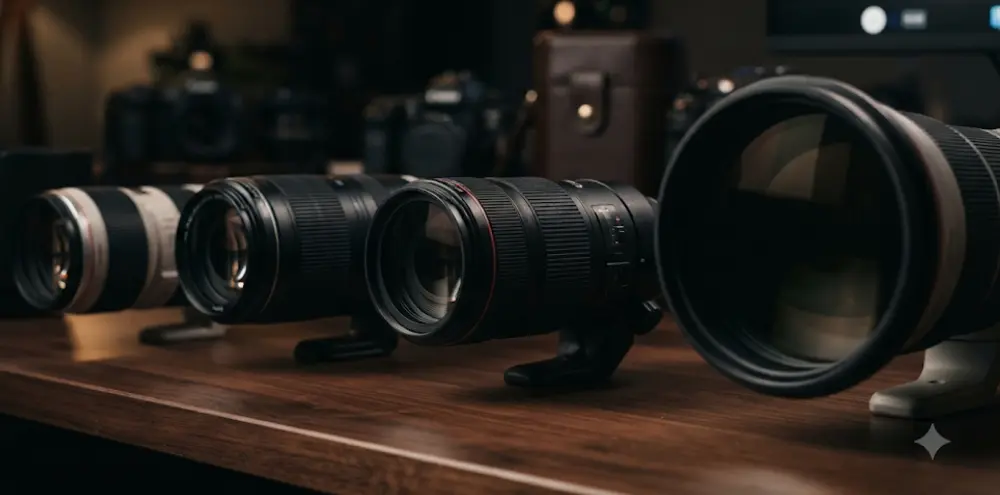
TL;DR: Choosing between a 70-300mm and a 70-200mm telephoto lens depends on what you photograph and the conditions in which you shoot. A 70-300mm lens offers a longer zoom range, reaching 300mm to capture distant subjects such as birds, wildlife, and outdoor sports. A 70-200mm lens, particularly an f/2.8 version, offers a wider maximum aperture, making it better suited to low-light photography, portraits, weddings, and fast-moving subjects. While 70-300mm lenses are often more affordable and portable, 70-200mm lenses generally offer more advanced features and greater flexibility in demanding shooting conditions. The right choice comes down to balancing reach, image quality, lighting, weight, and budget.
Understanding 70-300mm And 70-200mm Telephoto Lenses
Telephoto lenses are designed to photograph subjects that are difficult to approach physically. They are commonly used for wildlife, sports, portraits, concerts, and outdoor photography. Both 70-300mm and 70-200mm lenses begin at 70mm, providing a similar starting point for framing subjects, but their maximum focal lengths and typical designs serve different purposes.
A 70-300mm lens offers a 4.3x zoom range, allowing photographers to move from medium telephoto framing to tighter shots of distant subjects. The additional 100mm of reach can be useful when photographing birds, animals, or sporting events from a fixed position. Many lenses in this category use variable maximum apertures, such as f/4-5.6, which means the available light decreases as the lens is zoomed in.
A 70-200mm lens has a shorter zoom range but is available in versions with a constant maximum aperture, commonly f/2.8 or f/4. This means the maximum aperture remains available throughout the zoom range. It offers greater control over exposure and background separation, particularly in challenging lighting. Professional photographers often prefer this lens category for events, portraits, and sports where consistent performance matters.
70-300mm Vs 70-200mm: Key Differences
Although both lenses cover the same starting focal length, their differences become more noticeable when shooting distant subjects, working in low light, or carrying equipment for extended periods. Understanding these differences helps narrow down which lens is more suitable for your photography.
| Comparison Factor | 70-300mm Lens | 70-200mm Lens |
|---|---|---|
| Focal length | 70-300mm | 70-200mm |
| Maximum reach | Longer reach | Shorter reach |
| Typical aperture | f/4-5.6 | f/2.8 or f/4 |
| Low-light performance | More limited in common variable-aperture versions | Better with f/2.8 versions |
| Background blur | Depends on aperture, distance, and focal length | Strong subject separation, especially at f/2.8 |
| Portability | Often lighter | Can be heavier, especially f/2.8 versions |
| Price | Generally more affordable | Generally more expensive |
| Common uses | Wildlife, travel, outdoor photography | Portraits, weddings, sports, events |
1. Focal Length And Zoom Range
The most obvious difference is the maximum focal length. A 70-300mm lens reaches 300mm, while a 70-200mm lens stops at 200mm. At the same shooting distance and on the same camera format, 300mm provides a tighter field of view than 200mm, helping fill more of the frame with distant subjects.
This additional reach is particularly useful when photographing wildlife, birds, and outdoor sports from a distance. However, a longer focal length does not automatically produce better photographs. Atmospheric haze, camera shake, subject movement, and optical performance can all affect the final image.
2. Aperture And Low-Light Performance
Aperture determines how much light enters the camera through the lens. Many 70-300mm lenses have variable apertures, such as f/4-5.6, while popular 70-200mm models offer constant f/2.8 or f/4 apertures. A wider f/2.8 aperture allows more light to reach the sensor than f/5.6, giving photographers greater flexibility in dim environments.
This difference matters when shooting indoor sports, evening events, concerts, or weddings. A wider aperture can help maintain faster shutter speeds without increasing ISO as much, reducing the risk of motion blur. However, not every 70-200mm lens has an f/2.8 aperture, so buyers should compare the exact model rather than relying on focal length alone.
3. Weight And Portability
Weight is another important consideration, particularly for photographers who travel frequently or spend hours shooting outdoors. Many 70-300mm lenses are designed to be relatively compact, making them convenient for hiking, sightseeing, and wildlife photography. For example, Canon's EF 70-300mm f/4-5.6 IS II USM weighs approximately 710g.
Professional 70-200mm f/2.8 lenses can be considerably heavier. Nikon's Z 70-200mm f/2.8 VR S weighs approximately 1,360g without its tripod collar. However, lighter f/4 versions are also available. The actual difference depends on the lens generation, mount, optical design, and included accessories.
Image Quality And Photography Performance
Image quality is not determined by focal length alone. Lens construction, optical elements, coatings, autofocus performance, camera sensor, and shooting conditions all influence the final photograph. Both lens categories can produce detailed, professional-looking images when used appropriately.
A good 70-200mm lens is often valued for its consistent optical performance and wide aperture. Many professional versions are designed to maintain high contrast and sharpness throughout the zoom range. Their larger apertures also make it easier to isolate a subject against a blurred background, which is useful for portraits and event photography.
A 70-300mm lens can also deliver excellent image quality, particularly in good lighting. Its longer reach makes it useful for capturing details that would otherwise require cropping. However, image quality at the longest focal length can vary between models. Before buying, check independent sample images and reviews rather than assuming that every lens in one category is sharper than the other.
Background Blur And Subject Separation
Both lenses can create attractive background blur, often called bokeh. The effect depends on several factors, including aperture, focal length, subject distance, background distance, and sensor size. A 70-200mm f/2.8 lens generally offers an advantage when strong subject separation is required, particularly for portraits and event photography.
A 70-300mm lens can still produce pleasing background blur at 200mm or 300mm, especially when the subject is positioned away from the background. However, its smaller maximum aperture in common f/4-5.6 versions may limit how much light is available and how easily the photographer can achieve a shallow depth of field in difficult conditions.
Which Lens Is Better For Different Photography Styles?
The best lens depends largely on the subjects you photograph. A wildlife photographer working in daylight may value additional focal length more than a wide aperture, while a wedding photographer working in dim venues may prioritize a constant f/2.8 aperture. Neither lens is universally better because their strengths apply to different shooting situations.
Wildlife And Bird Photography
For wildlife and bird photography, a 70-300mm lens is generally the more practical choice between these two options. The additional reach helps photograph animals without approaching them too closely, which is particularly important when shooting shy or easily disturbed subjects. It is also useful for capturing birds perched on distant branches or animals moving across open landscapes.
However, a 300mm maximum focal length may still be insufficient for small birds or distant wildlife. In these situations, a 100-400mm or 150-600mm lens may be more suitable, depending on camera compatibility and budget. A 70-200mm lens remains useful for larger animals, environmental wildlife portraits, and situations where the photographer can work closer to the subject.
Sports And Action Photography
Both lenses can work well for sports, but the choice depends on the venue and lighting. A 70-300mm lens provides additional reach for outdoor sports, especially when the photographer cannot move closer to the playing area. Its longer focal length can help capture players across a large field or track.
A 70-200mm f/2.8 lens is often preferred for indoor sports, evening matches, and fast-moving action. Its wider aperture makes it easier to use faster shutter speeds in limited light. Autofocus performance and the camera body's subject-tracking capabilities also matter, so check these specifications alongside the lens before making a purchase.
Portraits And Wedding Photography
For portraits and weddings, a 70-200mm lens is generally the stronger option, particularly the f/2.8 version. It provides flattering framing options, attractive background separation, and flexibility when photographing people from different distances. Wedding photographers also benefit from its ability to handle indoor ceremonies, receptions, and changing lighting conditions.
A 70-300mm lens can still be useful for outdoor portraits and candid photographs. Its longer reach allows photographers to capture natural expressions without standing too close to the subject. However, the narrower aperture of many models can make it less convenient in dimly lit venues.
Travel And Everyday Photography
For travel photography, the 70-300mm lens is often a sensible choice because it combines a useful focal range with relatively manageable weight. It can capture architectural details, distant landscapes, wildlife, and candid moments without requiring frequent lens changes. It is particularly practical for photographers who prefer carrying a smaller kit.
A 70-200mm lens is also suitable for travel, especially an f/4 version. It offers consistent aperture performance and can be useful for portraits, street photography from a distance, and landscape details. However, photographers who regularly need longer reach may find the 200mm limit restrictive.
Price, Value, And Long-Term Investment
Price is often one of the deciding factors when choosing between these lenses. Generally, 70-300mm lenses are positioned towards hobbyists and enthusiasts, while premium 70-200mm lenses are designed for more demanding photography. This is not a universal pricing rule, as older professional lenses, third-party options, and newer consumer lenses can overlap considerably in cost.
A 70-300mm lens can offer excellent value if your primary requirement is additional reach. You may not need to spend extra on a professional f/2.8 lens if most of your photographs are taken outdoors in good lighting. For beginners, the money saved can also go towards a tripod, camera bag, memory cards, or other useful equipment.
A 70-200mm lens can justify its higher price if you regularly photograph weddings, events, indoor sports, or professional portraits. Its constant aperture, build quality, autofocus system, and handling can make it a valuable long-term investment. Before purchasing, compare new and used prices, check the lens mount, verify camera compatibility, and consider repair and maintenance costs.
Popular Lens Examples To Consider
Comparing actual lens models is more useful than judging two categories based only on their focal lengths. Manufacturers offer different versions for DSLR and mirrorless systems, and specifications can vary considerably even within the same category.
| Lens Model | Maximum Aperture | Approx. Weight |
|---|---|---|
| Canon EF 70-300mm f/4-5.6 IS II USM | f/4-5.6 | 710g |
| Nikon AF-P 70-300mm f/4.5-5.6E ED VR | f/4.5-5.6 | 680g |
| Canon EF 70-200mm f/4L IS II USM | Constant f/4 | 780g |
| Canon RF 70-200mm f/2.8L IS USM | Constant f/2.8 | 1,070g |
| Nikon Z 70-200mm f/2.8 VR S | Constant f/2.8 | 1,360g |
These examples illustrate why it is important to compare specific models. A 70-200mm f/4 lens can be relatively lightweight, while a professional f/2.8 version may weigh considerably more. Similarly, stabilization, weather sealing, autofocus motors, and optical construction vary across products.
Before buying, confirm that the lens mount matches your camera. DSLR lenses may require an appropriate mount adapter for mirrorless cameras, and autofocus or stabilization compatibility can vary. Also check whether the lens is designed for full-frame or APS-C sensors, as this affects the field of view.
Final Recommendation And Decision Framework
The choice between a 70-300mm and a 70-200mm lens should be based on your photography habits rather than specifications alone. If you regularly photograph birds, wildlife, outdoor sports, or distant subjects, a 70-300mm lens offers useful additional reach at a generally more accessible price. It is a practical option for enthusiasts who want versatility without investing in heavier professional equipment.
If you frequently shoot portraits, weddings, indoor sports, or events, a 70-200mm lens is usually the better investment. An f/2.8 version provides a meaningful advantage in low-light situations, while an f/4 version can offer a more manageable balance of weight, price, and performance. Consider the actual aperture and stabilization specifications before choosing a particular model.
Ultimately, there is no single winner for every photographer. Choose the 70-300mm if reaching distant subjects is your priority, and choose the 70-200mm if low-light flexibility, subject separation, and consistent aperture matter more. If you regularly need both, consider whether owning two complementary lenses or investing in a different telephoto zoom range makes more sense for your budget and camera system.
Frequently Asked Questions
Q. Is a 70-300mm lens better than a 70-200mm lens?
Neither is universally better. A 70-300mm lens offers greater reach for wildlife and outdoor photography, while a 70-200mm lens, particularly an f/2.8 version, performs better in low-light conditions and portrait photography.
Q. Which lens is better for wildlife photography?
A 70-300mm lens is generally more suitable because its additional reach helps capture distant animals and birds. However, photographers working with very distant wildlife may need a longer telephoto lens.
Q. Is a 70-200mm lens good for portraits?
Yes. A 70-200mm lens is excellent for portraits because it offers flexible framing, attractive background separation, and good subject isolation, especially with an f/2.8 aperture.
Q. Can I use a 70-300mm lens for sports photography?
Yes. It works well for outdoor sports where additional reach is useful. However, an f/2.8 70-200mm lens may be a better choice for indoor sports or evening matches.
Q. What is the difference between f/2.8 and f/5.6?
An f/2.8 aperture allows four times as much light as f/5.6, which is a two-stop difference. This helps photographers use faster shutter speeds or lower ISO settings in low-light conditions.
Q. Is a 70-300mm lens suitable for beginners?
Yes. It is a practical telephoto option for beginners interested in wildlife, travel, and outdoor photography. Its additional reach and generally accessible pricing make it a useful addition to a beginner's camera kit.
Q. Does a 70-200mm lens produce better background blur?
An f/2.8 70-200mm lens generally makes it easier to achieve strong background blur. However, both lenses can create attractive bokeh depending on aperture, focal length, subject distance, and background placement.
Q. Are 70-300mm lenses heavier than 70-200mm lenses?
Not necessarily. Many 70-300mm lenses are relatively lightweight, while professional 70-200mm f/2.8 lenses can be considerably heavier. Actual weight depends on the specific model.
Q. Can I use a 70-200mm lens with an APS-C camera?
Yes, provided the lens mount and camera compatibility requirements are met. The smaller sensor produces a narrower field of view, making the lens appear more zoomed in compared with its field of view on a full-frame camera.
Q. Should I buy a 70-300mm or 70-200mm lens for travel?
A 70-300mm lens is generally a good choice if you photograph distant subjects, landscapes, and wildlife. A 70-200mm f/4 lens may be preferable if you prioritise consistent aperture performance, portraits, and a versatile travel setup.
Ready to upgrade your tech?
Browse our collection of quality refurbished products at unbeatable prices.