
24-70mm vs 24-105mm: Which Standard Zoom Should You Buy?
The 24-70mm and 24-105mm are two of the most useful full-frame zoom ranges. Compare their reach, aperture, portability, low-light performance, and versatility before choosing one.

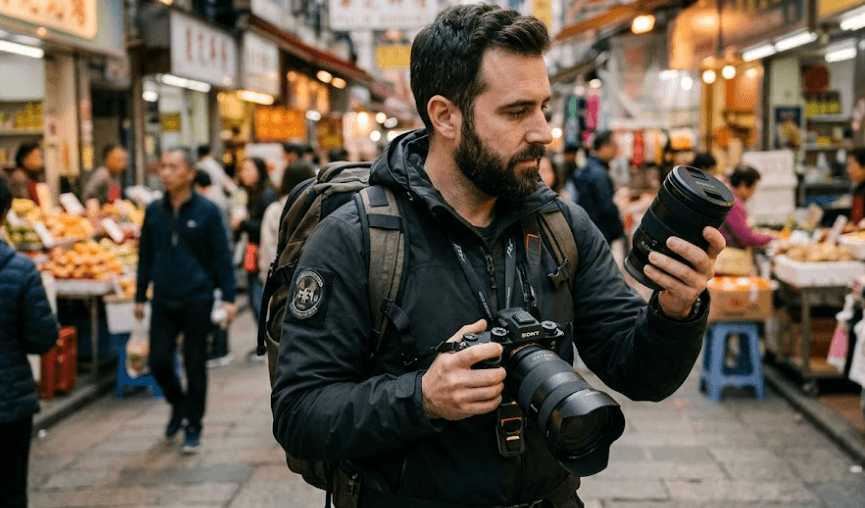
TL;DR The 24-70mm and 24-105mm are both versatile standard zoom lenses, but they suit different shooting styles. A typical 24-70mm f/2.8 is the better choice for weddings, events, portraits, low-light photography, and photographers who want stronger subject separation. A 24-105mm f/4 gives you more telephoto reach and is often the more practical one-lens solution for travel, landscapes, family photography, and everyday shooting. The 24-105mm does not automatically mean better image quality, and the 24-70mm does not automatically mean better versatility. Your decision should come down to whether you value a wider aperture or extra reach more.
Understanding 24-70mm And 24-105mm Lenses
The 24-70mm and 24-105mm ranges are designed to cover the focal lengths photographers use most often. On a full-frame camera, 24mm gives you a reasonably wide view for landscapes, interiors, groups, and environmental photographs, while 50mm sits close to the traditional normal perspective. Moving toward 70mm or 105mm gives you progressively tighter framing for portraits and distant subjects. That broad coverage is why standard zooms have become such important everyday lenses for full-frame photographers. A 24-70mm is widely regarded as a general-purpose professional zoom, while 24-105mm lenses extend that usefulness further into the short-telephoto range.
The biggest difference is therefore not that one lens is designed for professionals and the other for beginners. It is the amount of reach you get at the long end. A 24-70mm stops at 70mm, while a 24-105mm continues to 105mm. That extra 35mm can make a noticeable difference when you are photographing a subject from a fixed position. For travel, for example, 105mm can help you frame architectural details, distant people, or tighter portraits without changing lenses. A 24-70mm, however, gives you a very useful combination of wide-angle coverage and a relatively short telephoto perspective without becoming as focused on reach.
It is also important to avoid treating these focal-length ranges as fixed specifications for every lens. Manufacturers offer different aperture versions, and the most common comparison is a 24-70mm f/2.8 against a 24-105mm f/4. There are exceptions, including lenses such as Canon's RF 24-105mm f/2.8L IS USM, so the actual model matters when comparing brightness, size, weight, stabilization, and price. In other words, choose the specific lens rather than assuming that every 24-70mm is f/2.8 or every 24-105mm is f/4.
What The Numbers Mean
The first number represents the lens's widest focal length, while the second represents its longest focal length. A 24-70mm lens can therefore frame a scene at 24mm and gradually zoom in until it reaches 70mm. A 24-105mm lens starts at the same 24mm wide end but provides a tighter maximum framing at 105mm.
| Feature | 24-70mm | 24-105mm |
|---|---|---|
| Wide end | 24mm | 24mm |
| Maximum reach | 70mm | 105mm |
| Typical comparison | f/2.8 | f/4 |
| Best strength | Aperture and versatility | Reach and convenience |
| Common uses | Events, portraits, low light | Travel, everyday, landscapes |
24-70mm Vs 24-105mm For Image Quality And Aperture
If you are comparing a 24-70mm f/2.8 with a 24-105mm f/4, the aperture is one of the most important differences. An f/2.8 lens can let in twice as much light as an f/4 lens at the same focal length and exposure settings. That gives the 24-70mm an advantage when you are photographing indoors, working at dusk, or trying to maintain faster shutter speeds in challenging light. It can also provide more control over depth of field, although the amount of background blur depends on focal length, subject distance, sensor size, and framing rather than aperture alone.
This advantage becomes particularly useful for event and wedding photographers. Indoor venues often have inconsistent lighting, and subjects can move quickly. A faster aperture gives you another tool for maintaining shutter speed without immediately pushing ISO higher. The 24-70mm f/2.8 is consequently a common choice for photographers who need one lens to handle ceremonies, receptions, portraits, and general event coverage. Current professional options include the Sony FE 24-70mm F2.8 GM II and Nikon Z 24-70mm f/2.8 S II, while Canon offers the RF 24-70mm F2.8 L IS USM.
That does not mean a 24-105mm f/4 produces poor images. Modern 24-105mm lenses can deliver excellent sharpness and are often designed with image stabilization, making them highly useful for handheld photography. Sony's FE 24-105mm F4 G OSS, for example, combines a constant f/4 aperture with optical stabilization, while Canon's RF 24-105mm F4 L IS USM also combines the range with stabilization. For still subjects, landscapes, travel, and daylight photography, the difference in maximum aperture may be much less important than having the extra 35mm of reach.
Low-Light And Background Blur
A 24-70mm f/2.8 generally has the advantage when light levels drop or when you want stronger subject isolation. At the same framing, f/2.8 gives you more light than f/4 and can help create a shallower depth of field. This makes the faster zoom particularly attractive for portraits and indoor events.
| Shooting Situation | Better Choice | Main Reason |
|---|---|---|
| Indoor events | 24-70mm f/2.8 | Faster aperture |
| Weddings | 24-70mm f/2.8 | Low-light flexibility |
| Daylight travel | 24-105mm f/4 | Extra reach |
| Landscapes | Either | Usually stopped down |
| Portraits | 24-70mm f/2.8 | Aperture advantage |
| Family photography | 24-105mm f/4 | Useful reach |
24-70mm Vs 24-105mm For Travel And Everyday Photography
For travel photographers, the 24-105mm often has a compelling advantage because it reduces the need to change lenses. The 24mm wide end is useful for city streets, architecture, landscapes, and interiors, while 105mm gives you substantially more reach for details and portraits. That can make a single 24-105mm lens a practical choice when you want to pack light and do not know what you will encounter during the day. A photographer walking through a city can move from a wide street scene to a compressed architectural detail without reaching for another lens.
The 24-70mm is still extremely capable for travel. In fact, its shorter range can be an advantage when you want a relatively compact professional standard zoom with a bright aperture. If your trip includes museums, restaurants, evening streets, or indoor events, the f/2.8 aperture can become more valuable than the extra 35mm. A 24-70mm can also be easier to pair with a 70-200mm telephoto lens because the ranges complement each other naturally, whereas a 24-105mm overlaps more with a typical telephoto zoom.
Weight and size should also be part of the decision. There is no universal rule that a 24-105mm will always be lighter or a 24-70mm will always be heavier. Lens design varies significantly between manufacturers and generations. For example, current full-frame options include Nikon's Z 24-70mm f/2.8 S II at about 675g and Sony's FE 24-105mm f/4 G OSS at about 663g, illustrating how close the actual weights can be between different implementations. Check the specifications of the exact lenses you are considering rather than choosing based only on the focal range.
Travel Lens Comparison
| Priority | 24-70mm | 24-105mm |
|---|---|---|
| City photography | Excellent | Excellent |
| Architecture | Excellent | Excellent |
| Distant details | Good | Better |
| Indoor shooting | Better with f/2.8 | Good |
| One-lens travel setup | Very good | Excellent |
| Lens-changing reduction | Good | Better |
24-70mm Vs 24-105mm For Portraits, Events, And Video
Portrait photographers can use either lens effectively, but they approach the job differently. At 70mm, a 24-70mm can produce flattering portraits while retaining the f/2.8 aperture on common professional versions. The 24-105mm reaches farther, which can be useful for tighter head-and-shoulder compositions and for creating more working distance between the photographer and subject. That extra distance can be useful during candid photography because you can frame the subject without standing as close.
For weddings and events, the decision becomes more dependent on lighting and shooting style. A 24-70mm f/2.8 is often the safer professional choice when you expect dim venues, fast-moving subjects, and frequent changes between wide and tighter compositions. The faster aperture gives you more flexibility, while 24mm remains wide enough for groups and environmental shots. A 24-105mm f/4 can still be excellent for outdoor weddings, ceremonies in good light, travel events, and photographers who prioritize reach and stabilization over maximum aperture.
For video, neither focal range is automatically superior. The right choice depends on the camera body, stabilization, autofocus, aperture, breathing characteristics, and the type of footage you shoot. A 24-105mm can be useful when you want to reframe a shot without physically moving the camera, while a 24-70mm f/2.8 can be more attractive for low-light video and controlled background separation. Current lens designs vary considerably, so video shooters should evaluate the exact lens rather than relying only on the focal-length label.
Best Choice By Photography Type
| Photography Type | Recommended Range | Why |
|---|---|---|
| Weddings | 24-70mm f/2.8 | Low-light flexibility |
| Street photography | 24-70mm | Compact working range |
| Travel | 24-105mm | Greater reach |
| Landscapes | 24-105mm | Flexible framing |
| Portraits | Either | Different strengths |
| Events | 24-70mm f/2.8 | Faster aperture |
| Video | Either | Depends on workflow |
Which Standard Zoom Gives Better Value?
Value depends less on the focal-length range and more on how often you will use its strengths. If you regularly shoot indoors, photograph people, or work professionally, spending more on a 24-70mm f/2.8 can make sense because the wider aperture is something you can use repeatedly. The faster lens may also reduce the need to carry a separate fast prime for certain situations, although that depends on your shooting style. Professional 24-70mm lenses can also offer advanced autofocus, weather resistance, stabilization on some models, and high optical performance.
The 24-105mm can deliver better practical value when convenience matters more than maximum aperture. Having 105mm available can save you from changing lenses during travel, family events, and everyday photography. The range also works particularly well for photographers who want to travel with one camera and one lens. That is why the 24-105mm should not be treated as a cheaper compromise. It is often a deliberate choice for photographers who value coverage and flexibility.
There is also a third consideration: your existing lens collection. If you already own a fast 35mm or 50mm prime, a 24-105mm f/4 can complement it very well. You get the convenience of a long-range zoom while using the prime when you need a wider aperture. Conversely, if you already own a 70-200mm, the 24-70mm can create a highly practical two-zoom setup with little gap between focal ranges.
Value By User Type
| User | Better Starting Point |
|---|---|
| Professional event photographer | 24-70mm f/2.8 |
| Travel photographer | 24-105mm f/4 |
| Hobbyist | Depends on shooting style |
| Wedding photographer | 24-70mm f/2.8 |
| One-lens photographer | 24-105mm |
| Photographer with 70-200mm | 24-70mm |
| Photographer with fast primes | 24-105mm |
Common Mistakes When Choosing Between 24-70mm And 24-105mm
One common mistake is assuming that 105mm is always better because it gives you more zoom. More reach is useful, but it does not replace a wider aperture. If you frequently shoot in dim restaurants, wedding venues, or indoor events, the difference between f/2.8 and f/4 can matter more than the extra 35mm. Similarly, choosing a 24-70mm simply because it is considered a professional standard does not make sense if most of your photography involves daylight travel and distant details.
Another mistake is comparing focal ranges without checking the exact lens. A 24-70mm f/2.8, a 24-70mm f/4, a 24-105mm f/4, and a 24-105mm f/2.8 are not interchangeable products. They can differ in size, weight, stabilization, autofocus, weather sealing, close-focusing ability, and price. Canon, Sony, Nikon, Sigma, Tamron, and other manufacturers have different designs, so the model name and mount matter as much as the focal range.
You should also avoid ignoring your camera's sensor size. The 24-70mm and 24-105mm ranges are most commonly discussed as full-frame standard zooms. On an APS-C camera, the field of view becomes narrower because of the crop factor, so a 24mm starting point does not provide the same wide perspective as 24mm on full frame. That can make the 24-105mm less convenient for interiors and landscapes on some crop-sensor systems. Always check the equivalent field of view for your camera before buying.
Quick Buying Checklist
| Check Before Buying | Why It Matters |
|---|---|
| Maximum aperture | Determines low-light flexibility |
| Focal range | Determines framing flexibility |
| Sensor compatibility | Changes effective field of view |
| Weight | Matters for travel and long shoots |
| Stabilization | Helps with handheld stills and video |
| Autofocus | Important for people and moving subjects |
| Weather sealing | Useful for demanding outdoor work |
| Existing lenses | Prevents unnecessary overlap |
Frequently Asked Questions
Q. Is 24-70mm better than 24-105mm for photography?
A. Neither is universally better. A 24-70mm f/2.8 is generally better for low-light work, events, and portraits, while a 24-105mm is more versatile when you need additional telephoto reach.
Q. Is 24-105mm good for travel photography?
A. Yes. The 24mm wide end works for landscapes, architecture, and city scenes, while 105mm gives you extra reach for details and portraits. That makes it particularly useful as a one-lens travel setup.
Q. Is 24-70mm better for low-light photography?
A. A 24-70mm f/2.8 has an advantage over a 24-105mm f/4 because f/2.8 allows more light to reach the sensor. This can help maintain faster shutter speeds or lower ISO settings.
Q. Can a 24-105mm replace a 70-200mm lens?
A. No. A 24-105mm can cover many everyday telephoto situations, but a 70-200mm provides substantially more reach and is better suited to subjects that are farther away.
Q. Is 105mm useful for portraits?
A. Yes. The 105mm end can provide tighter framing and more working distance, which can be useful for portraits. A 24-70mm f/2.8 can still produce excellent portraits, particularly when you want the faster aperture.
Q. Is f/2.8 much better than f/4 on a zoom lens?
A. It can be important in low light. f/2.8 provides twice the light of f/4 at the same focal length and shutter speed, while also offering more potential for background separation.
Q. Which is better for weddings, 24-70mm or 24-105mm?
A. For many wedding photographers, a 24-70mm f/2.8 is the stronger primary choice because weddings often involve dim venues and fast-moving subjects. A 24-105mm can be attractive when reach and convenience are more important.
Q. Is a 24-105mm enough for everyday photography?
A. For many photographers, yes. Its range covers wide-angle scenes through short telephoto framing, making it suitable for family photos, travel, landscapes, portraits, and general everyday shooting.
Q. Should beginners buy a 24-70mm or 24-105mm?
A. Beginners should choose based on how they shoot rather than buying the lens considered more professional. A 24-105mm is often easier as a one-lens solution, while a 24-70mm f/2.8 makes more sense if low-light photography and portraits are priorities.
Q. Which should you buy, 24-70mm or 24-105mm?
A. Choose a 24-70mm f/2.8 if you prioritize low-light performance, events, portraits, and subject separation. Choose a 24-105mm f/4 if you prioritize travel, reach, and having one lens that can handle more situations.
Final Recommendation
The 24-70mm f/2.8 is the better choice for photographers who prioritize performance, particularly for weddings, events, portraits, indoor photography, and low-light shooting. Its constant f/2.8 aperture gives it a meaningful advantage when you need more light or want greater control over depth of field. It also makes a strong professional standard zoom and pairs naturally with a 70-200mm telephoto for a two-lens setup.
The 24-105mm is the better choice for photographers who value convenience and reach. The extra 35mm at the long end can make a real difference when travelling, photographing distant details, shooting family events, or trying to avoid changing lenses. For someone who wants to carry one zoom lens for most of the day, the 24-105mm can be the more practical option.
Ultimately, there is no universal winner in the 24-70mm vs 24-105mm debate. If your photography regularly takes you into difficult light, choose the faster 24-70mm f/2.8. If you want a flexible everyday lens that covers more focal length without changing lenses, choose the 24-105mm. The smartest purchase is the one whose strengths match the photographs you actually take, not simply the lens with the bigger number on the barrel.






