
18-55mm Kit Lens Explained: Canon vs Nikon vs Sony Compared
The 18-55mm kit lens remains a practical starting point for APS-C photography. Compare representative Canon, Nikon, and Sony versions to understand focal range, stabilization, aperture, and everyday performance.

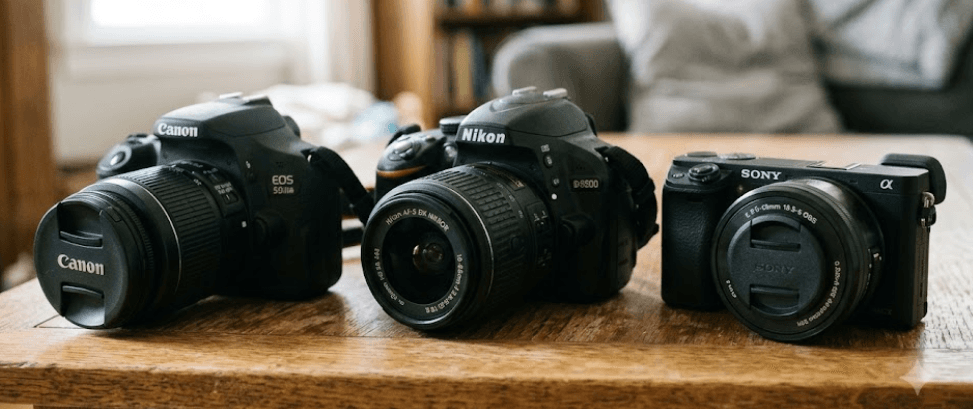
TL;DR An 18-55mm kit lens is one of the most common starting points for APS-C photography because it covers a useful range from wide-angle shooting to short telephoto framing without adding much size or weight. Canon, Nikon, and Sony have all offered 18-55mm lenses, but they are not identical products and should not be judged only by the focal-length numbers. Canon's EF-S 18-55mm f/3.5-5.6 IS STM, Nikon's AF-P DX NIKKOR 18-55mm f/3.5-5.6G VR, and Sony's E 18-55mm f/3.5-5.6 OSS represent different approaches to the same basic idea. Canon and Nikon versions were widely used with APS-C DSLRs, while Sony's E 18-55mm was designed for its APS-C E-mount system. All three are useful for everyday photography, travel, family pictures, landscapes, and learning composition, but their stabilization systems, autofocus technologies, handling, and compatibility differ. For beginners, the best choice is usually the lens that matches the camera body and system you already own rather than the one with the biggest specification on paper.
What Is An 18-55mm Kit Lens?
An 18-55mm kit lens is a variable focal-length zoom designed to cover several common shooting situations with one lens. At 18mm, it provides a relatively wide field of view that works well for landscapes, interiors, architecture, groups, and travel scenes. At 55mm, the framing becomes considerably tighter, making the lens more useful for portraits, details, food photography, and subjects that are not immediately in front of you. The lens does not physically change its focal length into a different lens as you zoom. Instead, the optical elements move inside the barrel to change the field of view.
The important detail is that an 18-55mm lens does not look exactly the same on every camera because sensor size affects field of view. Canon APS-C cameras use a crop factor of approximately 1.6x, while Nikon and Sony APS-C cameras use approximately 1.5x. That means an 18-55mm lens gives a field of view roughly equivalent to 29-88mm on Canon APS-C and about 27-83mm on Nikon or Sony APS-C when compared with full-frame framing. The physical focal length remains 18-55mm. The crop factor changes the field of view captured by the smaller sensor.
That makes the 18-55mm range particularly useful for beginners because it teaches you how different focal lengths change a photograph without requiring several lenses. You can shoot a wide scene at 18mm, move toward the middle of the range for everyday photography, and use 55mm when you want tighter framing. It is not designed to replace a dedicated wide-angle, telephoto, or fast prime lens, but that is also not its purpose. Its strength is flexibility.
What Does The 18-55mm Range Mean?
The 18mm end is the most useful when you need more of the scene in the frame. It can be helpful when photographing a landscape, a room, a group of people, or a street scene where you cannot physically move farther away. The 55mm end gives you a narrower field of view and can produce more natural-looking framing for portraits and details. On an APS-C camera, the crop factor makes the long end feel more like a short telephoto lens than a traditional 55mm lens would on full frame.
| Focal Length | Typical Use | How It Feels On APS-C |
|---|---|---|
| 18mm | Landscapes, interiors, groups | Wide |
| 24mm | Travel, street, everyday scenes | Moderately wide |
| 35mm | Street, people, general photography | Normal-looking |
| 50mm | Portraits, details | Short telephoto |
| 55mm | Portraits, close framing | Short telephoto |
Canon 18-55mm Kit Lens Explained
Canon has produced several EF-S 18-55mm lenses over the years, so it is important not to treat every Canon 18-55mm as the same optical design. One representative version is the EF-S 18-55mm f/3.5-5.6 IS STM. It was designed for Canon's APS-C DSLR system and combines a standard zoom range with optical image stabilization and an STM focusing motor. Canon describes the lens as compact and lightweight, with Optical Image Stabilizer support and a minimum focusing distance of 0.25m across the zoom range.
The variable f/3.5-5.6 aperture is typical of an entry-level kit zoom. At 18mm, the maximum aperture is f/3.5, while at the longer end it becomes f/5.6. This matters when you photograph in low light because the lens cannot maintain a wide aperture throughout the zoom range. It also means that creating very strong background blur is harder than it would be with a lens such as a 50mm f/1.8 prime. For daylight photography, travel, family pictures, and general learning, however, the range is practical.
The Canon version's optical stabilization is another useful feature for handheld shooting. Image stabilization can reduce the effect of camera shake when photographing relatively static subjects at slower shutter speeds, although it does not freeze a moving person or moving car. The STM focusing system was also intended to provide smoother and quieter focusing, which can be useful when recording video. For a beginner using a compatible Canon APS-C DSLR, the lens makes sense as an inexpensive way to learn the fundamentals before deciding what type of specialist lens is actually needed.
Canon's Main Strengths
Canon's 18-55mm IS STM is particularly easy to understand as a beginner lens because it combines the three things most new photographers need: a useful zoom range, stabilization, and a relatively compact design. It is not a premium lens, but that is not necessarily a disadvantage. A beginner can learn composition, focal-length selection, depth of field, shutter speed, and camera movement without spending heavily on specialized glass.
Nikon 18-55mm Kit Lens Explained
Nikon has also produced multiple versions of the 18-55mm kit lens, including the AF-S DX NIKKOR 18-55mm f/3.5-5.6G VR II and the later AF-P DX NIKKOR 18-55mm f/3.5-5.6G VR. Nikon describes the AF-P version as a compact and lightweight normal zoom covering the 18-55mm range, with a maximum aperture of f/3.5-5.6. The VR designation indicates Nikon's Vibration Reduction image stabilization system.
Like the Canon lens, the Nikon 18-55mm is intended to be an everyday general-purpose lens rather than a specialist optic. On Nikon's DX-format APS-C cameras, the 18mm end is useful for landscapes, travel, and interiors, while the 55mm end provides tighter framing for portraits and details. Nikon's APS-C format uses approximately a 1.5x crop factor, so the 18-55mm range provides a field of view comparable to approximately 27-82.5mm on full frame.
The Nikon version is particularly relevant when buying or using older Nikon DX DSLR equipment. The AF-P design uses a stepping motor technology intended for quieter and smoother autofocus, but compatibility can depend on the particular Nikon camera body and firmware. That is an important buying detail when shopping for older or used equipment. A lens can have attractive specifications and still be the wrong choice if it does not communicate properly with the camera body you own.
Nikon's Main Strengths
The Nikon 18-55mm VR lenses make a sensible match for beginners who want a simple everyday zoom on a DX-format DSLR. Vibration Reduction can help reduce camera shake when shooting handheld, while the 18-55mm range covers many common subjects. If you are buying used, however, checking the exact lens generation and camera compatibility is more important than simply searching for "Nikon 18-55mm."
Sony 18-55mm Kit Lens Explained
Sony's E 18-55mm f/3.5-5.6 OSS, model SEL1855, is another example of an APS-C kit zoom, but it belongs to Sony's E-mount system. Sony lists a 27-82.5mm full-frame equivalent field of view, a minimum focusing distance of 0.25m, maximum magnification of 0.3x, and a weight of 194g. It also includes Optical SteadyShot, Sony's optical image stabilization system.
The Sony lens therefore covers a very similar practical range to the Canon and Nikon versions when used on APS-C cameras. At the wide end, it can handle landscapes, travel scenes, and everyday environmental photographs. At the telephoto end, it can be used for portraits and details. The difference is that this particular Sony lens belongs to an older generation of the company's APS-C E-mount lineup, so buyers should not assume that it represents Sony's newest kit-lens technology.
This distinction matters in 2026. Camera manufacturers have increasingly moved toward newer compact kit zooms and different focal ranges. Sony's APS-C system, for example, now includes newer options that may be more appropriate for someone buying a current mirrorless camera. The older 18-55mm OSS can still be useful, particularly on the used market, but its age should be considered when comparing it with newer lenses.
Sony's Main Strengths
The biggest appeal of the Sony 18-55mm OSS is its compact all-purpose design and optical stabilization. It can be a useful lens for someone who already owns a compatible APS-C E-mount body and finds a clean used copy at a sensible price. However, someone buying a new Sony APS-C camera in 2026 should compare the included or recommended current kit lens rather than automatically searching for this older 18-55mm.
Canon Vs Nikon Vs Sony 18-55mm Compared
The three lenses follow the same basic philosophy, but the systems around them are different. Canon's representative EF-S lens uses IS and STM, Nikon's AF-P DX version uses VR and an AF-P focusing motor, while Sony's SEL1855 uses OSS. Their maximum aperture ranges are broadly similar, and all are designed to cover everyday APS-C photography rather than specialized low-light or telephoto work.
The biggest practical difference is compatibility. Canon's EF-S 18-55mm belongs to the EF-S DSLR ecosystem, Nikon's DX 18-55mm lenses belong to Nikon's DSLR DX ecosystem, and Sony's SEL1855 uses the E-mount. This means you cannot simply choose whichever 18-55mm lens has the best specifications. The mount and camera format must match. Adapters can change compatibility in some systems, but they should not be assumed to provide the same autofocus, stabilization, or handling experience as a native lens.
For image quality, it is also important not to exaggerate brand differences. A well-used technique, good lighting, accurate focus, and the camera sensor can have a much larger effect on a beginner's photographs than choosing between three broadly similar kit-zoom designs. These lenses have limitations, especially their relatively slow variable apertures, but they are capable of producing good photographs when used within those limitations.
| Feature | Canon EF-S 18-55mm IS STM | Nikon AF-P DX 18-55mm VR | Sony E 18-55mm OSS |
|---|---|---|---|
| System | Canon EF-S DSLR | Nikon DX DSLR | Sony APS-C E-mount |
| Focal Range | 18-55mm | 18-55mm | 18-55mm |
| Maximum Aperture | f/3.5-5.6 | f/3.5-5.6 | f/3.5-5.6 |
| Stabilization | IS | VR | OSS |
| Approx. APS-C Equivalent | 29-88mm | 27-82.5mm | 27-82.5mm |
| Minimum Focus | 0.25m | Depends on version | 0.25m |
| Best Fit | Canon APS-C DSLR users | Nikon DX DSLR users | Sony APS-C E-mount users |
What Can You Shoot With An 18-55mm Lens?
An 18-55mm kit lens is more capable than its inexpensive reputation suggests. For travel photography, the wide end can capture buildings, streets, landscapes, and larger scenes without requiring a dedicated wide-angle lens. At the middle of the range, it works well for everyday photographs, food, pets, and street scenes. Moving toward 55mm gives you tighter framing for portraits and details, although you should not expect the same background separation as a fast prime lens.
The lens is also useful for learning because it encourages you to experiment with focal length rather than staying locked into one perspective. You can photograph the same subject at 18mm, 35mm, and 55mm and see how the relationship between the subject and background changes. This teaches an important lesson: zooming is not only about getting closer to a distant subject. Changing focal length changes the way the scene is framed.
Where the 18-55mm range starts to struggle is when the light becomes difficult or when you need substantial reach. Its variable f/3.5-5.6 aperture is not particularly bright, so a faster prime or constant-aperture zoom can be more useful for low-light work. Wildlife is another obvious limitation because 55mm is not enough reach for most distant subjects. Those limitations are not failures. They simply show where a second lens can add value.
Best Uses For The Lens
| Photography Type | 18-55mm Suitability | Why |
|---|---|---|
| Travel | Excellent | Covers wide and normal views |
| Landscapes | Very good | 18mm provides a useful wide view |
| Street Photography | Very good | Flexible everyday focal range |
| Family Photos | Very good | Useful for groups and individuals |
| Portraits | Good | 55mm provides tighter framing |
| Indoor Low Light | Moderate | Variable aperture is limiting |
| Wildlife | Limited | 55mm lacks long reach |
| Sports | Limited | Slow aperture and limited reach |
Should You Buy An 18-55mm Kit Lens In 2026?
For a beginner buying a compatible used camera, an 18-55mm kit lens can still be a very sensible choice in 2026. It gives you a broad range without requiring a large investment, and it is capable of handling the majority of casual photography situations. If the lens is already included with the camera, there is usually little reason to replace it immediately. You can learn what you actually photograph before spending money on another lens.
The situation is different if you are buying a brand-new mirrorless camera. The phrase "18-55mm kit lens" can create the impression that Canon, Nikon, and Sony still use identical standard zooms across their current product ranges. They do not. Current mirrorless systems increasingly use compact lenses with different ranges, such as Canon RF-S and Nikon Z DX options, while Sony has newer APS-C lenses as well. Therefore, a buyer should compare the actual lens supplied with the camera rather than assuming an older 18-55mm is the default modern option.
If you already own an 18-55mm lens, the best upgrade is also dependent on what is missing from your photographs. If you struggle in low light, a fast prime may solve the problem. If you cannot get close enough to wildlife or sports subjects, a telephoto lens makes more sense. If you constantly need wider framing, a wider zoom is the logical upgrade. In other words, the 18-55mm should usually be replaced because you have identified a limitation, not simply because it is called a kit lens.
Frequently Asked Questions
Q. Is an 18-55mm lens good for beginners?
Yes. The 18-55mm range is particularly useful for beginners because it covers wide, normal, and short-telephoto perspectives in one lens. It also lets you learn how focal length changes composition without buying several lenses immediately.
Q. What is an 18-55mm lens equivalent to on full frame?
On Canon APS-C, an 18-55mm lens provides approximately the field of view of a 29-88mm lens on full frame because Canon APS-C uses a roughly 1.6x crop factor. On Nikon and Sony APS-C, the equivalent is approximately 27-83mm because those systems use roughly a 1.5x crop factor.
Q. Is an 18-55mm lens good for portraits?
Yes, particularly around the longer end of the range. Using 50-55mm on an APS-C camera gives relatively tight framing that can work well for portraits. However, a fast prime such as a 50mm or 56mm lens can provide stronger background separation and better low-light performance.
Q. Can an 18-55mm lens be used for landscapes?
Yes. The 18mm end provides a relatively wide field of view that works well for landscapes, travel scenes, architecture, and groups. For extremely wide compositions, however, a dedicated ultra-wide lens may be more suitable.
Q. Is 18-55mm enough for wildlife photography?
Usually not. The 55mm maximum focal length provides limited reach for distant wildlife. A dedicated telephoto lens, often starting around 70mm or longer, is generally more appropriate when the subject cannot be approached closely.
Q. Which is better, Canon, Nikon, or Sony 18-55mm?
There is no universal winner because these lenses belong to different camera systems and generations. Canon's EF-S 18-55mm IS STM, Nikon's AF-P DX 18-55mm VR, and Sony's E 18-55mm OSS all offer useful everyday ranges, but compatibility and the specific lens version matter more than the brand name alone.
Q. Does an 18-55mm lens have image stabilization?
Many versions do, but not every 18-55mm lens does. Canon uses IS on stabilized versions, Nikon uses VR, and Sony's SEL1855 uses OSS. Always check the exact model name before buying, particularly when shopping for older used lenses.
Q. Is an 18-55mm lens good for low-light photography?
It can be used in low light, especially when the camera has good high-ISO performance and the subject is relatively still, but the variable f/3.5-5.6 aperture is a limitation. A faster prime or constant-aperture zoom will generally be better when light levels are low.
Q. Should I replace my 18-55mm kit lens immediately?
Usually no. Keep using it until you identify a specific limitation. If you need more background blur, consider a fast prime. If you need more reach, consider a telephoto. If you need a wider view, consider an ultra-wide lens. Upgrading based on an actual need is usually better than replacing a kit lens simply because it is inexpensive.
Q. Are 18-55mm kit lenses still worth buying in 2026?
They can be, particularly when included with a compatible used APS-C camera or purchased inexpensively as part of an older system. However, buyers purchasing a new mirrorless camera in 2026 should compare the current kit lens options offered for that camera instead of assuming an older 18-55mm is the best choice.
Final Recommendation
The 18-55mm kit lens remains a practical starting point because it solves a simple problem: giving a photographer several useful perspectives in one affordable package. Canon, Nikon, and Sony have all produced 18-55mm lenses, but the exact versions differ in stabilization, autofocus technology, compatibility, and age. That is why the smartest comparison is not simply Canon versus Nikon versus Sony. It is the specific lens, the specific camera body, and the kind of photography you actually do.
For a beginner using a compatible Canon APS-C DSLR, the EF-S 18-55mm IS STM is a capable everyday option, particularly when stabilization and relatively quiet focusing are useful. Nikon's AF-P DX 18-55mm VR is similarly practical for compatible DX DSLR bodies, with VR and a compact design. Sony's E 18-55mm OSS remains a usable option for compatible APS-C E-mount cameras, although buyers in 2026 should remember that it is an older lens and compare it against Sony's newer APS-C offerings.
The most important takeaway is that you do not need to rush to replace an 18-55mm kit lens. Use it until you understand what your photography demands. If you eventually need better low-light performance, stronger background blur, wider framing, or longer reach, that limitation will tell you exactly what your next lens should be. For most beginners, learning to get the most from the 18-55mm range is a better investment than immediately chasing expensive glass.
Ready to upgrade your tech?
Browse our collection of quality refurbished products at unbeatable prices.






