
Why Laptop Prices Are Increasing in 2026: AI Memory Shortage Explained
Laptop prices in India are rising in 2026 due to increasing memory and SSD costs. This guide compares the latest prices across budget, mainstream, gaming, and premium laptops while explaining which configurations offer the best long-term value for different buyers.

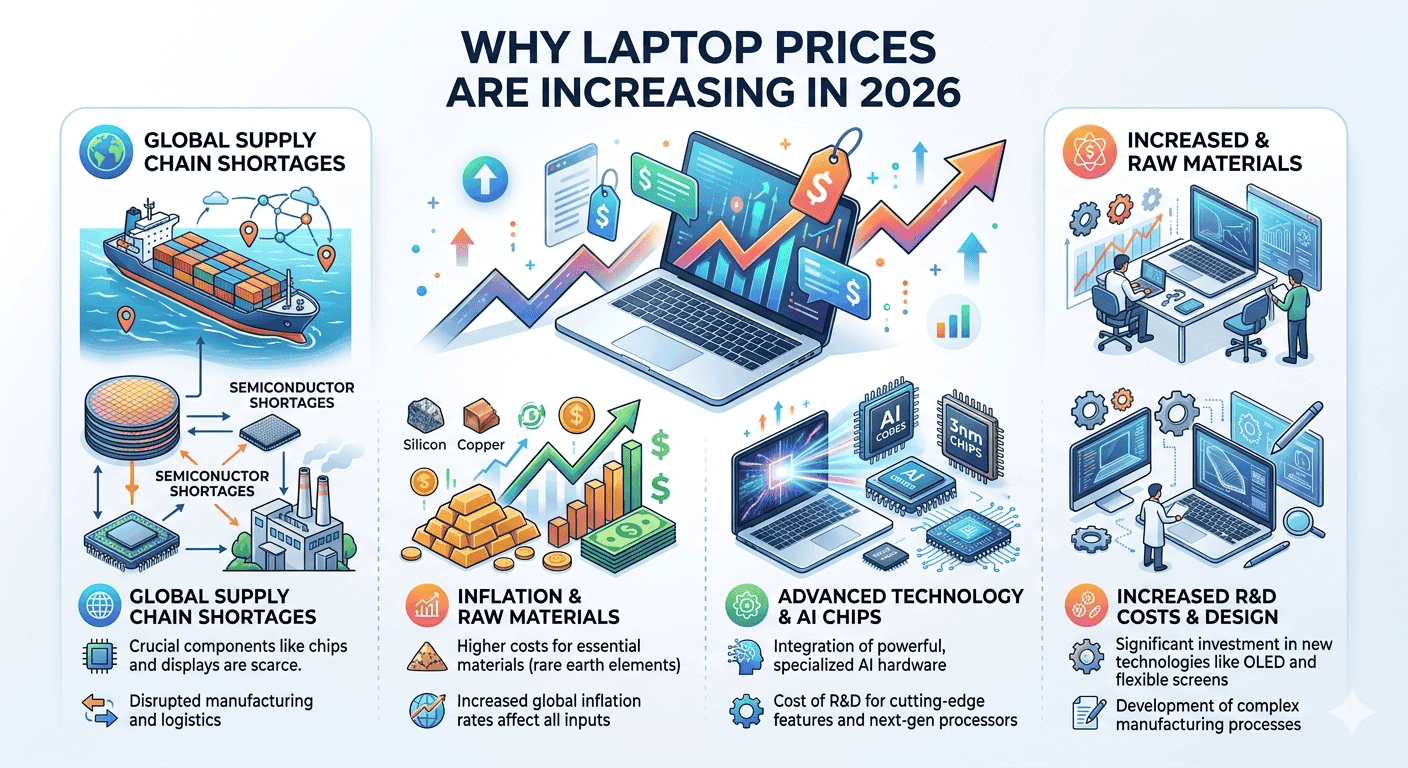
TL;DR Laptop prices 2026 are climbing in India because memory shortages are lifting RAM, SSD, and finished system costs. The Acer Swift Go 14 at ₹29,990 remains the budget anchor, while the Apple MacBook Air 2026 at ₹1,09,490 shows how far premium pricing has moved.
Why Laptop Prices 2026 Are Rising in India
In early 2025, a mainstream laptop often sat in the INR 50,000 to INR 65,000 band. In 2026, that same class is drifting toward INR 65,000 to ₹70,000 for similar hardware. The main pressure comes from memory shortages, and laptop makers are paying more for RAM and SSD components. When a machine includes a Core Intel processor, 16GB RAM, and a 512GB SSD, the final bill rises faster than most buyers expect.
The shift is already visible in current India pricing. The Acer Swift Go 14 and Acer Aspire 3 are both INR 29,990, the Acer Aspire 7 is INR 45,990, the HP 15 is INR 54,990, and the Dell Inspiron 15 is INR 55,150. By the time you reach the HP Victus 15 at INR 64,990 or the Lenovo IdeaPad Slim 3 at INR 68,999, the old mid-range comfort zone has already moved. A 13th gen processor in this bracket can push the price higher without changing the overall category.
That is why buyers now notice smaller spec changes more quickly than before. The difference between 8GB and 16GB RAM, or between a small SSD and a 512GB SSD, now affects value more directly. Even some NVIDIA GeForce RTX options feel the pressure because the base hardware costs more before the graphics card is added.
What the Mid-Range Now Means
The sharpest pressure sits in the middle of the market. Mid-range laptops that cost INR 50,000 in early 2025 are now trending toward INR 65,000 to INR 70,000 in 2026, and that jump changes what normal looks like. A laptop after the budget tier now buys less headroom for display quality, battery life, and storage.
That is why a 512GB SSD matters more than it used to. It used to be a nice upgrade, but today it is close to the practical floor for many buyers. If you keep large Excel files, Photoshop projects, or a full OneDrive sync, the smaller SSD fills up too quickly.
The Lenovo IdeaPad Slim 3 at INR 68,999 shows how quickly a familiar business laptop can move out of reach. The HP 15 and Dell Inspiron 15 are still mainstream choices, but the price gap between them and the cheaper Acer models is already wide enough to affect buying decisions.
- The Acer Swift Go 14 stays the cheapest entry point in this group.
- The HP 15 and Dell Inspiron 15 sit in the middle, where small spec upgrades raise the bill fast.
- The Lenovo IdeaPad Slim 3 pushes into a higher bracket without moving into gaming territory.
- A 512GB SSD and 16GB RAM now matter more than flashy naming because they determine how long the laptop stays useful.
June 2026 Laptop Price Comparison in India
| Model | Category | June 2026 Price |
|---|---|---|
| Acer Swift Go 14 | Budget | ₹29,990 |
| Acer Aspire 3 A324-45 | Budget | ₹29,990 |
| Acer Aspire 7 A715-76G NH.QMFSI.004 | Gaming | ₹45,990 |
| HP 15-fd0576TU | Mainstream | ₹54,990 |
| Dell Inspiron 15 3530 | Mainstream | ₹55,150 |
| HP Victus 15-fa1327TX | Gaming | ₹64,990 |
| Lenovo IdeaPad Slim 3 83K100CJIN | Mainstream | ₹68,999 |
| Apple MacBook Neo 2026 | Premium | ₹72,990 |
| Asus TUF Gaming A15 FA566NCR-HN075W | Gaming | ₹76,990 |
| Asus Vivobook S14 S3407CA-LY084WS | Premium | ₹83,990 |
| Lenovo LOQ 15ARP9 83JC0046IN | Gaming | ₹1,02,490 |
| Apple MacBook Air 2026 | Premium | ₹1,09,490 |
| HP OmniBook Ultra Flip 14-fh0029TU | Premium | ₹1,86,900 |
The table makes one thing obvious. The premium side is even more expensive. The Apple MacBook Neo at INR 72,990 is already well above mainstream Windows pricing, the Apple MacBook Air 2026 is INR 1,09,490, and the HP OmniBook Ultra Flip 14-fh0029TU reaches INR 1,86,900.
If you are asking whether laptop prices have gone up, the answer is already obvious in the mid-range and premium tiers. The gap between budget and premium has widened enough that buyers need to focus on the exact configuration, not just the brand name.
Budget and Home Use
Budget buyers should care about the full core package, not just the sticker price. A Core i3 or Core i5 machine can handle browser tabs, Word, and Google Sheets, but 8GB RAM can feel cramped once you open Chrome, Outlook, and a few PDFs at the same time. That is where 16GB starts to make sense for a home laptop.
The Acer Swift Go 14 remains the clearest budget anchor. It gives buyers a low starting point, and that matters if you are trying to save money without falling into a very weak configuration. The Acer Aspire 3 is in the same price band, so the real decision comes down to display quality, battery life, and SSD size.
Many buyers also shop for a laptop sale 2026 deal and expect a big discount on launch pricing. In practice, the stronger move is to compare the exact core parts. A 512GB SSD, 16GB RAM, and an IPS display usually matter more than a small sticker discount on a weaker machine.
- A budget laptop should still include a usable SSD, not a tiny boot drive.
- An IPS display is worth paying for if you spend hours in Excel or Google Docs.
- 16GB RAM helps if you keep Slack, Teams, and Chrome open together.
- A stronger battery is more useful than a flashy finish if you move the laptop between rooms or classes.
Gaming and Creator Buyers
Gaming laptop prices 2026 are rising because these systems start with more expensive parts. That is why the Acer Aspire 7, HP Victus 15, Asus TUF Gaming A15, and Lenovo LOQ 15ARP9 all sit well above the cheapest Windows models. The GPU matters, but it is not the only core part that counts.
If you play Valorant, Cyberpunk 2077, or EA Sports FC, an Intel Core or AMD Ryzen chip with enough cooling is what keeps performance stable over long sessions. The SSD also matters because game installs are huge now, and a 512GB SSD fills up quickly once you add a few modern titles. Creators should look at the same core trade-offs.
- The Acer Aspire 7 is the lowest-priced gaming entry here.
- The HP Victus 15 and Asus TUF Gaming A15 step up in GPU headroom.
- A 512GB SSD is the minimum I would want for gaming today.
Intel Core, AMD Ryzen, and Core Ultra Choices
Processor choice still matters, but not in the way many buyers think. Intel Core chips, AMD Ryzen chips, and Core Ultra models all have different strengths, yet the rest of the core configuration often matters more. Intel Core models remain the safest default for office work and school.
A Core i5 is the sweet spot for most people because it handles browser tabs, spreadsheets, and Zoom without feeling sluggish. Core Ultra models make more sense if you want newer efficiency tuning and are willing to pay more for the platform. AMD Ryzen systems still make sense in gaming and mixed-use laptops, especially when they pair well with Radeon graphics.
If you are choosing between Intel and AMD, the better question is what you actually run every day. For many buyers, the real comparison is RAM, SSD, and processor balance, not just the processor name. On a 14-inch or 15-inch laptop, the size matters less than how the machine is configured.
- Intel Core i3 is fine for light browsing and documents.
- Core Ultra is the newer premium path, but it usually costs more.
- AMD Ryzen and Radeon still make sense when you want value in a gaming laptop or a compact work machine.
What Laptop Prices After Budget 2026 in India Look Like?
The phrase laptop prices after budget 2026 in India describes the new gap between entry-level and serious daily-use machines. A cheap laptop still exists, but the jump from a basic configuration to a comfortable one is wider than it was a year ago. That is especially true once you move from 8GB to 16GB or from a small SSD to a 512GB SSD.
For many buyers, the real decision starts at the budget boundary. A machine around INR 29,990 can handle schoolwork and browsing, but a laptop around INR 54,990 or INR 55,150 usually gives a more balanced core setup for business work. That is why price matters less than the configuration once you move out of the cheapest tier.
In this range, NVIDIA GeForce and RTX branding can also show up on some models, especially where graphics are part of the appeal. Buyers should still check the rest of the system first, because a stronger GPU does not fix weak memory or storage.
Display, Battery, and Everyday Use
The display is one of the easiest places to feel the difference. Battery life also matters more now because many laptops are being sold with tighter margins. If you work from a café, a client site, or a classroom, battery life decides whether you carry the charger all day.
That is especially true for a business laptop that spends most of its time in Outlook, Teams, and Google Meet. Memory type is another part of the core picture. DDR4 still appears in cheaper models, while DDR5 and LPDDR5X are more common in newer systems.
DDR5 and LPDDR5X help with responsiveness and efficiency, which is why they show up more often in Core Ultra and premium Intel laptops. You may also see GB DDR5 listed in product specs, especially on newer configurations. Those details matter because they shape how smooth the laptop feels during everyday use.
- IPS display is the safer choice for work and study.
- Battery life matters most if you unplug often.
- DDR5 and LPDDR5X are the more modern memory options, while DDR4 still shows up in lower-cost machines.
What the Specs Mean in Real Use
8GB RAM is enough for basic browsing, but 16GB is the point where a laptop starts feeling less fragile. If you keep Chrome, WhatsApp, and a PDF reader open together, the extra memory saves you from reloads and lag. That is one reason the hardware feels higher even when the spec sheet looks similar.
Storage is just as important. A 512GB SSD gives you room for Windows, apps, and a decent stack of files without constant cleanup. A smaller SSD can still work, but it becomes annoying fast once you install Adobe apps, Steam, or a few large project folders.
The same logic applies to business users. A laptop that looks affordable on paper can become frustrating if it forces constant file cleanup or slows down under everyday multitasking. That is why the spec balance matters as much as the model name.
India, Nearby Markets, and the Bigger Price Picture
Searches for laptop price bd 2026 and laptop cost 2026 are rising for the same reason, Indian buyers are watching prices closely. When memory supply tightens, pricing moves across regions, even if taxes and local stock differ. That makes cross-border comparisons messy, especially for laptops with Intel Core Ultra or AMD Ryzen chips.
The global shortage is not a short blip. It could continue for another 4 to 5 years because semiconductor production remains structurally tight, and AI infrastructure keeps consuming more memory. That is why laptop prices have gone up today and may stay elevated for months rather than snapping back quickly.
Why Brands Matter Less Than the Core Configuration?
Brand names still help, but they do not tell the full story. Dell and HP have already begun raising prices in India, and HP models in the Pavilion and Victus range are among the ones seeing configuration changes or outright increases. That means the same brand can include both sensible and overpriced options depending on the core parts inside.
A Windows laptop with 16GB RAM and a 512GB SSD may look similar across brands, but the battery, panel quality, and GPU can change the real-world experience a lot. The same idea applies to Apple. The Apple MacBook Neo at INR 72,990 sits well below the Apple MacBook Air 2026 at INR 1,09,490, but both are premium machines.
If your work lives in Final Cut Pro, Xcode, or Logic Pro, the higher price can still make sense, but only because the core platform matches the software. In the same way, NVIDIA and GeForce RTX options can shift value depending on the workload, while the core configuration remains the main comparison point.
Which Laptop Type Makes Sense at Each Price Point?
At INR 29,990, the Acer Swift Go 14 and Acer Aspire 3 are the clearest budget picks for schoolwork, browsing, and light home use. At INR 45,990, the Acer Aspire 7 starts moving into gaming territory without jumping into the highest price bands. At INR 54,990 and INR 55,150, the HP 15 and Dell Inspiron 15 sit in the mainstream zone where balanced specs matter more than branding.
Once you reach INR 64,990 and INR 68,999, the HP Victus 15 and Lenovo IdeaPad Slim 3 ask buyers to pay more for either gaming headroom or a stronger everyday setup. The premium tier starts at INR 72,990 with the Apple MacBook Neo 2026 and climbs to INR 1,86,900 with the HP OmniBook Ultra Flip 14-fh0029TU. That spread shows how quickly laptop prices 2026 separate budget, mainstream, gaming, and premium buyers.
If you want the safest value, focus on 16GB RAM, a 512GB SSD, and a display that fits your work. If you need gaming or creator performance, the Acer Aspire 7, HP Victus 15, Asus TUF Gaming A15, and Lenovo LOQ 15ARP9 are the models to compare first. If you want premium portability, the Apple MacBook Air 2026 and HP OmniBook Ultra Flip 14-fh0029TU sit at the top of the list, but they demand a much larger budget.
Frequently Asked Questions
Q. Which model is the cheapest in the June 2026 price list?
The Acer Swift Go 14 and Acer Aspire 3 A324-45 are both listed at INR 29,990, so they are the lowest-priced options in the table. That makes them the clearest entry point for buyers who want to stay near the budget tier. They are also the best examples of how laptop prices in 2026 still leave a small opening for affordable models.
Q. Which laptops in the list are best for gaming?
The Acer Aspire 7 A715-76G NH.QMFSI.004 at INR 45,990 is the lowest-priced gaming option in the table. The HP Victus 15-fa1327TX at INR 64,990, Asus TUF Gaming A15 FA566NCR-HN075W at INR 76,990, and Lenovo LOQ 15ARP9 83JC0046IN at ₹1,02,490 also target gaming buyers. These models matter because gaming systems start with more expensive parts, especially GPU and cooling.
Q. What RAM and storage should most buyers look for in 2026?
The article points to 16GB RAM and a 512GB SSD as the practical comfort zone for most buyers. 8GB RAM can still work for basic browsing, but it feels cramped once you keep Chrome, Outlook, and PDFs open together. A 512GB SSD also gives enough room for Windows, apps, and files without constant cleanup.
Q. Are premium laptops much more expensive than mainstream ones?
Yes, the gap is large in this list. The Apple MacBook Neo 2026 is INR 72,990, the Apple MacBook Air 2026 is INR 1,09,490, and the HP OmniBook Ultra Flip 14-fh0029TU reaches INR 1,86,900. That spread shows how much laptop prices 2026 separate premium machines from mainstream Windows models like the HP 15-fd0576TU at INR 54,990.
Q. Should I wait for prices to fall before buying?
The article says the shortage could continue for another 4 to 5 years, so a quick drop is not guaranteed. If you need a laptop now, the safer move is to buy the best configuration you can afford, especially one with 16GB RAM and a 512GB SSD. Waiting may not help much if memory costs stay tight and the same class keeps moving toward INR 65,000 to ₹70,000.
Q. Which processor type makes the most sense for everyday use?
Intel Core i5 is the sweet spot for most people because it handles browser tabs, spreadsheets, and Zoom without feeling sluggish. AMD Ryzen still makes sense in gaming and mixed-use laptops, especially when paired with Radeon graphics. Core Ultra is the newer premium path, but it usually costs more, so the better choice depends on your workload and budget.
What to Buy Now If You Want the Best Value?
The best value in laptop prices 2026 comes from choosing the right configuration, not just the lowest sticker price. The Acer Swift Go 14 at INR 29,990 is still the budget anchor, while the HP 15 at INR 54,990 and Dell Inspiron 15 at INR 55,150 sit in the most practical mainstream range. If you need gaming, the Acer Aspire 7 at ₹45,990 is the lowest entry point, and if you want premium portability, the Apple MacBook Air 2026 at INR 1,09,490 sits near the top of the list.
Buyers who need a simple school or home machine should start with the Acer Swift Go 14 or Acer Aspire 3. Buyers who work in spreadsheets, meetings, and multitasking should look at the HP 15, Dell Inspiron 15, or Lenovo IdeaPad Slim 3, because those models better match daily use. Gaming and creator users should focus on the Acer Aspire 7, HP Victus 15, Asus TUF Gaming A15, or Lenovo LOQ 15ARP9, since those systems are built around stronger graphics and cooling.
If you are ready to buy, compare the exact RAM, SSD, and display before you decide. The price gap is wide enough now that a small spec upgrade can change the whole experience. Start with the table, match the laptop to your workload, and choose the model that gives you the best long-term value for your budget.






