Which Sony A6000-Series Camera Is Best for Vlogging?
The Sony A6400 is the best overall A6000-series camera for vlogging, while the A6600 is better for handheld shooting. The A6100 is the value pick.

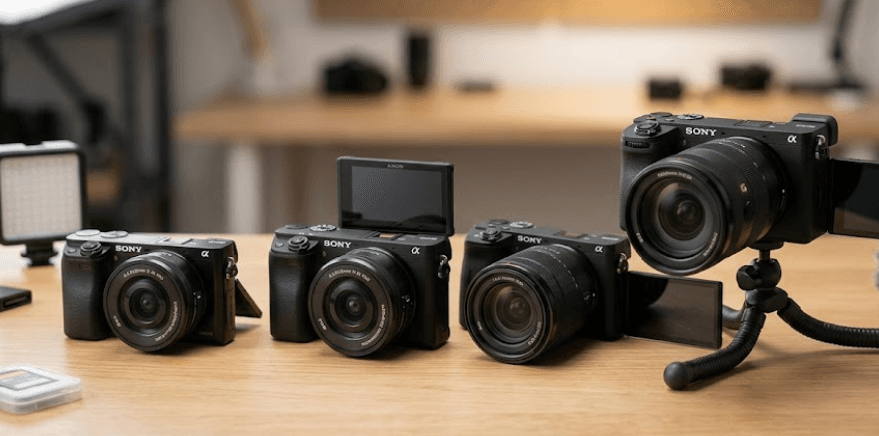
TL;DR The Sony A6000-series still offers several capable options for vloggers, but the models are not equally suited to video. The Sony A6400 is the best overall choice because it combines 4K recording, fast autofocus, a 180-degree tilting touchscreen, a microphone input, and useful video controls in a compact body. The A6100 is a sensible lower-cost alternative with the same basic 4K capability, flip-up screen, and microphone input, while the A6600 is the stronger choice for creators who regularly shoot handheld because it adds 5-axis in-body image stabilization, a larger battery, and a headphone jack. The older A6000 is better treated as a photography-focused budget option because it lacks 4K recording and a microphone input. The A6500 also offers 4K and stabilization, but its screen does not flip forward, which makes self-recording less convenient.
Why the Sony A6000 Series Still Works for Vlogging
The Sony A6000-series remains relevant for vlogging because several models combine an APS-C sensor, interchangeable E-mount lenses, strong autofocus, and relatively compact bodies. For a creator, that combination can be more useful than simply buying a camera with the highest resolution. The A6100, A6400, A6500, and A6600 can all record 4K video, although their supporting features are different. Sony lists 4K recording on the A6100 and A6400, while the A6500 and A6600 also support 4K recording with additional video-oriented features. This means you can build a more flexible setup around lenses, microphones, tripods, and other accessories rather than being restricted to the fixed lens and processing of a smartphone.
Autofocus is another reason these cameras remain attractive for vloggers. The A6100 and A6400 use Sony's Fast Hybrid AF system with extensive phase-detection coverage, while the A6600 adds Real-time Tracking and Real-time Eye AF. For a creator speaking directly to the camera, reliable autofocus matters because you may move closer to the lens, gesture with your hands, or change position without someone standing behind the camera to adjust focus. The A6400 and A6100 are particularly useful for this style because their 180-degree tilting screens let you monitor your framing while recording yourself. Sony specifically positions both cameras for selfies and vlogging.
The main thing to remember is that the A6000-series is not one single camera experience. The A6000 is an older model with Full HD video rather than 4K, while the A6100 and A6400 introduced much more useful vlogging features. The A6500 adds sensor-shift stabilization but keeps a screen that only tilts rather than fully flipping forward. The A6600 brings together stabilization, a large battery, fast autofocus, 4K recording, and microphone and headphone connections. For that reason, the best model depends heavily on whether you primarily vlog from a tripod, walk and talk outdoors, or want a camera that can also serve as a serious hybrid photography body.
Sony A6000-Series Models Compared for Vlogging
The easiest way to understand the line-up is to compare the features that actually affect vlogging rather than focusing only on megapixels. The A6100 and A6400 are especially convenient for self-recording because both have 180-degree tilting LCD screens and microphone inputs. The A6400 goes further with picture profiles and more advanced video controls, making it more appealing to creators who expect to edit and color-grade their footage. The A6600 takes a different approach by prioritizing stabilization and endurance. It has a 5-axis in-body image stabilization system and a much larger-capacity battery than the other models in this group.
The A6500 sits between these cameras in an interesting way. It has 5-axis sensor-shift stabilization and 4K recording, which makes it useful for handheld video, but its LCD only tilts upward by approximately 90 degrees and downward by approximately 45 degrees. That is very different from the A6100 and A6400, whose screens can tilt upward approximately 180 degrees. For traditional vlogging where you hold the camera at arm's length and need to see yourself, that difference is significant. A camera can have excellent stabilization and still be inconvenient if you cannot easily check your framing while recording.
The original A6000 is the weakest choice for modern vlogging. Sony lists its movie recording as AVCHD 2.0 and MP4, rather than the 4K XAVC S recording offered by the newer A6100 and A6400. It also does not have a microphone terminal, which means you cannot connect an external microphone directly to the camera. That makes it much harder to build a clean audio setup for talking-head videos or outdoor content. It can still produce good-looking Full HD footage in the right conditions, but if you are buying specifically for vlogging in 2026, the A6100 or A6400 makes considerably more sense.
Sony A6000-Series Vlogging Features
| Camera | 4K Video | Flip-Up Screen | Mic Input | IBIS | Headphone Jack | Vlogging Verdict |
|---|---|---|---|---|---|---|
| Sony A6000 | No | No | No | No | No | Not recommended |
| Sony A6100 | Yes | Yes | Yes | No | No | Best value |
| Sony A6400 | Yes | Yes | Yes | No | No | Best overall |
| Sony A6500 | Yes | No | Yes | Yes | No | Good for stabilized video |
| Sony A6600 | Yes | Yes | Yes | Yes | Yes | Best for advanced handheld vlogging |
The table makes the main difference clear. The A6400 has the strongest combination of features for a typical vlogger because it provides the features you are most likely to use without adding the size and cost associated with the A6600. The A6600 is more capable when stabilization, battery life, and monitoring audio through headphones become priorities. The A6100 is attractive if you want the core vlogging experience without paying for the more advanced controls of the A6400. These distinctions are based on Sony's published specifications and product information.
Sony A6400 Is the Best Overall Vlogging Pick
The Sony A6400 is the strongest overall A6000-series choice for most vloggers because it gets the fundamentals right. It has a 24.2MP APS-C sensor, 4K recording, a 180-degree tilting touchscreen, a microphone input, and Sony's fast autofocus system. The camera can record 4K at up to 30p in XAVC S, while Full HD recording can reach 120p in compatible settings. This gives creators enough flexibility for standard talking-head videos, travel content, product videos, and slow-motion clips without moving into a much larger camera body.
The screen is particularly important for vlogging. A forward-facing screen allows you to position the camera on a small tripod, handheld grip, or similar setup and still check whether your face is properly framed. The A6400's 3.0-inch touchscreen can tilt upward approximately 180 degrees, which Sony explicitly highlights for selfies and vlogging. It also includes a 3.5mm microphone input, allowing you to use an external microphone instead of relying only on the camera's built-in stereo microphone. For a creator who is serious about improving audio quality, that is one of the most useful differences between the A6400 and the older A6000.
The biggest limitation is the absence of in-body image stabilization. The A6400 does not have sensor-shift stabilization, so handheld creators need to think more carefully about lens choice, technique, or external stabilization. That does not make it a poor vlogging camera. It simply means the A6400 is particularly strong for tripod-based vlogging, controlled handheld shooting, and creators who can use stabilized lenses or a gimbal when necessary. If you mostly film yourself sitting at a desk, walking short distances, or recording travel clips with a stabilized lens, the A6400's overall balance makes it the easiest recommendation in this lineup.
Sony A6600 Is Better for Handheld Vlogging
The Sony A6600 becomes the more compelling choice when handheld shooting is central to your content. Its biggest advantage over the A6400 is 5-axis in-body image stabilization, which helps compensate for camera movement while recording. Sony states that the A6600's stabilization can provide an equivalent advantage of up to five shutter-speed steps under specified conditions. For vloggers who regularly walk, travel, or shoot without a tripod, that can make the camera easier to work with. Stabilization cannot eliminate every movement, but it can reduce the small shakes that become obvious when footage is viewed on a larger screen.
The A6600 also has the strongest battery setup in this group. Sony rates it at approximately 720 shots using the viewfinder or approximately 810 shots using the LCD under CIPA testing. More importantly for video creators, the camera combines its larger battery with a microphone input and a headphone output. The headphone jack is useful when recording serious content because it lets you monitor the audio signal rather than discovering after the shoot that the microphone was too quiet, distorted, or affected by unwanted noise. For creators producing interviews, travel videos, educational content, or longer shoots, this can be more valuable than a small increase in image quality.
The A6600 also retains the features that make the A6000-series attractive for video, including a 24.2MP APS-C sensor, 4K recording, Real-time Tracking, Real-time Eye AF, and a 180-degree tilting screen. Sony specifies internal 4K recording at up to 30p and supports S-Log2, S-Log3, and HLG options for creators who want more control over their footage. The tradeoff is that the A6600 is an older camera and can be harder to justify if its higher price is not buying features you will actually use. For a stationary vlogger, the A6400 is usually the more sensible choice. For a creator who spends a lot of time moving with the camera, the A6600's stabilization and audio monitoring make the upgrade more meaningful.
Sony A6100 Is the Best Value Option
The Sony A6100 is the model to consider when you want the essential features for vlogging without moving to the higher-end A6400 or A6600. It uses a 24.2MP APS-C sensor and can record 4K video at up to 30p. It also has a 180-degree tilting touchscreen and a 3.5mm microphone input, giving it the two features that matter enormously for beginner vloggers: the ability to monitor yourself and the ability to connect an external microphone. Sony also gives the A6100 a fast autofocus system with 425 phase-detection and 425 contrast-detection points.
The A6100 is particularly suitable for beginners because you do not have to learn an advanced video workflow immediately. You can pair it with a compact E-mount lens, place it on a small tripod, connect a microphone, and start recording. Its autofocus can track faces and eyes, which is useful when you are speaking to the camera rather than manually pulling focus. The camera is also relatively compact at approximately 396g with battery and memory card, according to Sony, making it easier to carry for travel or daily content creation.
There are compromises compared with the A6400. The A6100 does not offer the A6400's picture profiles, including S-Log2, S-Log3, and HLG, and it lacks in-body stabilization. It is therefore better suited to creators who want straightforward recording rather than a camera they expect to use for more advanced color grading and production work. If you are starting a YouTube channel, making college content, recording travel videos, or creating social media videos, those limitations may not matter much. In that situation, the A6100 can deliver the core vlogging experience without making you pay for features you may never use.
Sony A6500 Is Better for Stabilized Video
The Sony A6500 is still an interesting option because it was designed as a more advanced APS-C body and includes 5-axis in-body image stabilization. It records 4K video and supports Sony's XAVC S format, while its 24.2MP APS-C sensor provides the same general resolution class as the A6100, A6400, and A6600. The camera also has a microphone input, picture profiles, and clean HDMI output, giving it a useful feature set for creators who want more control over their footage.
However, the A6500 has one major problem for traditional self-vlogging: its LCD is not a 180-degree flip screen. Sony specifies an adjustable angle of approximately 90 degrees upward and 45 degrees downward. That means you cannot simply turn the display toward yourself in the same way you can with the A6100, A6400, or A6600. For someone recording landscapes, events, B-roll, or stabilized handheld footage, that may not matter much. For a creator who frequently talks directly into the camera while holding it at arm's length, it is a meaningful inconvenience.
The A6500 can therefore make sense when you find a good used-market deal and prioritize stabilization over self-monitoring. Its 5-axis stabilization is a genuine advantage for handheld shooting, while its 4K recording and picture profiles give it more video flexibility than the original A6000. However, buyers should be careful not to choose it simply because it has a higher model number than the A6400. For vlogging specifically, the A6400's 180-degree screen and newer autofocus features make it a more practical choice, while the A6600 is the more complete option if you need stabilization, a larger battery, and headphone monitoring.
Which Sony A6000 Camera Fits Your Vlogging Style?
The right camera depends more on how you shoot than on which model has the most expensive specifications. If most of your videos are recorded indoors, at a desk, or from a tripod, the A6400 is the strongest balance. Its 4K recording, 180-degree screen, microphone input, fast autofocus, and picture profiles give you a capable production setup without requiring the stabilization and battery features of the A6600. The A6100 follows closely for beginners who want similar core features and are less concerned about advanced picture profiles.
If you spend most of your time walking through cities, filming travel videos, or holding the camera while talking to the audience, the A6600 becomes more attractive. Its 5-axis stabilization is the biggest reason to choose it, while the larger battery and headphone output make it more useful for longer and more controlled shoots. The A6600 also supports 4K HDR recording and advanced picture profiles, so it can serve as a more serious hybrid video camera when your content becomes more demanding.
The A6100 makes the most sense for beginners and budget-conscious creators, while the A6500 is worth considering mainly when stabilization is important and the price is attractive. The original A6000 should generally be avoided for a new vlogging setup because its video feature set is now dated. The most practical hierarchy is therefore simple: choose the A6100 for value, the A6400 for the best overall vlogging balance, and the A6600 for handheld and more advanced video work.
Best Sony A6000-Series Camera by Use Case
| Use Case | Best Choice | Main Reason |
|---|---|---|
| Overall vlogging | Sony A6400 | 4K, flip screen, mic input, strong AF |
| Beginner vlogging | Sony A6100 | Essential vlogging features at a lower tier |
| Handheld vlogging | Sony A6600 | 5-axis IBIS and strong battery |
| Advanced video | Sony A6600 | IBIS, headphone jack, picture profiles, 4K |
| Stabilized budget option | Sony A6500 | 5-axis IBIS and 4K |
| Basic photography | Sony A6000 | Affordable older APS-C option |
| Self-vlogging | Sony A6400 | 180-degree screen and mic input |
Common Mistakes When Choosing a Sony Vlogging Camera
One common mistake is focusing on resolution while ignoring the features that make a camera practical for vlogging. All the megapixels in the world do not help much if you cannot see yourself while recording or connect an external microphone. This is why the A6400 and A6100 are more practical than the older A6000 for modern vloggers. The A6000 can still produce useful Full HD footage, but its lack of 4K and microphone input makes it a much less complete video platform. Buyers should therefore look beyond sensor resolution and check the screen, microphone connection, stabilization, autofocus, and recording format before choosing a camera.
Another mistake is assuming that in-body stabilization automatically makes one camera better for every creator. The A6500 and A6600 have 5-axis stabilization, which is useful for handheld shooting, but the A6500 lacks the forward-facing screen that makes self-vlogging easier. The A6400 does not have IBIS, yet it can still be the better choice for a creator who primarily uses a tripod or stabilized lens. This is why buying decisions should start with your shooting style rather than a single specification. A feature only has real value when it solves a problem you actually encounter during recording.
Audio is another area that new vloggers sometimes underestimate. The A6100, A6400, A6500, and A6600 all provide a 3.5mm microphone input, while the A6000 does not. The A6600 goes one step further by adding a headphone output, which is particularly useful for monitoring recorded sound. If your videos depend heavily on dialogue, interviews, tutorials, or outdoor commentary, an external microphone can make a more noticeable improvement to the finished video than moving between two cameras with similar image quality. For this reason, audio connectivity should be treated as a core vlogging specification rather than an optional extra.
Frequently Asked Questions
Q. Which Sony A6000-series camera is best for vlogging?
The Sony A6400 is the best overall choice for most vloggers. It combines 4K recording, fast autofocus, a 180-degree tilting touchscreen, a microphone input, and advanced picture profiles. The A6600 is better if you specifically need in-body stabilization and headphone monitoring.
Q. Is the Sony A6400 good for YouTube videos?
Yes. The A6400 supports 4K recording, has a microphone input, and offers a 180-degree tilting screen that makes self-recording easier. Its autofocus system is also well suited to keeping a presenter in focus while recording.
Q. Does the Sony A6400 have image stabilization?
No. The A6400 does not have in-body image stabilization. You can use a stabilized lens or an external gimbal if you need smoother handheld footage.
Q. Is the Sony A6600 better than the A6400 for vlogging?
It is better for creators who need handheld stabilization, a larger battery, and headphone monitoring. For tripod-based or controlled vlogging, the A6400 can be the better-balanced choice because it offers many important vlogging features in a simpler package.
Q. Does the Sony A6100 have a flip screen?
Yes. The A6100 has a 3.0-inch LCD that can tilt upward approximately 180 degrees, making it suitable for selfies and vlogging.
Q. Does the Sony A6100 record 4K video?
Yes. The A6100 can record 4K video at 3840 x 2160 resolution using Sony's XAVC S format.
Q. Does the Sony A6000 record 4K video?
No. The original Sony A6000 records video in AVCHD 2.0 and MP4 formats rather than the 4K XAVC S recording available on the newer A6100 and A6400.
Q. Does the Sony A6000 have a microphone jack?
No. Sony's specifications list a Multi Interface Shoe and USB connection for the A6000 but do not list a dedicated microphone terminal. The A6100, A6400, A6500, and A6600 have 3.5mm microphone inputs.
Q. Which Sony A6000-series camera has the best stabilization?
The A6500 and A6600 both use 5-axis in-body image stabilization. The A6600 is the stronger vlogging choice because it combines stabilization with a 180-degree screen, newer autofocus features, a larger battery, and a headphone output.
Q. Is the Sony A6500 good for vlogging?
It can be, particularly if stabilization is important, because it has 5-axis IBIS, 4K recording, and a microphone input. However, its screen does not flip forward, so the A6400 or A6600 is more convenient for creators who frequently record themselves.
Final Recommendation
The Sony A6400 is the best Sony A6000-series camera for vlogging for most buyers in 2026. It offers the combination that matters most for everyday content creation: 4K video, fast autofocus, a 180-degree screen, a microphone input, and advanced video controls. It does not have in-body stabilization, but that limitation is easier to work around if you mostly vlog from a tripod, use a stabilized lens, or shoot in controlled environments.
The Sony A6600 is the better premium choice for handheld vloggers. Its 5-axis stabilization, larger battery, headphone jack, 4K HDR recording, and strong autofocus make it the more complete tool for creators who regularly shoot while walking or traveling. The A6100 is the better value option if you want the essential vlogging features without moving into the higher-end models. The A6500 remains useful for buyers who prioritize stabilization but can live without a forward-facing screen.
The original A6000 is difficult to recommend specifically for vlogging in 2026 because its Full HD-only recording and lack of a microphone input make it noticeably less suited to modern video creation. If you are buying a Sony A6000-series camera primarily for vlogging, start with the A6400, move to the A6600 if handheld stabilization and audio monitoring are important, and choose the A6100 when keeping the overall setup affordable matters most.