What Is Edge AI? Local AI Guide
Edge AI brings intelligence closer to the source by processing data directly on devices, enabling faster decisions, stronger privacy and offline functionality. Explore its benefits, real-world applications, edge vs cloud AI differences and future deployment trends.

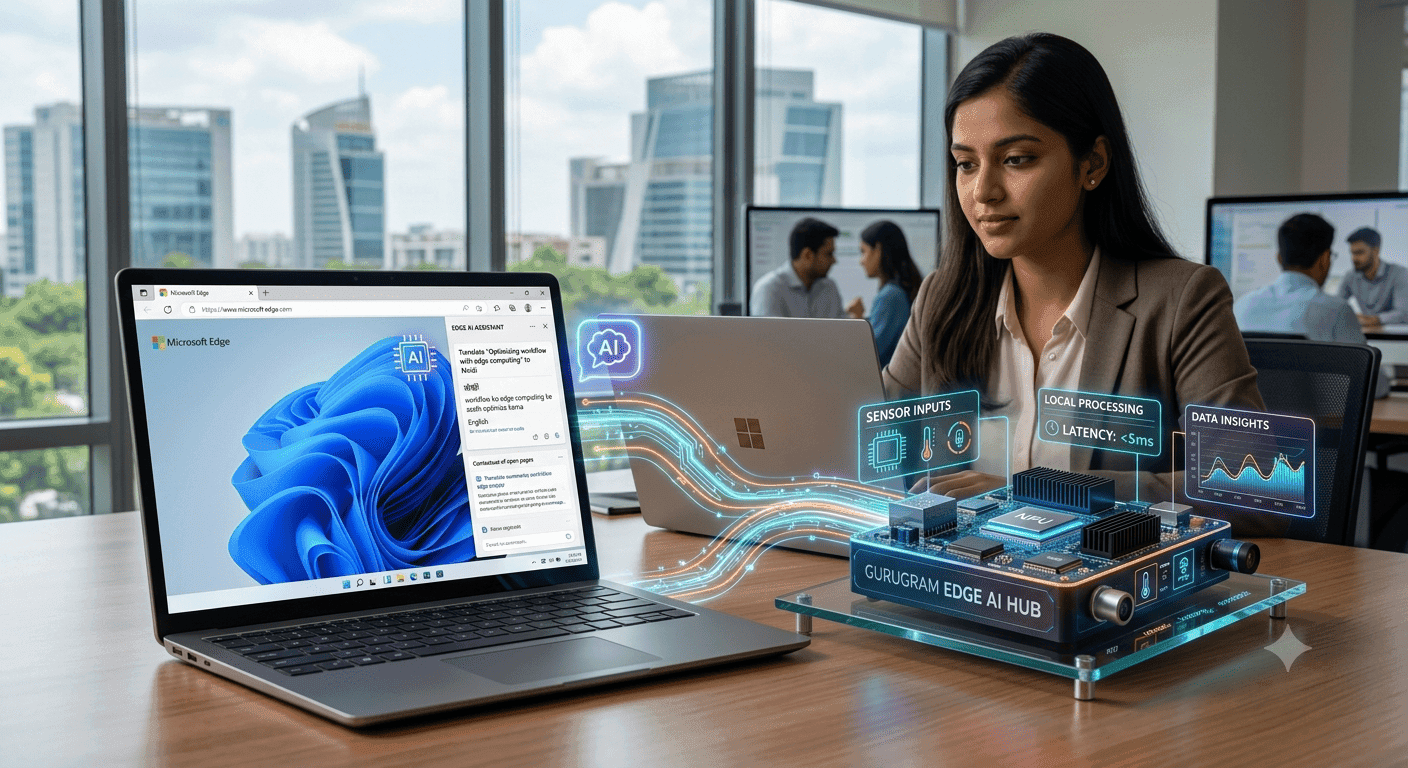
TL;DR Edge AI runs artificial intelligence on the device itself, so decisions happen locally instead of waiting on cloud infrastructure. That lowers latency, improves privacy, and keeps systems working when connectivity is weak.
What Edge AI Means and Why It Matters
Edge AI is the deployment of AI applications on devices throughout the physical world. Instead of sending every signal to a remote server, the device runs the model and produces a result on-site. That simple shift changes where intelligence lives, and it is why edge computing matters in factories, hospitals, vehicles, and smart homes.
The phrase what is edge ai sounds abstract until you see it in action. A camera in a factory, a bedside monitor in a ward, or a vehicle sensor stack can all make decisions where the signal is captured. That is the core idea behind AI edge systems, and it is also why edge AI devices are becoming standard in industrial and consumer deployments.
At its core, edge AI combines artificial intelligence, machine learning, and embedded computing in one place. The model is deployed on the device, then inference happens where the signal is captured. That means the device can classify, detect, or trigger an action without waiting for a server.
Edge AI enables real-time data processing and analysis without constant reliance on cloud infrastructure. It also processes information within milliseconds, which is what gives it real-time feedback. In practice, that matters when a machine controller, a smart home hub, or a medical monitor has to act before the moment passes.
How Edge Computing Changes the Architecture
Edge computing shortens the path between sensing and action. The device may still sync summaries or logs later, but the critical decision happens locally. That makes the system feel like a control layer, not a remote analytics pipeline.
This is also where edge processing differs from ordinary cloud AI. Cloud systems are still useful for training large models, fleet analytics, and long-running batch work. Edge AI belongs where latency, autonomy, and local context matter more than centralized scale.
When people ask what is edge processing, they usually want to know why the location of computation matters. It matters because a shorter path means faster responses, less network dependence, and fewer points of failure. Real-time processing is not just a technical label, it is the difference between a camera rejecting a defective part immediately and a cloud workflow catching it after the line has already moved on.
How Edge AI Works With Devices and Models
The device can still send summaries to the cloud later, but the important action happens on-site. That is what makes edge AI feel responsive instead of sluggish. This architecture depends on fitting the model to the device’s memory, power budget, and compute limits.
A small sensor hub, a camera, and an industrial controller all have different constraints, so edge computing is as much about hardware fit as software design. If the workload is too heavy, the system stops being efficient and starts becoming a bottleneck. In practice, that means choosing AI models that can run well within those limits and keep data locally.
Local Inference and Machine Learning
Local inference is the moment when a trained model applies what it has learned to new input. That is where machine learning becomes practical, because the device can act without sending everything to a distant server. For a business that runs a point-of-sale scanner, a warehouse camera, or a predictive maintenance node, that local step is where the value shows up.
Machine learning at the edge also changes how teams think about deployment. The goal is not to push every task into the smallest device possible. The goal is to place the right intelligence in the right place so the system stays fast, secure, and manageable. That is especially true when AI models need to match the device’s limits and keep data locally.
Edge AI Devices in the Real World
These AI devices are built to collect signals at or near the physical location, then respond without a round trip through cloud infrastructure. That is why they work so well in systems that must make decisions across many cases, not just one. A factory camera running defect detection, a home hub handling voice commands, and a vehicle sensor pack reading LiDAR all follow the same pattern.
The difference is the context, not the logic. In each case, the device does the useful work where the information appears, and the edge keeps the response local. That is the core advantage of edge AI in real-world deployments, especially when teams want to keep data locally.
Where Cloud AI Still Fits?
Cloud AI still has a place, and pretending otherwise would be sloppy. It is useful for training large models, aggregating data across fleets, and running heavy analytics that do not need instant response. The problem is not cloud computing itself; it is using cloud AI for jobs that should never leave the site in the first place.
That is also why many solutions use both layers. The edge handles immediate action, while the cloud handles coordination, training, and reporting. In a business deployment, that split usually gives the best mix of speed and oversight.
Edge AI Benefits for Security, Speed, and Cost
The benefits of edge are easiest to understand when you look at what happens to the signal. Less leaves the device, less travels over the network, and less waits in a queue. That improves speed, reduces exposure, and keeps the system useful when connectivity is poor.
Edge AI enhances operational resilience by allowing devices to process information locally, even without internet access. It also reduces latency by keeping the decision close to the source. Those two advantages matter across healthcare, manufacturing, retail, and smart homes.
When the model runs on the device, the response does not have to travel to a remote server and back. That is why real-time processing is such a common requirement in cameras, robots, and safety systems.
Faster Decisions With Real-Time Processing
Cisco’s point about reduced decision-making latency is easy to see in the field. A machine safety controller cannot wait for cloud infrastructure to catch up, and a vehicle cannot pause for a network round-trip. Edge AI processes signals within milliseconds, and that is what keeps the response aligned with the moment.
Privacy and Data Sovereignty
Keeping information local changes the privacy profile of the system. IBM notes that edge AI can help maintain compliance with data sovereignty regulations by processing sensitive information on the device where it is gathered, stored, and processed. That matters for healthcare records, industrial telemetry, and customer-facing systems that should not expose raw signals unnecessarily.
NVIDIA also notes that edge AI can analyse real-world information without exposing it to a human being. In plain language, the device can interpret the signal without pushing it through a wider cloud pipeline. For regulated environments, that is often the cleanest way to reduce risk.
Cost and Resource Efficiency
Local processing reduces the amount of information that has to be sent to the cloud, which lowers bandwidth pressure and infrastructure cost. IBM also notes that filtering the signal locally can improve energy efficiency, because the device does not waste resources moving every frame or sensor event upstream.
A useful Indian example makes the economics obvious. A mid-sized factory can reduce unplanned downtime by 42 percent, achieve payback in under four months, and cut cloud-related infrastructure costs by up to 92 percent by shifting intelligence from distant data centers to the factory floor itself. That is not a cosmetic gain; it is a hard operational result.
The common thread is simple: keep the important action close to the source. That is where edge AI delivers the clearest return, especially when the workload depends on speed, privacy, and resilience.
Where Edge AI Fits in Healthcare, Vehicles, and Manufacturing
Healthcare, autonomous vehicles, manufacturing, smart homes, and retail all use local inference for different reasons. The architecture is the same, but the business case changes by sector. In each case, the goal is not novelty, it is better timing, better control, and fewer dependencies on distant systems.
That is what makes edge AI devices so useful in real deployments. The same local decision-making pattern can protect patients, keep vehicles responsive, and improve production quality. The details change, but the logic stays consistent.
Healthcare Monitoring
In healthcare, edge AI can monitor vital signs in real time, which is useful when delay changes the outcome. A bedside monitor or wearable can analyze heart rate, oxygen saturation, or movement locally, then alert staff without waiting on cloud processing. That local loop matters because the signal is time-sensitive and the environment is full of interruptions.
This is a strong fit for machine learning models that score risk continuously. A nurse station running local alerts in a ward does not need to wait for a remote service to confirm a change. The result is faster escalation and less dependence on network stability.
Autonomous Vehicles and Sensor Fusion
Arm’s framing makes the reason obvious: the vehicle has to interpret signal as it moves, not after the fact. If the model waits on cloud AI, the car has already passed the decision point. This is a classic edge processing case because the sensors are constantly changing the scene.
A lane marker, a pedestrian, or a sudden obstacle cannot wait for a long round trip. The vehicle needs local intelligence to stay safe. That is why edge AI belongs in sensor fusion stacks where timing matters more than centralized analysis.
Manufacturing Quality Control
Manufacturing is where edge AI gets brutally practical. IBM notes that visual information can be processed locally for quality control, and RDP adds that sub-10ms inference is critical for defect detection, autonomous robots, and traffic management. If a camera spots a misaligned part or a surface flaw, the system can reject it immediately instead of letting bad output continue down the line.
This is also one of the clearest business cases for local inference. A plant that catches defects on the line saves materials, reduces rework, and protects throughput. In that setting, edge computing is not a nice-to-have, it is the difference between control and waste.
Smart Homes, IoT, and Retail
Smart homes use edge AI to process commands locally, which cuts the lag between a spoken command and the result. A voice trigger, sensor rule, or scene automation can execute on the hub without routing every request through the cloud. That is why a smart speaker feels immediate when it is working well.
Splunk’s IoT framing matters here too, because continuous local collection gives the system enough context to react to patterns instead of single events. Retail uses edge AI for inventory management and automated checkout systems, where fast recognition and local decisions reduce friction at the point of sale. These are simple cases, but they are exactly the sort of solutions businesses deploy first.
- Healthcare systems use local inference to react to vital-sign changes without delay.
- Vehicles depend on cameras and LiDAR because motion decisions cannot wait for the cloud.
- Manufacturing plants use visual inspection on the line to catch defects immediately.
- Smart homes process commands locally so voice and sensor responses feel instant.
- Retail systems use local recognition for stock control and checkout automation.
- Predictive maintenance depends on continuous sensor analysis to catch anomalies early.
Predictive maintenance follows the same logic in industrial settings, because sensor information can be analysed for anomalies before a machine fails. That makes edge AI less about novelty and more about keeping operations moving when the real world refuses to pause. For a business with rotating equipment or conveyors, that can be the difference between a planned service window and an expensive shutdown.
Edge AI vs Cloud AI and Traditional Cloud Systems
The comparison with cloud AI is not about declaring a winner in every case. It is about matching the architecture to the job. Cloud systems still make sense for training, aggregation, and broad reporting, but they are weaker when every millisecond counts.
Edge AI is considered more secure than cloud AI because it keeps sensitive information locally, on the device where it is gathered, stored, and processed. That local boundary also helps with resilience, because the device can keep working even when the network is unstable.
Security and Privacy Differences
Security improves when fewer raw streams leave the site. That reduces exposure risk because fewer systems touch the information before the decision is made. For medical, industrial, and customer-facing deployments, that is a major reason local inference is preferred.
Cloud AI can still be secure, but it has a broader attack surface because the signal travels farther. Edge AI narrows that surface by keeping the important action on-device. In practical terms, that means fewer handoffs and fewer places where sensitive information can leak.
Latency and Time-Sensitive Work
Latency is where the architectural split becomes obvious. Edge AI reduces latency by processing information locally, so the device responds faster than a cloud-based system that must transmit, queue, and return a result. In decision-heavy systems, that difference changes behaviour, not just benchmark numbers.
This is why people often ask what edge processing is in the first place. They are really asking why the location of computation matters so much. The answer is simple: if the task is time-sensitive, the shortest path usually wins.
Connectivity, Cost, and Business Fit
Cloud AI depends on connectivity much more heavily than edge AI does. IBM notes that edge devices can keep processing even without internet access, which makes them more resilient in offline or unstable-network environments. If a remote site loses its connection, the edge system can keep making decisions, while a cloud-first design slows down or stops.
The cost trade-off is not just hardware versus software; it is bandwidth versus autonomy. That is why the financial case improves as the number of devices, sensors, or camera feeds grows. For a business running many endpoints, local processing usually becomes the more efficient choice over time.
- Use cloud AI when centralized training or fleet-wide analytics matter more than response speed.
- Use local inference when privacy rules or sovereignty requirements are strict.
- Use cloud systems when your workload can tolerate network delay.
- Use edge computing when the site must keep working during outages.
If your application is a factory controller, a medical monitor, or an autonomous sensor stack, edge AI is the cleaner choice. If you are training large models or coordinating many sites, cloud AI still has the better fit. The right answer depends on the case, not on hype.
Edge AI Market Size, Pricing, and Device Choices
The edge AI market is not a niche experiment anymore. That pace tells you the category is moving from pilot projects toward standard infrastructure. That is especially true in factories, retail locations, logistics hubs, and connected infrastructure.
The growth also explains why more AI devices are being adopted across these environments. For a business, the main signal is not just growth, it is maturity. More deployments mean more tooling, more integration patterns, and more pressure to make systems efficient.
That is good news if you are building around local decision making, because the ecosystem gets easier to support. The broader trend also points to more solutions that blend device intelligence with central oversight. That mix is useful because it lets teams keep the real-time control path local while still coordinating across sites.
Market Momentum and Business Adoption
In other words, the market is rewarding systems that are practical, not flashy. Businesses want devices that can run local workloads, support real-time decisions, and reduce dependence on constant network access. That is why edge AI keeps moving from specialized deployments into everyday operations.
Pricing Example and What It Means
On its own, that number can look steep, but the better comparison is against the downtime, bandwidth, and cloud infrastructure it can avoid. For a pilot project, that makes it a concrete starting point for testing local inference before scaling a broader deployment.
Indian buyers should think in terms of hardware fleets, not one-off experiments. If a device can keep a camera line running, support a warehouse workflow, or power a small business deployment, the price becomes part of the operating model. That is the right way to judge edge AI solutions.
Choosing Between Solutions
Not every solution needs the same level of compute. Some deployments need a compact device that handles a narrow task, while others need more headroom for machine learning, sensors, and future expansion. The best choice is the one that matches the workload without wasting resources.
- Pick a device with enough headroom for the model you actually plan to run.
- Match the hardware to the number of cameras, sensors, or endpoints.
- Compare total operating cost, not just purchase price.
- Think about whether the system must keep working during outages.
For most buyers, the best starting point is a device that can run current workloads locally and still leave room for expansion. If you expect strict privacy requirements or unstable connectivity, prioritize security and resilience over raw cloud-style scale. That is where edge AI usually pays off first.
Future Trends in Edge Computing and AI Deployment
Edge AI is moving into a more connected phase, and 5G is a major part of that shift. The point is not to replace local inference, but to make the surrounding information movement cleaner and faster. That matters for distributed systems that need both local action and wider coordination.
The next phase is less about proving the concept and more about standardizing it. As more businesses adopt local intelligence, the line between device logic and central coordination will keep getting sharper. That makes deployment planning more important, not less.
5G, Synchronization, and Real-Time Systems
The integration of 5G with edge AI is helping distributed systems move data more efficiently between devices and central platforms. That does not remove the need for local decisions, but it does improve synchronization across sites. For businesses with many endpoints, this can make reporting and coordination smoother without slowing the response path.
What the Next Phase Means for Buyers
For buyers, the practical takeaway is simple. Local intelligence will keep expanding into more devices, but the best systems will still balance edge and cloud instead of choosing only one. That means planning for local inference, remote oversight, and future scaling at the same time.
Is Edge AI Worth It for Your Use Case
Edge AI is worth it when the decision has to happen where the signal appears, not after it has travelled through cloud infrastructure. Across healthcare, vehicles, manufacturing, smart homes, and retail, the same pattern shows up, and the numbers make the case concrete: a mid-sized factory can reduce unplanned downtime by 42 percent and cut cloud-related infrastructure costs by up to 92 percent.
Those gains come from keeping the important action local while still using the cloud for training, coordination, and reporting. If you are evaluating a deployment, start by matching the workload to the device, then choose the mix of edge and cloud that keeps the system fast, secure, and resilient.
For buyers who need low latency, privacy, and offline resilience, edge AI is the stronger fit. For teams focused on large-scale training or fleet-wide analytics, cloud still plays a central role. The best action now is to map your workload, compare the device limits, and choose the architecture that supports the real operating environment.
Frequently Asked Questions
Q. What is Edge AI in simple terms?
Edge AI means running artificial intelligence on the device itself instead of sending every task to cloud infrastructure. That local setup lets the device make decisions in milliseconds, which is useful for cameras, medical monitors, and vehicle sensors. It also keeps sensitive information closer to where it is gathered and processed.
Q. How is edge AI different from cloud AI?
Edge AI processes information locally, while cloud AI sends data to a remote server for analysis. That difference matters because edge systems reduce latency and can keep working without internet access. Cloud systems still help with training large models and fleet analytics, but they are weaker when every millisecond counts.
Q. Where is edge AI used most often?
It is used heavily in healthcare, autonomous vehicles, manufacturing, smart homes, and retail. A bedside monitor can alert staff locally, a vehicle can react to a pedestrian, and a factory camera can reject a defective part immediately. Those examples all depend on local inference and fast response.
Q. Why does edge AI improve privacy?
It improves privacy because the device can process sensitive information on-site instead of sending raw data through a wider cloud pipeline. IBM notes that this can help with data sovereignty requirements, especially in healthcare and industrial settings. Keeping information local also reduces the number of systems that touch the data before a decision is made.
Q. Is edge AI expensive to deploy?
It can require dedicated hardware, but the operating cost often improves when you factor in bandwidth, downtime, and cloud infrastructure costs. The article’s factory example shows up to 92 percent lower cloud-related infrastructure costs, plus payback in under four months. That makes the upfront spend easier to justify when the workload is time-sensitive or high volume.
Q. When should I choose cloud instead of Edge?
Choose cloud when centralized training, aggregation, or broad reporting matters more than immediate response. Cloud AI is still the better fit for large model training and fleet-wide analytics. If the site must keep working during outages or needs local privacy controls, Edge is usually the better choice.
Ready to upgrade your tech?
Browse our collection of quality refurbished products at unbeatable prices.