
Variable Aperture Smartphone Cameras: Marketing Gimmick or Useful Feature?
Variable aperture smartphone cameras adjust how much light enters the lens, improving exposure and depth-of-field control. Learn how the Huawei Mate 50 Pro, Xiaomi 14 Ultra, and Samsung Galaxy S9 use this technology to enhance mobile photography.

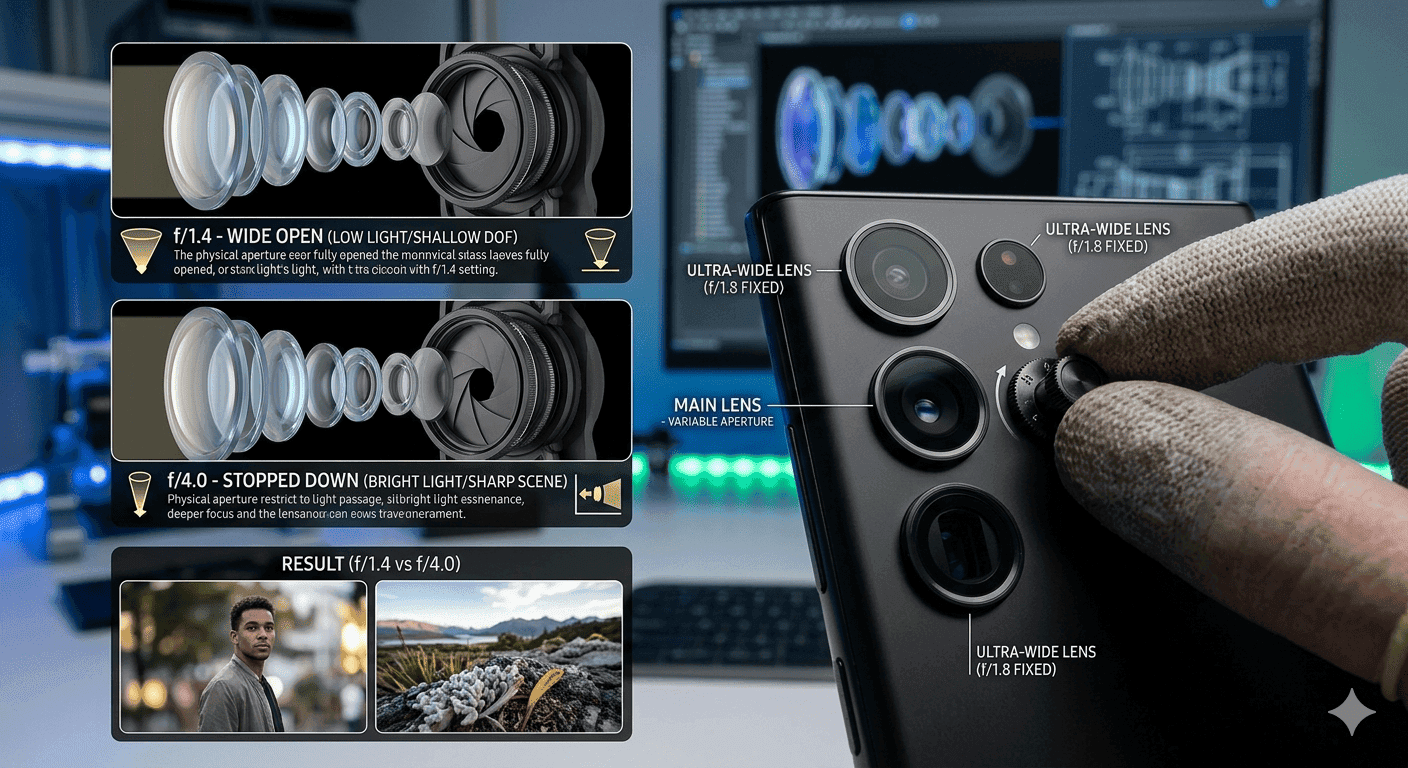
TL;DR Variable Aperture Smartphone Cameras give the Huawei Mate 50 Pro and Xiaomi 14 Ultra a real optical advantage, with the Mate 50 Pro’s ƒ/1.4 to ƒ/4 range standing out for flexibility.
Variable aperture smartphone cameras matter because they change how much light reaches the sensor, and that affects exposure, focus behavior, and the look of the final image. The Huawei Mate 50 Pro and Xiaomi 14 Ultra show why this feature is more than a spec-sheet detail. In practice, it can help in bright scenes, low light, and portraits where background control matters.
Understanding Variable Aperture Smartphone Cameras
Variable aperture matters because it changes how much light reaches the sensor, and that directly affects exposure, focus behavior, and the overall character of the image. A fixed aperture camera locks the opening in place, so the phone has to solve every lighting problem with software alone. A variable aperture camera gives the lens another way to adapt, which is why the feature is relevant in bright scenes, portraits, and landscape shots.
A variable aperture is a lens system that can open wider or close down to change aperture size during capture. In practical terms, a wider opening lets in more light, while a smaller opening limits light intake and can help avoid over-exposure in bright environments. That control is useful when the scene is too bright and the main cameras would otherwise clip highlights or lose detail in the sky.
The other major benefit is depth of field, often shortened to DOF. A wide aperture creates a shallow depth of field, which keeps a subject sharp while softening the background. A narrower aperture increases depth of field, which is better when you want more of the frame in focus, such as a cityscape or a group shot. That is the core reason variable aperture smartphone cameras are more than a marketing label when they are implemented well.
The feature gives the camera a physical way to respond to changing light. It also helps explain why some smartphones feel more flexible than others in real shooting conditions, especially when the scene is larger or more demanding.
Why It Matters For Photos
The most obvious gain is exposure control, but the more interesting gain is creative control. Variable aperture allows you to adjust the look of the scene instead of relying entirely on processing after the fact. In portraits, that can mean cleaner subject separation. In daylight, it can mean fewer blown-out highlights and a more balanced image.
It also changes how a smartphone handles focus decisions. When the lens can move between aperture sizes, the phone can choose a setting that favors subject isolation or scene depth depending on the shot. That is why the feature is especially relevant for smartphone cameras that try to serve both casual snapshots and more deliberate photography.
A wider aperture helps the camera gather more light in darker rooms. A narrower aperture helps avoid over-exposure in bright environments. A shallow depth of field can make portraits look more natural.
Early Flagship Adoption
The Samsung Galaxy S9 was one of the first high-profile phones to make variable aperture easy to understand. Its main camera switched between f/1.5 and f/2.4, which gave users a visible difference in how the lens handled light and focus. That mattered because it turned a technical camera feature into something ordinary buyers could notice in real use.
The Galaxy S9 also set the tone for later Samsung Galaxy flagships that treated camera hardware as a headline feature rather than an afterthought. It was not the end of the story, but it proved that variable aperture could live in a mainstream smartphone instead of a niche camera phone. If you want the historical reference point, the Galaxy S9 is the one to remember because it made the idea feel practical rather than experimental.
Key Factors to Consider
The headline feature sounds simple, but the real value depends on aperture range, blade design, and how smoothly the lens moves between settings. Without those pieces working together, the feature becomes a spec-sheet talking point instead of a photographic tool.
Aperture Range And Blade Count
A continuous range of aperture sizes is more flexible than a simple two-step system because it gives the camera more room to adapt to the scene. That matters when you are shooting a bright street in daylight and then walking indoors a few minutes later. Huawei’s variable aperture technology uses at least 6 aperture blades, which helps with control over light intake and suggests a more refined mechanical design.
Blade count is not a magic number, but it does tell you something about optical sophistication. More blades generally allow finer shaping of the opening, which helps the phone maintain smoother exposure control across different aperture settings. If the hardware is limited, the feature can feel abrupt, and abrupt changes are not what you want when the camera is trying to preserve focus and image quality.
Hardware Matters More Than Hype
Most smartphones with variable aperture rely on Voice Coil Motor technology to move the lens mechanism. That matters because the motor has to shift aperture positions quickly and consistently without making the camera bulky or fragile. If the movement is sloppy, the feature loses much of its appeal because the camera cannot respond cleanly as lighting changes.
This is also where the difference between a real camera feature and a marketing claim becomes obvious. A phone that can physically control aperture sizes is doing something different from a phone that simply simulates blur after the shot. For users who edit in tools like Adobe Lightroom Mobile, that difference shows up in how much work the software has to do to rescue the file.
Software Blur Versus Optical Control
Software bokeh can look convincing in some portraits, but it often struggles around hair, glasses, and irregular edges. A variable aperture phone camera reduces that dependency by changing the optical depth of field before the image is captured. That gives the camera a cleaner starting point, which usually means fewer obvious cutout errors in the final photo.
The important tradeoff is that hardware control does not replace good tuning. A variable aperture system still needs solid focus behavior, a capable sensor, and sensible processing. If those pieces are weak, the feature only gives you more control over a mediocre image instead of a better one.
Look for a continuous variable aperture range, not just a two-position gimmick. Check whether the phone uses a real mechanical system such as VCM. Pay attention to blade count because it affects how precisely the opening can be shaped. Treat software blur as a fallback, not the main reason to buy the phone. If you want the most practical test, shoot the same subject in portrait mode and then with the lens set to a wider optical aperture. The better phone will need less cleanup afterward, and that is the real sign you are getting useful hardware rather than a brochure feature.
Comparing Leading Smartphones with Variable Aperture Cameras
The strongest variable aperture phones are not equal, and the differences are obvious once you look at the lens ranges. The Huawei Mate 50 Pro uses a variable aperture from ƒ/1.4 to ƒ/4, the Xiaomi 14 Ultra ranges from ƒ/1.63 to ƒ/4.0, and the Samsung Galaxy S9 switches between f/1.5 and f/2.4. Those numbers matter because they tell you how much room each main camera has to adapt to light and depth of field.
The apertures also show how much control each phone gives you in real shooting situations. Newer systems give photographers more flexibility, while the older dual-aperture setup remains important as the feature's starting point.
Huawei Mate 50 Pro Specifications
Huawei’s variable aperture system stands out because it combines a wide opening with a strong closed-down position. The Mate 50 Pro’s ƒ/1.4 to ƒ/4 range gives the camera a broad spread, which helps in both low light and bright outdoor scenes. Huawei’s implementation also uses at least 6 aperture blades, so the optical control is not just about range, but also how carefully the opening is shaped.
That combination makes the Mate 50 Pro feel like a camera-first phone rather than a phone that merely borrows a camera trick. If you shoot subjects where the background matters, such as food photos in a café or portraits in mixed light, the broader control can be more useful than a narrower system. It is one of the clearest examples of Android smartphones with variable aperture being treated as a serious flagship feature, with clear benefits for flexibility.
Xiaomi 14 Ultra Aperture Range
The Xiaomi 14 Ultra uses a variable aperture from ƒ/1.63 to ƒ/4.0, and that range is wide enough to change how the lens behaves in real scenes. At the wider end, it lets more light in for darker interiors or evening shots. At the narrower end, it gives the camera more depth of field, which helps when you want more of the frame to stay sharp.
The Xiaomi 14 Ultra’s 23mm lens also uses the same ƒ/1.63 to ƒ/4.0 variable aperture range, which reinforces that this is a real optical feature rather than a one-off marketing line. Xiaomi’s positioning matters because the 14 Ultra is not presented as a novelty camera phone. It is a flagship that uses variable aperture as part of a broader imaging package, which is exactly how the feature should be judged.
Samsung Galaxy S9 Dual Aperture
The Samsung Galaxy S9 remains important because it introduced many buyers to the concept through a simpler dual-aperture setup. Its f/1.5 and f/2.4 switch was easier to explain than a fully continuous system, and that helped the feature become visible in mainstream marketing. The Galaxy S9 series was marketed with variable aperture as a flagship feature, which shows early brands understood its appeal.
That said, the S9’s role is historical more than competitive today. It proved the value of the idea, but newer phones like the Mate 50 Pro and Xiaomi 14 Ultra show how much more room there is for control when the aperture range is broader. For anyone comparing variable aperture phones now, the S9 is the benchmark for origin, not the benchmark for performance.
| Feature | Huawei Mate 50 Pro | Xiaomi 14 Ultra | Samsung Galaxy S9 |
|---|---|---|---|
| Aperture range | ƒ/1.4 to ƒ/4 | ƒ/1.63 to ƒ/4.0 | f/1.5 and f/2.4 |
| Technology type | Variable aperture lens | Variable aperture lens | Dual aperture lens |
| Flagship positioning | Camera-focused flagship | Imaging-focused flagship | Early flagship feature |
| Low-light flexibility | Wide opening for darker scenes | Wide opening for darker scenes | Strong for its era |
| Depth of field control | Broad optical control | Broad optical control | Limited compared with newer systems |
| Main camera role | Central camera feature | Central camera feature | Main camera headline feature |
| Market significance | Modern reference point | Modern reference point | Early popularizer |
What The Comparison Shows
The table shows a simple pattern: the newer the system, the more useful the control. The S9 still matters because it normalized the feature, but the newer phones are the ones that make the case for buying into it now. If you shoot in a mobile editor or compare files side by side, the broader aperture range can reduce how much you need to rescue highlights or fake background blur later.
If you want a phone that treats the lens as a real tool instead of a spec, the Mate 50 Pro is the strongest hardware statement here, while the Xiaomi 14 Ultra is the cleaner modern comparison for most buyers. Both show why variable aperture smartphone cameras continue to matter. The difference is mostly in how much control each system gives you.
- The Huawei Mate 50 Pro offers the broadest range in this set, which gives you the most optical flexibility.
- The Xiaomi 14 Ultra sits close behind and feels like the most balanced modern flagship implementation.
- The Galaxy S9 is historically important, but its dual-aperture approach is less versatile than newer systems.
- If you want the clearest proof that variable aperture can be more than a gimmick, compare the Mate 50 Pro and Xiaomi 14 Ultra first.
Pricing Impact and Market Trends for Variable Aperture Cameras
Variable aperture raises hardware cost because the lens assembly has to move, lock, and repeat that movement reliably. That extra complexity is exactly why the feature tends to show up in higher-end phones rather than entry-level models. Buyers should expect it to appear where camera hardware gets priority over cost savings.
The market trend is also clear from the phones already using it. In other words, the feature matters most when it is part of a broader imaging strategy rather than a single headline spec. The iPhone 18 Pro camera module is a useful comparison point for buyers watching premium camera hardware, even though this feature is not the only path Apple can take.
That makes the variable aperture discussion more interesting, not less, because it shows one of the few remaining places where hardware still changes the image before software gets involved. When considering the hardware, this becomes especially relevant.
Frequently Asked Questions
Q. What does variable aperture do on a smartphone camera?
It changes how much light reaches the sensor, which affects exposure and depth of field. That means the phone can adapt more naturally to bright scenes, darker rooms, and portraits. It also gives the camera more optical control before software processing starts.
Q. Why is the Huawei Mate 50 Pro often mentioned with variable aperture?
The Huawei Mate 50 Pro uses a variable aperture ranging from ƒ/1.4 to ƒ/4, and that range gives it strong flexibility. Huawei’s implementation also uses at least 6 aperture blades, which supports more precise light control. That combination makes it one of the clearest examples of the feature in a modern flagship.
Q. How does the Xiaomi 14 Ultra compare?
The Xiaomi 14 Ultra features a variable aperture ranging from ƒ/1.63 to ƒ/4.0. That gives it a useful spread for both low light and brighter scenes. It also shows the feature fits into a broader imaging package rather than standing alone.
Q. Is variable aperture better than software portrait blur?
It can be, because it changes the optical depth of field before the image is captured. That often reduces the need for software to guess around difficult edges like hair or glasses. Software blur still has a place, but variable aperture gives the camera a cleaner starting point.
Q. Why was the Samsung Galaxy S9 important?
Its f/1.5 and f/2.4 switch helped mainstream buyers see the benefit in real use. It remains an important reference point for how the feature entered the market. It also showed that a phone could use hardware changes, not just processing, to shape the photo.
Q. What should I look for if I care about variable aperture?
Look for a continuous range of aperture sizes, a real mechanical system such as VCM, and a design that uses the feature as part of the full camera system. Huawei’s use of at least 6 aperture blades is a good example of the kind of hardware detail that matters. The best results come when the lens, sensor, and processing all work together.
Which Variable Aperture Smartphone Camera Fits Your Needs?
Choose the Huawei Mate 50 Pro if you want the broadest optical flexibility in this group. Its ƒ/1.4 to ƒ/4 range and at least 6 aperture blades make it the strongest hardware statement here. It is the clearest fit for readers who care most about light intake and depth of field, especially in a camera context where control matters.
Choose the Xiaomi 14 Ultra if you want a modern flagship that balances range and practicality. Its ƒ/1.63 to ƒ/4.0 aperture range gives you strong flexibility without losing the sense that the camera belongs to a current premium phone. For buyers comparing an iPhone Pro, it is also the easiest model to use as a direct reference point.
Skip the Huawei Mate 50 Pro if you do not care about the widest optical spread and prefer a simpler camera experience. Skip the Xiaomi 14 Ultra if you want the most historically important reference point rather than the most balanced modern one. Skip the Samsung Galaxy S9 if you want the most versatile current implementation, because its dual-aperture setup is less flexible than newer systems.
The Samsung Galaxy S9 still matters as the phone that helped popularize the idea. It is best treated as the origin point, not the best current answer. For long-term value, the newer systems' variable aperture can move from a novelty into a practical camera tool, with shape memory alloy hardware helping make that shift possible.
What Variable Aperture Smartphone Cameras Mean for Buyers?
Variable aperture smartphone cameras now sit in a useful middle ground between hardware innovation and everyday photography. The Huawei Mate 50 Pro offers the broadest range here, the Xiaomi 14 Ultra delivers a balanced modern implementation, and the Samsung Galaxy S9 remains the historical starting point. Together, they show that the feature matters most when the lens itself changes before software steps in.
If you want the most flexibility, the Mate 50 Pro is the strongest choice because of its ƒ/1.4 to ƒ/4 range and at least 6 aperture blades. If you want a current flagship that feels easier to compare against other premium phones, the Xiaomi 14 Ultra is the cleaner pick. If you only want to understand where the feature came from, the Galaxy S9 still gives you the clearest origin story.
The best next step is to compare the lens range, the mechanical design, and how the camera behaves in real scenes. That is the most reliable way to judge whether the feature will help your photos. If you are shopping with camera quality in mind, start with the Mate 50 Pro and Xiaomi 14 Ultra, then use the Galaxy S9 as the reference point that explains why the feature became relevant in the first place.






