UFS 4.0 vs UFS 5.0: Best Storage Guide 2026
UFS 4.0 vs UFS 5.0 compares today's mature storage standard with the next generation of mobile storage. UFS 5.0 offers up to 10.8 GB/s speeds and advanced features, while UFS 4.0 remains the practical choice in 2026 thanks to its proven performance, efficiency, and availability.

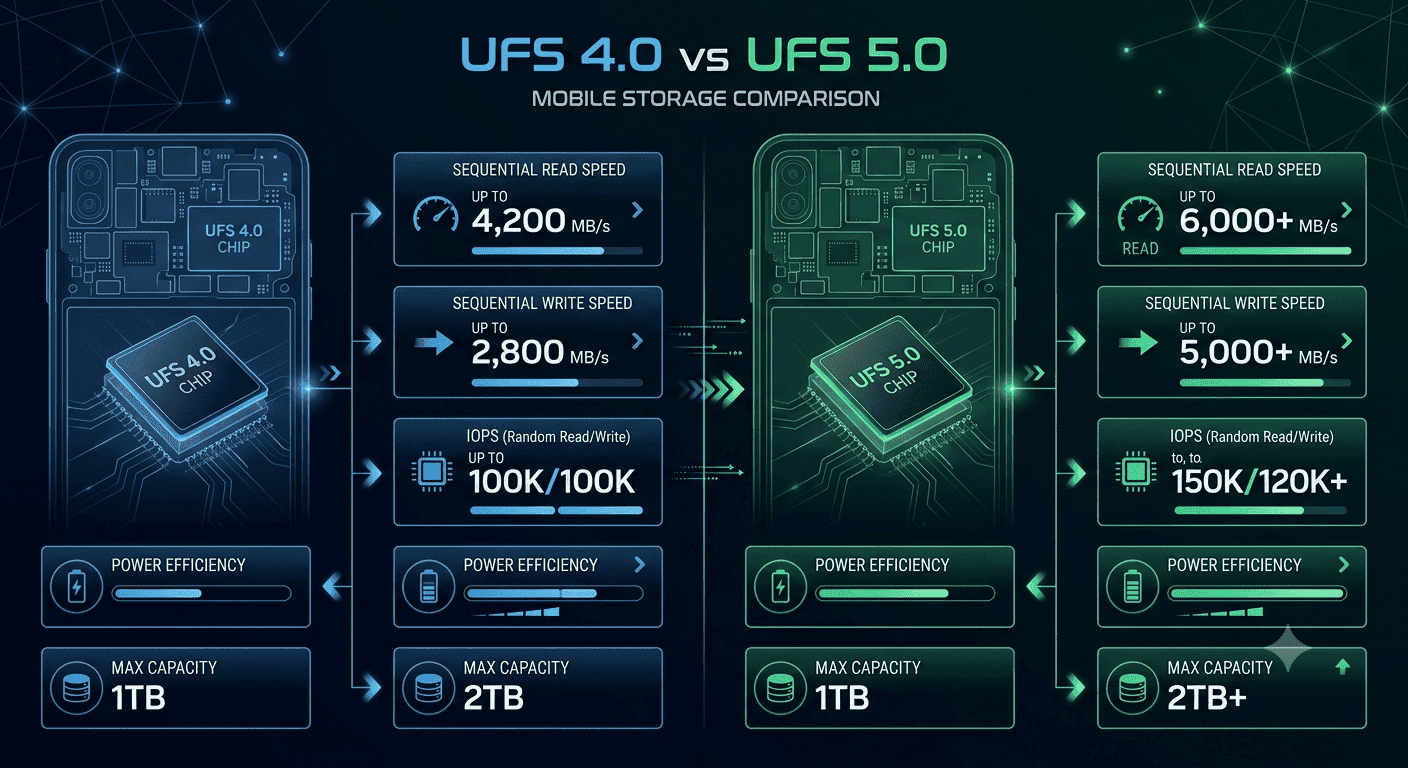
TL;DR UFS 4.0 vs UFS 5.0 comes down to immediate practicality versus future headroom. UFS 5.0 is the technical winner with up to 10.8 GB/s and 2.5 times more baseline performance, but UFS 4.0 is the better practical choice in 2026 because it is already mature, widely available, and still delivers 4.2 GB/s with 1TB support.
Overview
UFS 4.0 was published in August 2022, UFS 4.1 followed in December 2024, and UFS 5.0 was announced in February 2026. That timeline shows where each standard sits today. UFS 4.0 is the established mobile storage baseline, while UFS 5.0 is the next step manufacturers are preparing to mass-produce in 2026. Universal Flash Storage sits at the center of flash storage performance, and JEDEC defines the rules that keep that ecosystem moving. You do not notice UFS when it works well, but you feel it immediately when a device hesitates while opening a camera, loading a game, or switching between heavy apps. That is why storage standards are not abstract engineering news. They decide how fast your device can feed data to the rest of the system, and they shape what manufacturers can ship in the next generation of mobile hardware.
Why The Standard Matters
UFS is not just another storage version. It is the bridge between NAND flash and the rest of the device, and that bridge gets more important as apps grow larger and cameras capture more data. A modern flagship phone can push through photo bursts, 4K video, and large app installs in minutes, so the storage layer has to keep up. The MIPI PHY layer is part of why these standards keep advancing, and JEDEC works alongside that ecosystem to keep the specs aligned. UFS 4.0 uses MIPI M-PHY 5.0 High-Speed Gear 5, while UFS 5.0 moves to MIPI M-PHY v6.0.
That matters because the physical link carries the data signals cleanly enough for the storage stack to hit higher speeds without becoming unstable. It also affects board design, validation, and how quickly a device can move from prototype to mass production. For manufacturers, that is not a minor detail. UFS 4.0 already gives product teams a mature target with known behaviour, including for PDF workflows and other demanding tasks, while UFS 5.0 pushes the platform toward a more advanced hardware foundation. The difference is not only about speed on a spec sheet. It also changes how confidently engineers can plan the next wave of phones, tablets, and embedded devices.
Release Timeline At A Glance
UFS 4.0 arrived in August 2022 and became the reference point for modern mobile storage. UFS 4.1 landed in December 2024 and refined the standard rather than replacing it. UFS 5.0 was announced in February 2026 and is positioned for mass production later in 2026. JEDEC published the newer milestones on that schedule, which makes the rollout easier to track. The important takeaway is that UFS 4.0 is already a mature technology, while UFS 5.0 is the newest standard with a longer runway ahead.
Performance and Capacity Comparison
UFS 5.0 raises the ceiling to 10.8 GB/s, while UFS 4.0 tops out at 4.2 GB/s. That is the headline difference, and it is not subtle. UFS 5.0 also brings 2.5 times more baseline performance than UFS 4.0, which means the newer standard is not just a small tuning exercise. It is a real step change in bandwidth for flash storage and mobile storage workloads that constantly move large data blocks.
UFS 4.0 already delivers strong numbers. Samsung Semiconductor’s published figures put it at 4200 MB/s read speed and 2800 MB/s write speeds, which is why it feels fast enough for demanding phones, camera pipelines, and app installs. It also supports a maximum capacity of 1TB, which remains plenty for most users who store 4K video, offline media, and large game libraries. The key point is that UFS 4.0 is not slow. UFS 5.0 is simply much faster, and that gap becomes visible in heavier workflows.
What The Numbers Mean In Practice
The speed difference matters most when you push the storage hard, not when you open a messaging app. A device using UFS 4.0 can already handle a burst of photos in a camera workflow, but UFS 5.0 gives the controller more headroom when the device is juggling background uploads, video capture, and app switching at the same time. That extra bandwidth is what reduces the chance of the storage layer becoming the bottleneck. UFS 4.0 also improved the efficiency side of the equation.
Better efficiency means less wasted power for the same class of work, and that matters on phones where storage activity is constant. You feel that in long camera sessions, extended downloads, and repeated file writes, which would otherwise heat the device and drain the battery faster. This is where memory behavior becomes easier to notice in real use, especially on devices that rely on universal UFS storage for daily tasks.
Key Spec Comparison
| Feature | UFS 4.0 | UFS 5.0 |
|---|---|---|
| Maximum speed | 4.2 GB/s | 10.8 GB/s |
| Baseline performance | Reference level | 2.5 times higher |
| Read speed | 4200 MB/s | Higher than UFS 4.0, exact read figure not published here |
| Write speed | 2800 MB/s | Higher than UFS 4.0, exact write figure not published here |
| Maximum capacity | 1TB | Not yet finalized in the same public detail |
| Efficiency gain vs previous generation | 45% better | Not stated in the same form |
| Market maturity | Established | Emerging in 2026 |
| Typical role | Current flagship and premium devices | Next-wave premium devices |
Innovative Features and Technology Enhancements
UFS 5.0 is not only about faster transfers. That matters because storage corruption and silent data errors are not theoretical problems in flash memory systems. When data protection is stronger, the device has a better chance of keeping files consistent during heavy writes, interrupted transfers, or complex app activity. Link Equalization is the other major addition, and it exists for a very practical reason: signal stability.
As speeds rise, the electrical link becomes harder to keep clean, especially in compact hardware layouts. UFS 5.0 uses Link Equalization to stabilize data signals, while UFS 4.0 relies on a more mature but less advanced stack. For device manufacturers, that difference affects how confidently they can design thin phones, embedded systems, and boards that need high-speed flash storage without instability. It is a more controlled path to higher-speed tech and hardware.
Feature Differences That Matter
UFS 4.0 already carries useful features such as Write Booster, Deep Sleep, and Performance Throttling Notification. Write Booster helps the storage layer absorb bursts more effectively, Deep Sleep reduces power draw when the device is idle, and Performance Throttling Notification helps the system manage heat before performance drops too far. Those are not flashy marketing terms. They are the kinds of controls that keep a phone responsive during long sessions of camera use, downloads, and background syncing.
UFS 5.0 builds on that base rather than replacing it with something unrelated. It is backwards compatible with UFS 4.x hardware, which is a major advantage for manufacturers planning product lines across multiple tiers. Compatibility lowers integration risk, and that matters when a company has to support several device families at once. It means the transition to the new flash storage UFS generation can happen without forcing every product team to redesign from scratch. Samsung Semiconductor’s UFS 4.0 work also shows how much the memory side has matured before UFS 5.0 arrives. Kioxia, Micron, and SK Hynix all operate in the same broader memory ecosystem, so the move to further UFS development has a clear supply-chain context.
MIPI PHY And Hardware Compatibility
The physical layer is where the newer standard really separates itself. UFS 4.0 incorporates MIPI M-PHY 5.0 High-Speed Gear 5, while UFS 5.0 uses MIPI M-PHY v6.0 technology.
- Inline Hashing adds a data protection layer that UFS 4.0 does not emphasize in the same way.
- Link Equalization helps UFS 5.0 keep the signal stable at much higher speeds.
- UFS 5.0 remains backwards compatible with UFS 4.x hardware, which reduces adoption friction.
- UFS 4.0 already includes Write Booster, Deep Sleep, and Performance Throttling Notification for everyday stability.
- The move from MIPI M-PHY 5.0 Gear 5 to MIPI M-PHY v6.0 is the hidden hardware shift behind the newer standard.
Comparative Analysis with Previous Generations
UFS 4.0 matters not only because it is faster than UFS 3.1. It also delivers 46% more power efficiency than UFS 3.1, and it doubles data transfer speeds compared with the earlier generation. Those two changes explain why UFS 4.0 became the de facto standard for next-generation mobile and embedded storage. In a brief PDF comparison, that combination is easy to spot: it changes the feel of a phone in ways users actually notice.
Multitasking gets smoother because the storage controller can serve more requests without getting backed up, and lag drops because the system spends less time waiting on flash memory reads and writes. In a real phone, that shows up when you jump between Chrome, Gmail, Google Photos, and a camera app without the device feeling sticky. It also helps in heavier workflows, such as editing a timeline in Cap-Cut or moving large project files between apps. UFS 4.0 is not just a spec update. It is the generation that reset expectations for everyday responsiveness.
Why UFS 4.0 Became The New Baseline
Those numbers tell you that the market believes this standard has room to expand, not just survive. Growth like that usually follows a standard that solves a real bottleneck, and UFS 4.0 does exactly that for mobile storage and embedded devices. The expert view is consistent with the numbers. That is why it fits so well into premium smartphones, tablets, and compact embedded systems where every watt and every millisecond matter.
UFS 5.0 will push the ceiling higher, but UFS 4.0 is the one that already changed the baseline behaviour of the category. In a brief PDF, that is the difference between a standard that is still proving itself and one that has already changed the market. If you are comparing phones or embedded hardware in 2026, UFS 4.0 is already the mature next generation, while UFS 5.0 is the newer option that will define the following wave.
Previous Generation Comparison Points
- UFS 4.0 doubles transfer speed versus UFS 3.1, which cuts storage-side waiting in heavier tasks.
- UFS 4.0’s 46% power efficiency gain means less wasted energy during sustained use.
- UFS 5.0 builds on that foundation, but it still needs time to reach the same deployment scale.
The comparison with UFS 4.0 vs 3.0 is similar in spirit. The real story is not one isolated benchmark. It is the way each generation removes a bottleneck, then becomes the new baseline for the next round of devices. If you are comparing phones or embedded hardware in 2026, UFS 4.0 is already the mature next generation, while UFS 5.0 is the newer option that will define the following wave.
Pricing and Market Availability Outlook
Pricing and availability for UFS 4.0 vs UFS 5.0 will be shaped less by headline speed numbers and more by how quickly the ecosystem can absorb each standard. UFS 4.0 was published in August 2022, and that matters because it has had enough time to move from specification to real shipping products, with UFS 4.1 following in December 2024 as an incremental refinement. In practice, older-but-current standards usually benefit from better component sourcing, more mature validation flows, and fewer surprises during device certification.
That is why UFS 4.0 is already becoming the practical baseline for premium phones, including flagship smartphones, and some embedded designs. UFS 5.0 was announced in February 2026 and is still in the early commercial ramp. For now, that usually means wider availability and more predictable pricing for UFS 4.0, while UFS 5.0 remains the newer option for early adopters.
Which UFS Standard Makes Sense In 2026
Choose UFS 4.0 if you want a proven standard with 4.2 GB/s performance, 1TB support, and a mature rollout that already fits premium devices well. It is the safer current choice because it is already established and practical for today’s needs. The trade-off is straightforward: UFS 5.0 is the stronger forward-looking platform, while UFS 4.0 is the more immediate option.
If you need broad availability right now and do not want to wait for the 2026 production ramp, UFS 5.0 is not the right choice yet. For most buyers in 2026, UFS 4.0 remains the more practical answer. It offers the balance of maturity and performance that fits current premium devices without waiting for newer hardware to arrive. UFS 4.0 vs UFS 5.0 is really a choice between immediate maturity and newer headroom, not between good and bad storage.
Best Storage Choice
UFS 5.0 is the technical leader, with up to 10.8 GB/s and 2.5 times more baseline performance, but it is still the newer standard entering mass production later in 2026. That makes UFS 5.0 the forward-looking option and UFS 4.0 the safer practical pick for current devices. If you are buying now, UFS 4.0 gives you the most balanced mix of speed, maturity, and availability. If you are planning for the next wave of hardware, UFS 5.0 is the standard to watch.
Frequently Asked Questions
Q. What is the biggest difference between UFS 4.0 and UFS 5.0?
The biggest difference is performance headroom. UFS 5.0 reaches up to 10.8 GB/s and offers 2.5 times more baseline performance than UFS 4.0, which tops out at 4.2 GB/s. That makes UFS 5.0 the faster standard, while UFS 4.0 remains the more established one. The shift also matters for write speeds, especially in heavier camera and app workloads.
Q. Is UFS 5.0 backwards compatible with UFS 4.x hardware?
Yes, UFS 5.0 is backwards compatible with UFS 4.x hardware. That compatibility helps manufacturers adopt the newer standard without forcing every product line to start over. It also lowers integration risk during the transition. For device teams, that makes the move less disruptive.
Q. When were UFS 4.0 and UFS 5.0 announced or published?
UFS 4.0 was published in August 2022. UFS 4.1 followed in December 2024. UFS 5.0 was announced in February 2026. JEDEC tracks those releases, and the dates show how quickly the standard has moved.
Q. Does UFS 4.0 still make sense in 2026?
Yes, UFS 4.0 still makes sense in 2026 because it is already mature and widely understood by the ecosystem. It offers 4.2 GB/s speeds, 1TB support, and strong efficiency improvements. For many buyers, that combination is easier to trust than a newer standard that is still ramping up. It also has broad support from the memory supply chain, including Samsung Semiconductor, Kioxia, Micron, and SK Hynix.
Q. What new features does UFS 5.0 add?
UFS 5.0 introduces Inline Hashing for enhanced data protection and Link Equalization for stable data signals. It also moves to MIPI M-PHY v6.0 technology. Those changes are aimed at making higher-speed storage more reliable in real devices. In practical terms, they help the system maintain cleaner data during sustained writes.
Q. How does UFS 4.0 compare with UFS 3.1?
UFS 4.0 doubles data transfer speeds compared with UFS 3.1 and offers 46% more power efficiency. That is why it became the new baseline for premium mobile storage. It improves both speed and efficiency. The result is faster memory behaviour without a major battery penalty.
Is UFS 4.0 or UFS 5.0 Better for Buyers in 2026
UFS 4.0 is the better buy for most people in 2026 because it already combines 4.2 GB/s performance, 1TB support, and a mature rollout. That makes it the safer choice for premium phones and other devices that need reliable storage today. UFS 5.0 is the stronger standard on paper, with 10.8 GB/s and 2.5 times more baseline performance, but it is still entering mass production later in 2026.
Buyers who want a device they can use immediately should lean toward UFS 4.0. Buyers who care most about future-proofing and are willing to wait for the newer rollout should watch UFS 5.0. The right choice depends on whether you value proven availability or the higher ceiling of the next generation.
If you are shopping now, focus on UFS 4.0 devices and treat UFS 5.0 as the next step rather than a must-have. If you are planning a future purchase or product launch, keep UFS 5.0 on your shortlist because it sets the direction for the next wave of hardware. In either case, the comparison is less about which standard is good and more about which one matches your timing.
Ready to upgrade your tech?
Browse our collection of quality refurbished products at unbeatable prices.