The Rise of Subscription Hardware: Are Laptop and Phone Leasing Models Worth It?
Laptop and phone leasing helps businesses access current devices without large upfront costs. With plans starting from ₹849 per month, leasing offers predictable expenses, flexible scaling, maintenance support, and easier upgrades for startups, SMEs, and growing teams in 2026.

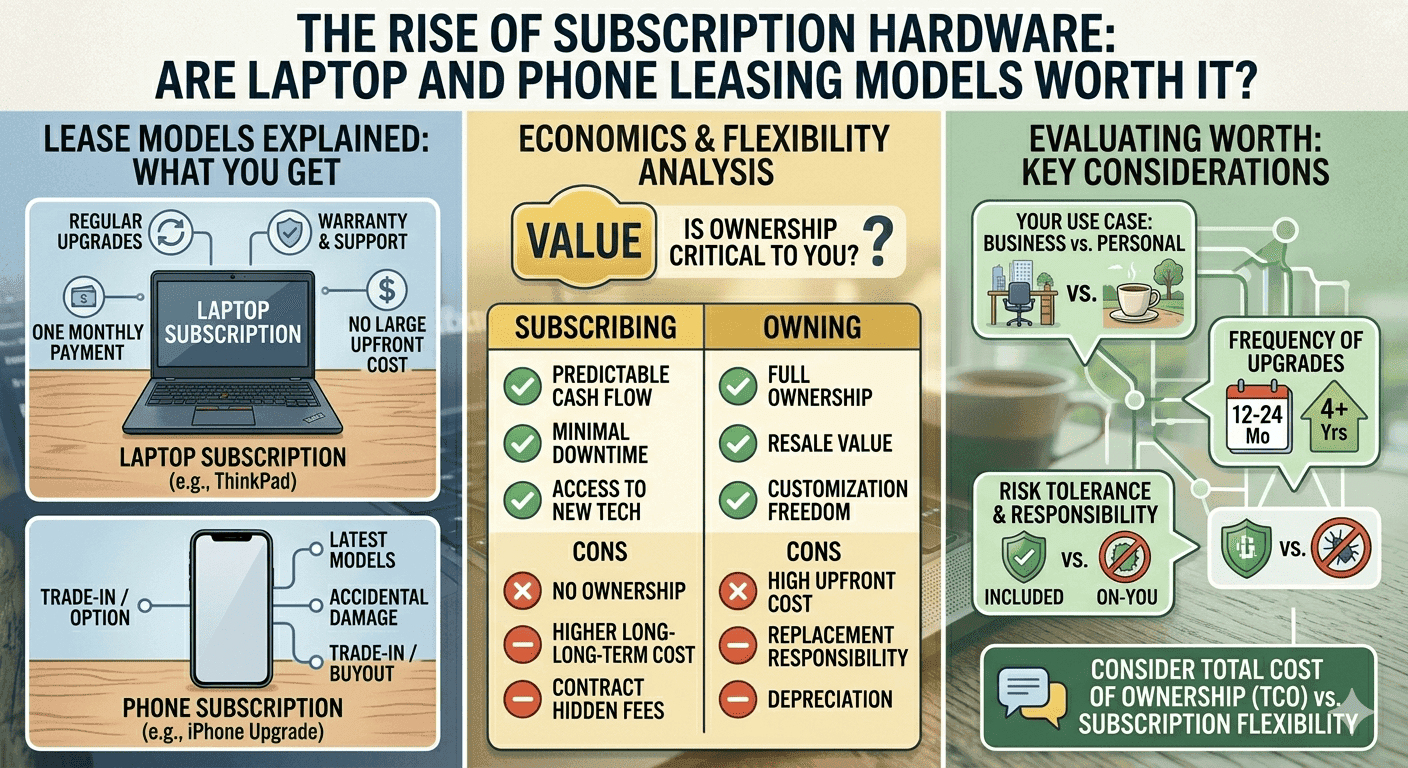
TL;DR Laptop and phone leasing helps businesses get current devices without a large upfront investment. Rentopay starts at INR 849, HP business leasing begins at INR 4,185, and the best plan depends on whether you want the lowest entry price or a more structured business tier.
Understanding Laptop and Phone Leasing Models
Laptop and phone leasing turns hardware from a capital purchase into a planned monthly cost. For businesses, that matters because it keeps cash available for payroll, software, and network upgrades instead of tying it up in equipment that starts losing value immediately. A lease is not the same as a short rental. Rental services are usually built for temporary use, while a lease follows a defined term, fixed monthly payments, and often support or upgrade options.
That structure is why many businesses in Bangalore use leasing for laptops and phones when they need predictable access, not ownership. The model also fits tech-heavy teams that need to scale quickly. A start-up opening a new office can lease devices for new hires, then refresh the fleet later without a fresh capital round.
Why the model is growing?
The market is growing because businesses want the latest technology without the upfront investment that comes with buying every device outright. That is especially true for start-ups, SMEs, and Gen-Z professionals in India, where mobility and short planning cycles are common. Phones are now work tools as much as personal devices.
Leasing provides that access while keeping monthly costs easier to plan. The broader trend is not just about price. It is about flexible access, predictable delivery, and fewer surprises when a team needs to scale. In Bangalore, that combination is often more useful than chasing the cheapest purchase price.
What businesses actually get?
Businesses are not only leasing a device. They are leasing a process that can include maintenance, upgrades, and replacement support. That makes the model more useful for companies that want to standardize laptops and phones across departments. Fixed payments also help finance teams.
A known lease cost is easier to fold into monthly planning than a one-time purchase, especially when headcount changes often. For companies managing multiple devices, that predictability is a real operational advantage. The best leasing solutions also reduce internal IT pressure. When support is included, a broken laptop or phone does not become a long ticket queue.
- Businesses can lease laptops, phones, and desktops without a large purchase cycle.
- Flexible terms make it easier to scale hiring in Bangalore and other fast-moving markets.
- Support and maintenance can be bundled into the monthly rental, which helps IT teams.
- Delivery of replacement devices can be faster than managing a full repurchase.
Key Factors to Consider When Choosing Leasing Options
The monthly number is only part of the decision. A lease that looks cheap can become awkward if the term is rigid, the support is weak, or the hardware class does not match the workload. Start with the contract structure, then look at performance and support. You should also check how flexible the plan is when your team changes.
The right choice should provide room to grow without forcing a new purchase every time headcount shifts. Lease term matters because it shapes how well the plan fits your operating rhythm and infrastructure. A short term works for project teams and temporary staff, while monthly leasing can be easier to align with changing staffing needs.
Lease term and flexibility
HP Business Leasing offers laptops for leasing on a case-by-case basis for up to 36 months. Lenovo’s pay for use model takes a different path with customized structure-based leasing options, which can suit businesses with seasonal demand or project-based staffing. That flexibility is useful when your team changes quickly.
A lease that fits one project should still make sense when the next project starts. In Bangalore, where hiring can move fast, that flexibility is often worth more than a slightly lower headline payment. The better leasing services also provide clearer upgrade paths, helping businesses avoid getting stuck with older devices when a team’s needs change mid-contract.
Performance and device fit
Processor choice matters because it determines how long the laptop stays useful for daily work. Rentopay provides laptops with processors ranging from Intel i3 to i9 and MacBook models with M2, M3, and M4 chips, so the lineup covers everything from basic office work to heavier creative and development tasks.
That range matters in real use. A support team working in Chrome, Outlook, and Excel does not need the same machine as a design team in Adobe Creative Cloud or a developer in VS Code. Matching the device to the workload is the easiest way to keep the lease cost sensible. Memory and storage matter too.
A machine with 16GB RAM and SSD storage will feel much faster when you move between Slack, Teams, and a browser with many tabs open.
Support, maintenance, and upgrades
Leasing models often include options for upgrades and maintenance support, which means the business is not left handling every fault alone. Most laptop leasing plans also come with technical support and regular updates. That service layer is especially useful for companies that rely on uptime.
A reliable service plan and quick delivery of replacements can keep that disruption short. It also helps when businesses want to provide the same hardware standard across teams. A structured rental process can make it easier to keep laptops, phones, and desktops aligned without a large equipment refresh.
Comparing Popular Laptop Leasing Options and Specifications
The most useful way to compare leasing options is to look at what you get for the monthly payment. Rentopay starts at INR 849, HP’s business models sit in the mid-range from INR 4,185 to INR 5,703, and a high-performance Dell laptop that costs INR 80,000 to buy outright may be available at INR 2,500 per month on lease. That spread shows why leasing can be cost-effective.
A company can keep the upfront investment low, then choose a device class that fits the role instead of paying for features nobody uses. HP’s line-up is more structured. The HP EliteBook 840 14-inch G10 Notebook PC is available from INR 4,185 per month, the HP Elite x360 1040 14-inch G10 2-in-1 Notebook PC starts at INR 4,448 per month, and the HP ZBook Power 15.6-inch G10 Mobile Workstation PC starts at INR 5,703 per month.
For businesses comparing Windows Pro devices, that tiering makes it easier to match the lease to the job. The EliteBook tier is a straightforward business laptop, the Elite x360 adds convertible flexibility, and the ZBook is aimed at heavier workloads.
Rentopay versus HP leasing
Rentopay offers the widest spread of configurations, which makes it easier to match devices to different teams. That flexibility helps when one business unit needs basic productivity hardware and another needs higher-performance machines. HP’s leasing line-up is more defined, which can make planning simpler for businesses that want clear tiers.
For Bangalore businesses, that contrast matters. Rentopay gives more room to request the right equipment for each role, while HP gives a cleaner structure when procurement wants consistent business classes.
What do the specs mean in practice?
A business laptop is not just about the processor label. It is about how the machine fits into the work your team actually does in Windows, Chrome, and Microsoft 365. The EliteBook tier is appropriate for everyday office tasks, browser-heavy work, and general productivity.
The Elite x360 adds 2-in-1 flexibility, which helps for presentations, note-taking, and teams that want a convertible display for client meetings. The ZBook is aimed at users who need more serious workstation capacity. For teams standardizing on Windows Pro, the main question is whether the device matches the workload, not just the spec sheet.
Premium leasing alternative
The Dell example shows that premium hardware does not always require a premium monthly outlay. A laptop that costs INR 80,000 to buy outright may be available at INR 2,500 per month on lease, which makes the device much easier to fit into a monthly budget. It also shows leasing solutions can provide access to cutting edge hardware without forcing a large purchase decision.
| Model | Monthly Lease | Class | Best For |
|---|---|---|---|
| HP EliteBook 840 G10 | INR 4,185 | Business laptop | Standard office use |
| HP Elite x360 1040 G10 | INR 4,448 | 2-in-1 business laptop | Flexible presentations |
| HP ZBook Power G10 | INR 5,703 | Mobile workstation | Demanding workloads |
| Dell high-performance option | INR 2,500 | Premium laptop | Cost-conscious performance |
- Rentopay is the better fit when businesses need a wide range of device choices.
- HP is stronger when procurement wants clear business tiers.
- The Dell option suits teams that want premium performance at a short monthly commitment.
- The x360 is the most flexible pick if presentations and note-taking matter.
Cost Analysis and Pricing Tiers for Leasing Solutions
Leasing changes the timing of costs more than the existence of costs. Instead of paying the full amount upfront, businesses spread hardware expenses across monthly payments, which helps protect cash flow and makes planning easier. That is one reason the model has become appealing to start-ups and SMEs.
It lets them access the latest devices without a heavy upfront investment, and it keeps the lease cost visible from month to month. At the entry level, Rentopay offers laptops starting at INR 849 per month. That is the most affordable option in the fact set and is useful for teams that need basic access to devices without committing a large amount of cash.
Budget tier analysis
Rentopay’s starting point at INR 849 per month is the clearest budget option. It works well for interns, temporary staff, field teams, and short projects where the business needs access more than ownership. The real benefit is working capital preservation.
A lower rental can be easier to absorb than a purchase order, especially for businesses with uneven revenue or rapid hiring plans. It also keeps the hardware decision separate from other costs like payroll, software subscriptions, and storage tools. For Bangalore start-ups, that separation can be the difference between waiting to buy and getting devices into users’ hands now.
Mid-range business pricing
The HP models sit in a more structured mid-range. The EliteBook is the straightforward business choice, the Elite x360 adds convertible flexibility, and the ZBook is positioned for more demanding work. For companies that need stable devices for daily use, paying more for a workstation they will not fully use is usually inefficient.
A better approach is to align the monthly lease with the actual workload and the role. That is where flexible leasing helps.
Premium value at a lower monthly outlay
The Dell example shows that premium equipment can still be managed through monthly rental services. A laptop that costs INR 80,000 to buy outright may be available at INR 2,500 per month on lease. That matters for businesses that want performance without a large upfront commitment.
For Bangalore companies comparing vendors, this is often the most practical route. It keeps the monthly cost predictable while still giving access to leading brands and higher-spec devices.
- Budget leasing is cost-effective when the goal is to equip more users quickly.
- Premium monthly plans can still be cheaper than buying a high-end laptop outright.
- Flexible payment structures help businesses scale without a large capital hit.
Laptop and Phone Leasing in Practice
The biggest advantage of the hardware model is that it helps businesses scale without locking money into equipment. That matters when headcount is moving fast and cash has to stay available for operations. Equipment leasing also gives businesses access to the latest technology without the delays that come with a full purchase cycle.
For many companies, that is more useful than owning devices that age quickly. The phone side is moving in the same direction. Leasing your next phone may save you 30 to 40 percent on high-end phones with zero upfront costs, and RentoMojo allows customers to lease phones at 60% of market value.
Cash flow and budget control
Fixed monthly payments make budgeting easier. A company can plan around a known lease cost instead of dealing with a large upfront investment that hits the budget all at once. That predictability matters for businesses with seasonal hiring or uneven revenue.
It also helps finance teams keep hardware separate from other expenses, which makes monthly reporting cleaner. For Bangalore businesses in particular, that can make procurement less painful. A lease gives them a clear cost structure while still leaving room to add more devices as the team grows.
Mobility and team deployment
Leasing is useful when businesses need to provide laptops and phones to employees in different locations. A sales team on the road, a support team in a call center, and a remote engineering team all need dependable devices. That is where delivery speed becomes important.
If a new hire starts on Monday, the device needs to arrive on time and in working order. Good rental services and support can keep that process short. It also helps businesses standardize on the same hardware class across teams. That makes onboarding easier and reduces the number of device types IT has to support.
Support and maintenance relief
Leasing can reduce maintenance headaches because support is often included. It also helps teams stay focused on work instead of hardware issues. For companies that depend on uptime, that support layer is not a bonus.
It is part of the value of the lease itself.
- Leasing helps businesses scale operations without a large purchase cycle.
- It gives teams access to current laptops and phones with less upfront cost.
- Support services can reduce the burden on internal IT.
- Delivery of replacement devices can keep downtime short.
Why Leasing Fits Bangalore?
Leasing is gaining momentum among start-ups and SMEs in Bangalore because flexibility matters more than ownership in many early-stage teams. Bangalore also has a dense mix of software companies, service firms, and field teams, so the need for different device types is constant. One business may need lightweight laptops for account managers, while another needs desktops for back-office work.
Bangalore businesses often need to scale fast. A lease lets them add laptops, phones, and desktops as the team grows, then adjust later if headcount changes. That flexibility is especially helpful for start-ups that are still testing hiring plans. Instead of buying hardware too early, they can rent devices and keep the balance sheet cleaner.
Matching Devices to the Work
It also works for established businesses that open project teams on short notice. That includes companies that run on monthly budgets, short project cycles, or fast hiring plans. It is also useful when the hardware role is clear.
For Bangalore companies, that is often the real win. They get the right devices in the right hands without turning procurement into a long capital project. Teams can also match device needs more closely, whether that means an i5 for everyday work or an i7 for heavier use.
- Bangalore businesses use leasing to scale teams faster.
- Flexible plans help when hiring is short-term or project-based.
- Delivery and support matter when new staff need devices immediately.
- Rental services are useful when the company wants predictable monthly planning.
Rentopay starts at INR 849, while HP business leases begin at INR 4,185, so the right choice depends on whether you need the lowest entry price or a more structured business tier. Rentopay can offer more variety, while HP can offer clearer business tiers. The Dell lease example suits teams that need premium performance at a manageable monthly cost. The HP x360 is the most flexible option if you want a 2-in-1 form factor. Lenovo can offer clearer frameworks that may be easier to manage over time.
Frequently Asked Questions
Q. Is laptop and phone leasing better than buying outright?
Leasing is better when a business wants lower upfront costs, predictable monthly payments, and easier device refresh cycles. Buying outright still makes sense if the company wants full ownership and does not need frequent upgrades. The better choice depends on cash flow, device turnover, and how short your planning cycle is.
Q. What is the cheapest leasing option in the fact set?
Rentopay offers laptops starting at INR 849 per month, which is the lowest starting price listed here. That makes it the most affordable entry point for businesses that want to keep monthly commitments low. It is especially useful when the priority is broad access rather than premium hardware.
Q. Which HP laptop leasing options are listed here?
The HP EliteBook 840 14-inch G10 Notebook PC, the HP Elite x360 1040 14-inch G10 2-in-1 Notebook PC, and the HP ZBook Power 15.6-inch G10 Mobile Workstation PC are all included. Their monthly lease prices are INR 4,185, INR 4,448, and INR 5,703, respectively. These options cover standard office work, flexible presentations, and heavier workstation needs.
Q. How should a business choose the right lease term?
The lease term should match the company’s operating rhythm, staffing plans, and refresh cycle. HP Business Leasing offers laptops for leasing on a case-by-case basis for up to 36 months, while Lenovo’s pay-for-use model adds customized structure-based leasing options. A stable team may prefer a simpler term, while a fast-growing team may need more flexibility.
Q. What specs matter most when comparing leasing options?
Processor class, RAM, storage, and device form factor matter most because they shape how useful the machine will be over time. A 16GB RAM laptop with SSD storage will usually feel better for multitasking than a weaker build. For some teams, that means a lightweight laptop, while others need a pro workstation for heavier tech work.
Q. Do leasing plans usually include support and upgrades?
Many leasing models include options for upgrades and maintenance support, and most laptop leasing plans come with technical support and regular updates. That can reduce the burden on internal IT teams and make monthly costs easier to plan. It is still important to confirm what is included before signing a contract.
Which Leasing Option Fits Your Team Best?
Rentopay works well for businesses that need to match different hardware levels to different roles without overcommitting to one device class. The broad processor range from Intel i3 to i9, plus MacBook models with M2, M3, and M4 chips, gives businesses room to scale when leasing laptops. HP is the better fit when you want clearly defined business tiers.
The HP EliteBook 840 14-inch G10 Notebook PC at INR 4,185, the HP Elite x360 1040 14-inch G10 2-in-1 Notebook PC at INR 4,448, and the HP ZBook Power 15.6-inch G10 Mobile Workstation PC at INR 5,703 give procurement teams a cleaner way to map devices to roles. A laptop that costs INR 80,000 to buy outright may be available at INR 2,500 per month on lease, which is useful when a business wants performance without the upfront cost.
For most businesses in Bangalore, the best choice is the one that matches the actual workload, not the flashiest spec sheet. If you want a cleaner business structure, HP is easier to manage, and both can provide a cost-effective path to current devices by leasing laptops without the upfront burden of buying everything outright.
Is Laptop and Phone Leasing Worth It for 2026?
Laptop and phone leasing in 2026 is less about ownership and more about keeping teams equipped without tying up cash. The pricing range shows why: Rentopay starts at INR 849, HP business leasing begins at INR 4,185, and a Dell high-performance option may be available at INR 2,500 per month even when the device costs INR 80,000 to buy outright.
That spread gives businesses room to choose between budget access, structured business tiers, and premium performance. For Bangalore teams in particular, the combination of predictable monthly payments, support, and faster device replacement can make leasing more practical than buying.
Businesses should buy the plan that matches their workload, not the one with the biggest spec sheet. Rentopay suits teams that want a lower entry point and greater variety, while HP suits companies that want clearer business tiers. If your team needs current devices, predictable costs, and room to scale, this is a practical time to choose a lease and move forward.