Sony ZV-E10 vs A6400: Which Is the Better Content Creator Camera?
The Sony ZV-E10 and A6400 share a 24.2MP APS-C sensor and strong autofocus, but they are designed for different users. The ZV-E10 favors creators and vloggers, while the A6400 is better suited to hybrid photography and video.

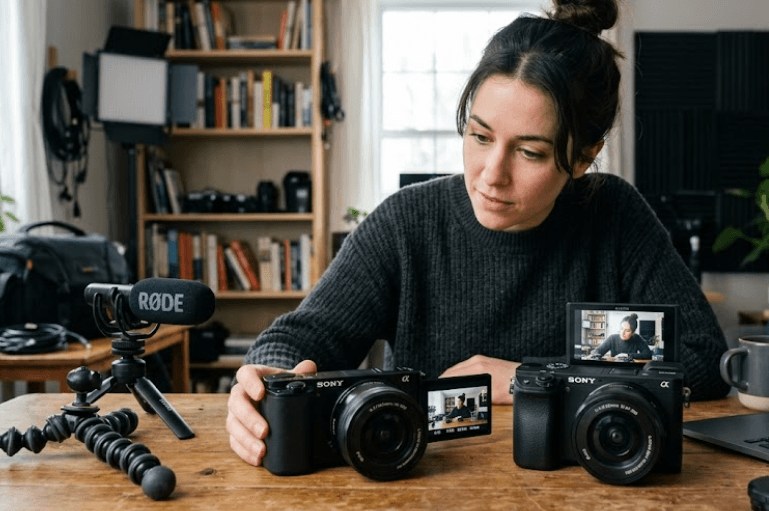
TL;DR The Sony ZV-E10 is the better content creator camera if your priority is vlogging, talking-head videos, product demonstrations, and easy audio monitoring. It has a fully articulating screen, dedicated creator-focused controls, a built-in directional microphone, and both microphone and headphone ports. The Sony A6400 is the better choice for creators who also take photography seriously because it adds an electronic viewfinder, built-in flash, stronger stills-oriented handling, and a more traditional camera design. Both use a 24.2MP APS-C sensor, Sony E-mount lenses, 11fps continuous shooting, and advanced autofocus, so the decision is less about image quality and more about how you plan to create content.
Sony ZV-E10 vs A6400: What Is Different?
The Sony ZV-E10 and Sony A6400 may look like two versions of the same camera at first glance, but their design priorities are quite different. Both cameras use a 24.2MP APS-C sensor and Sony E-mount, which means they can use the same wide range of interchangeable lenses. Both also offer 4K video recording and Sony's highly capable autofocus system, so neither camera is a poor choice for image quality or focusing. The biggest difference is how each body is built around the person using it. The ZV-E10 was designed specifically with vloggers and video creators in mind, while the A6400 is a more traditional hybrid mirrorless camera intended to handle both photography and video.
That difference becomes obvious as soon as you look at the screens and controls. The ZV-E10 has a fully articulating 3-inch touchscreen that can face forward, which is particularly useful when you are recording yourself without another person behind the camera. The A6400 also has a screen that flips upward by 180 degrees, but it uses a tilting mechanism rather than the ZV-E10's fully articulating design. More importantly, the A6400 has a 2.36-million-dot electronic viewfinder, while the ZV-E10 does not have an electronic viewfinder at all. For someone who photographs outdoors frequently, the A6400's viewfinder can be a significant advantage because it gives you a more traditional way to compose images in bright sunlight.
The ZV-E10 also takes a more creator-focused approach to audio. It includes a built-in directional three-capsule microphone and provides both a 3.5mm microphone input and a 3.5mm headphone output, allowing creators to connect an external microphone and monitor sound while recording. The A6400 has a 3.5mm microphone input but does not include a headphone output. That distinction may seem minor if you mainly take photos, but it becomes much more important when you are recording interviews, tutorials, podcasts, or YouTube videos where monitoring the audio can help catch problems before you finish recording.
Core Specifications Compared
| Feature | Sony ZV-E10 | Sony A6400 |
|---|---|---|
| Sensor | 24.2MP APS-C CMOS | 24.2MP APS-C CMOS |
| Lens Mount | Sony E-mount | Sony E-mount |
| Maximum Video | 4K/30p | 4K/30p |
| Electronic Viewfinder | No | Yes, 2.36M dots |
| Rear Screen | Fully articulating touchscreen | Tilting touchscreen |
| Microphone Input | Yes | Yes |
| Headphone Output | Yes | No |
| Built-In Flash | No | Yes |
| In-Body Stabilization | No | No |
| Continuous Shooting | Up to 11fps | Up to 11fps |
| Battery Rating | Approx. 440 shots | Approx. 410 shots |
The core specifications show why these cameras appeal to different buyers. The ZV-E10 is not simply a cheaper A6400 with fewer features. Its missing viewfinder and flash make sense when you consider that Sony designed the camera around video creators who are more likely to use the rear screen, an external microphone, and a tripod or handheld rig. The A6400, meanwhile, retains features that photographers expect from a conventional mirrorless camera.
Video Performance for Content Creators
Video is where the Sony ZV-E10 makes its strongest case. The camera records 4K video using an oversampled image from the APS-C sensor, and its autofocus is well suited to keeping people in focus during recording. Sony also added creator-friendly features such as Product Showcase, which can help the camera shift focus toward an object placed in front of the lens. That is particularly useful for YouTubers reviewing gadgets, beauty products, food, or other objects where you repeatedly move something toward the camera. The fully articulating screen also makes framing yourself easier when shooting alone.
The A6400 is no slouch for video, though. It also records 4K video and uses a strong autofocus system that was highly regarded when the camera launched. Its 4K recording can be detailed, and the camera has a 180-degree upward-tilting screen that works for self-recording. However, the A6400 does not offer the same creator-oriented audio setup as the ZV-E10 because there is no headphone output. It also lacks in-body image stabilization, meaning creators who want smoother handheld footage may need to rely on stabilized lenses, a tripod, or additional stabilization methods.
There is one important limitation that should not be ignored when choosing either camera for video. Both cameras can experience rolling shutter during fast movement, and the ZV-E10's 4K footage can show a noticeable "jello" effect when the camera moves quickly. The ZV-E10 also applies a crop when recording 4K at 30p, while 4K/24p uses the full sensor width. This means creators who frequently walk while filming or use very fast camera movements should not assume that either camera will deliver perfectly stable footage straight from the body. A wide lens, stabilized lens, tripod, gimbal, or other support can make a meaningful difference.
Which Camera Is Better for YouTube?
For YouTube creators who primarily shoot talking-head videos, tutorials, product reviews, or desk-based content, the ZV-E10 is the more convenient option. Its front-facing articulating screen lets you see your composition, while its microphone and headphone connections make it easier to build a proper audio setup. The camera's autofocus is also capable of tracking faces and eyes reliably, which reduces the need to constantly check whether you are in focus.
The A6400 makes more sense for creators whose work regularly moves between video and photography. Its electronic viewfinder becomes valuable when you are shooting stills outdoors, while its traditional camera controls are better suited to someone who wants direct access to photographic settings. The A6400 also has a built-in flash, which gives photographers another option when shooting portraits or casual indoor images.
| Content Type | Better Choice |
|---|---|
| YouTube talking-head videos | Sony ZV-E10 |
| Product reviews | Sony ZV-E10 |
| Vlogging | Sony ZV-E10 |
| Interviews | Sony ZV-E10 |
| Photography | Sony A6400 |
| Outdoor photography | Sony A6400 |
| Hybrid photo and video use | Sony A6400 |
| Beginner content creation | Sony ZV-E10 |
Autofocus and Image Quality
Autofocus is one area where the difference between these two cameras is smaller than you might expect. Both use Sony's highly capable hybrid autofocus system, with 425 phase-detection autofocus points covering a large portion of the sensor. The ZV-E10's autofocus performance for stills and video was found to be effectively comparable to the A6400, including reliable face and eye detection. That means you are not giving up Sony's major autofocus advantage simply because you choose the creator-oriented ZV-E10.
Image quality is similarly close because both cameras use a 24.2MP APS-C sensor. With the same or comparable E-mount lens, neither camera suddenly produces dramatically better still images simply because of the model name. Lens selection, lighting, exposure, shooting technique, and post-processing will have a much larger effect on the final image. The A6400 does have an advantage for photographers because the electronic viewfinder gives you another way to compose and review a scene, particularly when the rear display is difficult to see in strong sunlight.
For content creators, the ZV-E10's advantage is therefore less about having a superior sensor and more about making the process of recording easier. You can flip the screen toward yourself, connect a microphone, monitor your audio through headphones, and use creator-focused features without building as traditional a photographic setup. The A6400 gives you a more conventional shooting experience, which can be preferable if photography is just as important as video. In other words, the cameras are closer in output than they are in shooting experience.
Autofocus and Shooting Features
| Feature | Sony ZV-E10 | Sony A6400 |
|---|---|---|
| Effective Resolution | 24.2MP | 24.2MP |
| Autofocus | Hybrid AF | Hybrid AF |
| Phase Detection Points | 425 | 425 |
| Eye AF | Yes | Yes |
| Real-Time Tracking | Yes | Yes |
| Maximum Burst Rate | 11fps | 11fps |
| Sensor Size | APS-C | APS-C |
The important takeaway is that the ZV-E10 is not a camera that sacrifices autofocus to become a vlogging camera. It retains the fast focusing system that makes Sony's APS-C cameras attractive for moving subjects and people. The A6400 remains highly capable as well, particularly for photographers who want fast tracking and continuous shooting.
Design, Handling, and Everyday Use
The ZV-E10 is designed to be approachable for creators who may not want a traditional camera interface. Its body is compact and relatively light, and the fully articulating screen is useful when the camera is mounted on a tripod, handheld grip, or small creator setup. The dedicated video-oriented controls also make sense when your primary goal is recording rather than changing photographic settings quickly. Its design feels more like a camera built around the creator standing in front of it than a conventional stills camera adapted for video.
The A6400 has a more traditional mirrorless-camera layout and adds features that photographers are likely to appreciate. The electronic viewfinder is probably the most important difference for everyday still photography. It allows you to bring the camera to your eye and compose without relying entirely on the rear display. The A6400 also includes a built-in flash, which the ZV-E10 does not. These features do not necessarily make it better for video, but they make the A6400 more versatile as a general-purpose camera.
Neither camera has sensor-shift in-body image stabilization, so this is not an area where one model has a major advantage over the other. If you intend to shoot handheld video while walking, stabilization should be part of your lens and accessory planning rather than something you expect the camera body to provide. Sony's OSS lenses can help, while a tripod or gimbal may be more appropriate for creators who regularly move while recording.
Battery and Connectivity
Battery life is reasonably close between the two models. The ZV-E10 is rated for approximately 440 shots using its rear LCD, while the A6400 is rated for approximately 410 shots under CIPA testing. The difference is useful but not large enough to determine the purchase by itself. For long recording sessions, carrying a spare battery or using external power is a more practical solution than choosing one camera solely because of its CIPA rating.
Audio connectivity is a much more meaningful difference for creators. The ZV-E10 includes both a microphone input and headphone output, which allows you to connect an external microphone and listen to the recorded audio. The A6400 has a microphone input but no headphone jack, making the ZV-E10 better equipped for creators who want to take audio recording seriously without adding an external monitoring solution.
For everyday content creation, that difference can save time. If you record an interview and discover afterward that your microphone was too quiet, distorted, or disconnected, the footage may be difficult to use. Headphone monitoring does not guarantee perfect audio, but it gives you an opportunity to identify obvious problems while you are still recording. That makes the ZV-E10 particularly appealing to solo creators and small production setups where there may not be a dedicated person monitoring the camera and sound.
Sony ZV-E10 vs A6400: Which Offers Better Value?
Value depends heavily on what you expect the camera to do. The ZV-E10 gives you features that directly address common content creation problems, particularly self-framing and audio monitoring. If your primary output is YouTube videos, social media content, product demonstrations, tutorials, or vlogs, those features can be more useful than an electronic viewfinder. You are effectively paying for a camera designed around the workflow of recording yourself rather than simply buying a small mirrorless body and adapting it for video.
The A6400 offers better value for someone who wants a genuinely hybrid camera. Its viewfinder, built-in flash, traditional body design, fast autofocus, 11fps burst shooting, and strong image quality make it a more natural fit for photography. It can still produce high-quality 4K video, so choosing the A6400 does not mean giving up video. Instead, you are choosing a camera that divides its strengths more evenly between still photography and video.
Price should also be considered carefully when buying either camera in 2026 because these are older models and actual retail pricing can vary considerably depending on stock, kit lens bundles, refurbished availability, and promotions. Rather than assuming that one is automatically better value based on its original positioning, compare the current body or kit price and then decide whether you will actually use the features that separate the two. If you are buying primarily for video, the ZV-E10's creator-oriented features are easier to justify. If you will spend a significant amount of time taking still photographs, the A6400's viewfinder and traditional controls may be worth prioritizing.
Which Camera Should Content Creators Choose?
The Sony ZV-E10 is the better choice for most creators whose primary goal is video. Its fully articulating screen, dedicated creator features, built-in directional microphone, microphone input, headphone output, and strong autofocus make it easier to use for solo content production. The camera is particularly well suited to creators who record themselves, because the screen can face forward and the autofocus can keep faces and eyes sharp without requiring constant manual intervention.
The Sony A6400 becomes the stronger option when photography is an important part of the workflow. The electronic viewfinder makes outdoor photography easier, while the built-in flash and more traditional camera design make it feel more like a conventional mirrorless camera. Its autofocus, 24.2MP APS-C sensor, 11fps burst shooting, and 4K video capabilities also mean it remains a capable hybrid camera rather than an outdated option simply because it was designed earlier than the ZV-E10.
The biggest mistake would be choosing between them based only on the sensor resolution. Both cameras use a 24.2MP APS-C sensor, so the real difference is the experience they provide around that sensor. The ZV-E10 prioritizes video creation and ease of self-recording, while the A6400 prioritizes versatility between photography and video. For a creator buying a first interchangeable-lens camera primarily for YouTube, vlogging, or product content, the ZV-E10 is the more logical starting point. For a photographer who also wants reliable video, the A6400 remains the better-balanced choice.
Frequently Asked Questions
Q. Is the Sony ZV-E10 better than the A6400 for video?
The Sony ZV-E10 is generally better suited to content creators because it has a fully articulating screen, headphone output, built-in directional microphone, and creator-focused video features. Both cameras record 4K video and have strong autofocus.
Q. Does the Sony A6400 have better image quality than the ZV-E10?
Not inherently. Both cameras use a 24.2MP APS-C sensor, so image quality is broadly comparable. Lens choice, lighting, exposure, and shooting technique will have a greater impact on the final image than the difference between these two bodies.
Q. Does the Sony ZV-E10 have an electronic viewfinder?
No. The ZV-E10 does not have an electronic viewfinder and is designed around its rear articulating touchscreen. The A6400 has a 2.36-million-dot electronic viewfinder, making it more suitable for photographers who prefer composing through a viewfinder.
Q. Does the Sony A6400 have a headphone jack?
No. The A6400 has a microphone input but does not have a headphone output. The ZV-E10 has both microphone and headphone connections, which gives it an advantage for creators who need to monitor audio while recording.
Q. Does the Sony ZV-E10 have image stabilization?
The ZV-E10 does not have sensor-shift in-body image stabilization. It offers electronic stabilization for video, while compatible Sony lenses with optical stabilization can provide additional stabilization.
Q. Does the Sony A6400 have image stabilization?
No. The A6400 does not have in-body image stabilization. Stabilization therefore depends on the lens or external equipment such as a tripod or gimbal.
Q. Which camera is better for vlogging, the ZV-E10 or A6400?
The ZV-E10 is the better choice for vlogging because its fully articulating screen, creator-focused controls, built-in directional microphone, and headphone output are particularly useful when recording yourself. Its autofocus also works well for faces and eyes.
Q. Which camera is better for photography, the Sony ZV-E10 or A6400?
The A6400 is the better choice for photography because it has an electronic viewfinder, built-in flash, and a more traditional stills-oriented design. Both cameras share a 24.2MP APS-C sensor and can shoot at up to 11fps, so the main advantage comes from the A6400's shooting experience rather than a fundamentally different sensor.
Q. Can the Sony ZV-E10 shoot 4K video?
Yes. The ZV-E10 can record 4K video up to 30 frames per second. Its 4K/24p mode uses the full sensor width, while 4K/30p introduces a crop. Fast camera movement can also produce noticeable rolling shutter.
Q. Which should beginners buy, the Sony ZV-E10 or A6400?
For beginners focused mainly on YouTube, vlogging, and social media video, the ZV-E10 is easier to recommend because its design and features are centered around content creation. Beginners who want to learn photography as seriously as video may prefer the A6400 because its electronic viewfinder and traditional controls make it a more versatile hybrid camera.
Final Recommendation
The Sony ZV-E10 is the better content creator camera if video is your main priority. Its fully articulating screen, creator-focused design, built-in directional microphone, headphone monitoring, and reliable autofocus make it particularly well suited to vloggers, YouTubers, product reviewers, and solo creators. It does not have an electronic viewfinder or in-body stabilization, but those omissions make more sense when you consider the camera's intended audience and workflow.
The Sony A6400 is the better hybrid camera. Its 24.2MP APS-C sensor, strong autofocus, 11fps continuous shooting, 4K video, electronic viewfinder, and built-in flash make it a better fit for someone who expects to photograph as much as they record. It is especially appealing if you regularly shoot outdoors or want a more traditional mirrorless-camera experience.
For a creator choosing between the two in 2026, the decision should therefore come down to the type of work you actually do. Choose the ZV-E10 for video-first content creation, especially vlogging and talking-head work. Choose the A6400 if you want one camera that gives photography equal importance. Neither camera wins because of a dramatically better sensor. The ZV-E10 wins on creator convenience, while the A6400 wins on photographic versatility.