
Sony A7-Series Buying/Renting Guide: III vs IV vs R IV Explained
The Sony A7 III, A7 IV, and A7R IV remain strong full-frame options in 2026. This guide compares their resolution, autofocus, video, handling, and value to help you decide which camera to buy or rent.

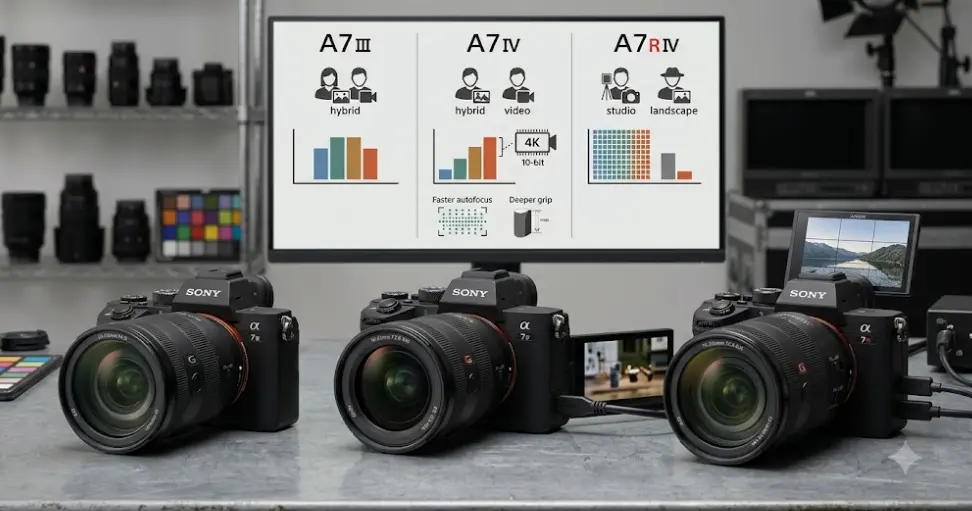
TL;DR The Sony A7 III, A7 IV, and A7R IV are all full-frame E-mount mirrorless cameras, but they are designed with different priorities. The A7 III remains a capable all-rounder with a 24.2MP sensor and 4K video, while the A7 IV moves the series forward with a 33MP sensor, improved autofocus, a fully articulating screen, and 10-bit video capabilities. The A7R IV is the resolution specialist, offering a 61MP sensor that is particularly useful for commercial photography, landscapes, studio work, and situations where extensive cropping is important. For most buyers looking for one camera for both photography and video, the A7 IV is the most balanced choice. The A7 III makes more sense when a lower purchase or rental cost is the priority, while the A7R IV is worth considering when maximum still-image resolution matters more than advanced video features.
Understanding The Sony A7-Series
The Sony A7-series helped establish full-frame mirrorless cameras as practical alternatives to traditional DSLR systems, and the A7 III, A7 IV, and A7R IV show how the line-up evolved in different directions. All three cameras use Sony's E-mount and full-frame sensors, but their specifications are not simply a case of newer being better. The A7 III was introduced as a well-rounded full-frame model with a 24.2MP sensor, while the A7 IV increased resolution to 33MP and added a more modern processor and video feature set. The A7R IV takes a different approach by using a 61MP full-frame sensor, making it the most resolution-focused camera of the three.
The distinction becomes important when you are deciding whether to buy or rent. A photographer shooting weddings, portraits, travel, or general-purpose content may not benefit enough from 61MP to justify choosing the A7R IV over the A7 IV. On the other hand, a commercial photographer photographing products, architecture, landscapes, or large prints can make much better use of those additional pixels. The A7 III remains relevant because 24.2MP is still enough for many professional and enthusiast workflows, and its full-frame sensor, 10fps continuous shooting, in-body stabilization, and 4K recording give it a feature set that is far from basic.
For renters, the choice can be even more straightforward because you do not necessarily need to own the body that covers every possible situation. If you have a specific assignment, renting the A7R IV for a high-resolution shoot can make sense, while the A7 IV may be the better rental for a mixed photo and video project. The A7 III can be attractive when you need a reliable full-frame body without paying for features you will not use. The important point is to choose the camera around the assignment rather than assuming the highest number on the specification sheet automatically represents the best camera.
A7 III, A7 IV, And A7R IV At A Glance
| Feature | Sony A7 III | Sony A7 IV | Sony A7R IV |
|---|---|---|---|
| Sensor | Full-frame Exmor R CMOS | Full-frame Exmor R CMOS | Full-frame Exmor R CMOS |
| Effective Resolution | 24.2MP | 33MP | 61MP |
| Continuous Shooting | Up to 10fps | Up to 10fps | Up to 10fps |
| 4K Video | Up to 4K 30p | Up to 4K 60p | Up to 4K 30p |
| In-Body Stabilization | 5-axis | 5-axis | 5-axis |
| Best Suited To | General photography | Hybrid photo and video | High-resolution photography |
The core specifications above are based on Sony's official specifications for the three models.
Sony A7 III Vs A7 IV Vs A7R IV Performance
The biggest difference between these cameras is not simply their generation, but what each sensor is designed to achieve. The A7 III uses a 24.2MP full-frame sensor, which provides a practical balance between image resolution, file size, and everyday performance. The A7 IV increases that to 33MP, giving photographers more room for cropping and larger output while still keeping the camera firmly in the general-purpose category. The A7R IV goes much further with 61MP, giving it substantially more resolving power. That additional resolution can be particularly useful when a photographer needs to crop aggressively or deliver very large, highly detailed images.
Autofocus is another area where the A7 IV has a meaningful advantage over the older A7 III. Sony lists 693 phase-detection AF points for the A7 III, compared with 759 phase-detection points on the A7 IV. The A7 IV also includes subject-recognition autofocus for humans, animals, and birds in still photography, along with additional recognition capabilities for video. The A7R IV has 567 phase-detection AF points and remains a capable autofocus camera, but its strongest reason for existing in this comparison is still its high-resolution sensor rather than being the newest all-round hybrid body.
For general shooting, all three cameras can produce excellent results when paired with an appropriate lens. The A7 III's 24.2MP output is more than adequate for social media, editorial work, events, portraits, and many commercial applications. The A7 IV adds useful flexibility for photographers who want more resolution without moving into a specialist high-resolution workflow. The A7R IV is different because 61MP files can provide considerably more detail, but they also require more storage and processing capacity. That makes the A7R IV powerful, but not automatically the most convenient choice for every photographer.
Performance Differences
| Category | A7 III | A7 IV | A7R IV |
|---|---|---|---|
| Resolution | 24.2MP | 33MP | 61MP |
| AF Phase-Detection Points | 693 | 759 | 567 |
| Max Burst Speed | 10fps | 10fps | 10fps |
| Stabilization | 5-axis | 5-axis | 5-axis |
| Main Strength | Balanced performance | Hybrid flexibility | Maximum detail |
Sony confirms 5-axis sensor-shift stabilization and up to 10fps continuous shooting on the A7 III, A7 IV, and A7R IV.
Video Features Make The A7 IV Different
If video is an important part of your workflow, the A7 IV is the clearest choice of these three bodies. The camera can record 4K video at up to 60p and supports 10-bit recording options, including 4:2:2 modes. Sony also gives the A7 IV XAVC S, XAVC S-I, and XAVC HS recording options, giving creators more flexibility when choosing between file size, editing requirements, and recording quality. This makes the A7 IV considerably more suited to modern hybrid work than the A7 III and A7R IV.
The A7 III can still record 4K, but its capabilities are more limited compared with the A7 IV. Sony specifies 4K recording at up to 30p, with XAVC S recording and 8-bit output. That is perfectly usable for many YouTube videos, interviews, travel videos, and general content, but it gives the A7 IV a clear advantage for creators who need greater flexibility during color grading or want 4K 60p recording.
The A7R IV also records 4K, with Sony specifying up to 4K 30p. That reinforces the fundamental difference between the R-series model and the A7 IV. The A7R IV is primarily attractive because of its 61MP still-image capability, while the A7 IV is built more deliberately as a hybrid camera. If you are renting a camera for a video-heavy project, the A7 IV is therefore the safer choice among these three. If you are renting specifically for detailed still photography, the A7R IV becomes much more compelling.
Video Comparison
| Feature | A7 III | A7 IV | A7R IV |
|---|---|---|---|
| Maximum 4K Frame Rate | 30p | 60p | 30p |
| 10-bit Internal Recording | No | Yes | No |
| Video Focus | General video | Hybrid video | High-resolution stills |
| Best For | Basic to advanced content | Photo and video | Photography-first workflows |
Sony's specifications confirm the A7 IV's 10-bit recording options and 4K 60p capability, while the A7 III and A7R IV are limited to 4K 30p.
Handling And Everyday Usability
The physical experience is also worth considering because specifications do not tell you how quickly a camera fits into a real workflow. The A7 III has a conventional tilting rear screen and a 2.36-million-dot electronic viewfinder. The A7 IV upgrades the viewing experience with a 3.69-million-dot electronic viewfinder and a fully articulating 3-inch touchscreen. This makes the A7 IV particularly useful for video creators, self-shooters, and photographers who regularly work from unusual angles.
The A7R IV also has a high-resolution 5.76-million-dot electronic viewfinder, which is the highest-resolution EVF among these three cameras. Its rear screen is a 3-inch tilting display with approximately 2.36 million dots. For still photographers who spend considerable time composing through the viewfinder, this can be a genuine advantage. However, its screen design is less convenient for self-recording than the fully articulating display on the A7 IV.
All three cameras use Sony's NP-FZ100 battery and provide 5-axis in-body image stabilization, so none of them is fundamentally lacking in the areas that matter for handheld shooting. The difference is more about workflow. The A7 III feels like the established general-purpose option, the A7 IV feels like the most modern hybrid body, and the A7R IV feels like a photography-focused tool built around resolution. That distinction becomes especially useful when choosing between buying and renting.
Which Body Fits Which User?
| User Type | Recommended Camera | Reason |
|---|---|---|
| Beginner moving to full frame | A7 III | Strong core feature set |
| Hybrid creator | A7 IV | Better video and autofocus features |
| Wedding photographer | A7 IV | Resolution and hybrid flexibility |
| Landscape photographer | A7R IV | 61MP resolution |
| Commercial photographer | A7R IV | High-resolution files |
| Video-first creator | A7 IV | 4K 60p and 10-bit recording |
| Budget-conscious renter | A7 III | Older body can offer better rental value |
Buying Or Renting The Sony A7-Series
Buying makes the most sense when you expect to use the camera regularly and already know which type of work you do. For someone shooting several times a month, investing in the A7 IV can be easier to justify because its 33MP sensor, improved autofocus, articulating screen, and modern video capabilities give it room to handle different types of projects. The A7 III can be a smarter purchase when the priority is getting a capable full-frame camera without paying for newer features that may not affect your work.
Renting changes the calculation because you can choose the body according to the assignment. A landscape shoot that requires extensive cropping can justify the A7R IV, while a corporate video, wedding, or social-media production can make the A7 IV a more practical rental. This is one of the biggest advantages of renting professional camera equipment. You do not need to compromise your entire camera system around one occasional requirement. Instead, you can select the body that matches the job and pair it with the appropriate Sony E-mount lens.
Before buying or renting, however, remember that the body is only one part of the system. Lens selection can influence image quality, low-light performance, autofocus behavior, portability, and overall cost more than moving from one A7 body to another. A photographer choosing an A7 III with a strong lens may produce better results than someone buying an A7R IV but using a lens that does not suit the assignment. The same principle applies to rentals, where the cost of the lens should be included when comparing complete kits rather than looking only at the camera body.
Buying And Renting Decision
| Situation | Better Choice |
|---|---|
| Regular mixed photo and video work | A7 IV |
| Lower-cost full-frame setup | A7 III |
| Maximum still-image detail | A7R IV |
| Short video project | A7 IV |
| Large prints and heavy cropping | A7R IV |
| Occasional photography | Consider renting |
| Frequent professional use | Consider buying |
Common Mistakes When Choosing An A7 Camera
One common mistake is assuming that the A7R IV is automatically the best camera because it has the highest megapixel count. Resolution is valuable, but it is not the only factor that determines how useful a camera is. A 61MP file can provide excellent cropping flexibility and detail, but it also creates larger files that require more storage and processing. If your work consists mainly of web content, events, portraits, or video, the A7 IV may offer a more useful overall package. The A7 III can also remain perfectly adequate when your priority is reliable full-frame image quality rather than maximum resolution.
Another mistake is comparing cameras only by their release generation. The A7 III is older than the A7 IV, but that does not make it unusable. Its 24.2MP full-frame sensor, 10fps continuous shooting, 5-axis stabilization, and 4K recording still cover a wide range of photographic needs. Similarly, the A7R IV should not be treated as simply an older A7 IV. Its 61MP sensor gives it a specific advantage for high-resolution still photography, while the A7 IV's newer processing and video capabilities make it more attractive to hybrid creators.
A third mistake is ignoring the lens when budgeting for the system. Sony's E-mount gives photographers access to a broad range of lenses, but the camera body does not determine the final image on its own. A wide-angle landscape photographer, portrait photographer, sports shooter, and video creator can all need very different lenses even when they use the same camera body. If you are renting, check whether the quoted price includes the lens, battery, memory card, and other accessories you actually need. If you are buying, calculate the complete system cost before deciding whether the extra resolution or video capability is worth the upgrade.
Frequently Asked Questions
Q. Is the Sony A7 IV better than the A7 III?
The A7 IV is the more advanced overall camera, with a 33MP sensor, newer autofocus system, fully articulating screen, and stronger video capabilities. The A7 III remains a capable option if you do not need those newer features.
Q. Is the Sony A7R IV better than the A7 IV for photography?
For maximum still-image resolution, the A7R IV has the advantage with its 61MP sensor. The A7 IV is more balanced if you also shoot video or want a more modern hybrid workflow.
Q. Which Sony A7 camera is best for video?
The A7 IV is the strongest choice among these three because it supports 4K recording up to 60p and 10-bit recording options. The A7 III and A7R IV top out at 4K 30p.
Q. Which Sony A7 camera has the highest resolution?
The A7R IV has the highest resolution, with approximately 61.0 effective megapixels. The A7 IV has 33.0MP, while the A7 III has 24.2MP.
Q. Is the A7 III still worth buying?
Yes. The A7 III remains a capable full-frame camera for photography and general video work. Its 24.2MP sensor, 10fps shooting, 5-axis stabilization, and 4K recording are still useful for many photographers.
Q. Which camera is best for landscape photography?
The A7R IV is particularly attractive for landscape photography because its 61MP sensor provides extensive detail and cropping flexibility. The A7 IV can still be an excellent landscape camera if you also need stronger hybrid video capabilities.
Q. Which Sony A7 camera is best for wedding photography?
The A7 IV is the better all-round choice for many wedding photographers because it combines 33MP resolution, advanced autofocus, 10fps continuous shooting, and strong video capabilities. The A7R IV can be useful when maximum still-image resolution is a priority.
Q. Can the Sony A7 III record 4K video?
Yes. The A7 III can record 4K video up to 30p using Sony's XAVC S format. It does not offer the A7 IV's 4K 60p and 10-bit internal recording capabilities.
Q. Should I rent the A7R IV instead of buying it?
Renting can make sense if you only occasionally need 61MP resolution for commercial, landscape, studio, or large-print work. If high-resolution photography is a regular part of your work, buying can make more sense depending on your budget and expected usage.
Q. Which Sony A7 camera should beginners choose?
The A7 III can be a sensible entry into Sony's full-frame system if available at a good price, while the A7 IV is the better choice for someone who wants a newer body with stronger hybrid capabilities and plans to keep it for several years.
Final Recommendation
The Sony A7 IV is the best overall recommendation if you want one camera that can handle photography and video without leaning too heavily toward either side. Its 33MP full-frame sensor sits between the A7 III and A7R IV, while its 759-point phase-detection autofocus system, fully articulating touchscreen, 4K 60p recording, and 10-bit video options make it the most versatile body in this comparison.
The Sony A7 III remains the value-oriented choice when you want a proven full-frame camera and do not need the newer A7 IV features. Its 24.2MP sensor, 10fps shooting, 5-axis stabilization, and 4K recording still make it useful for portraits, events, travel, and general photography.
The Sony A7R IV is the specialist choice. Its 61MP full-frame sensor makes it the camera to consider when resolution, cropping flexibility, and fine detail are more important than advanced video features. For a photographer who regularly produces large prints, commercial images, landscapes, or highly detailed stills, those extra pixels can be genuinely useful.
For most people buying one Sony A7 body in 2026, the A7 IV is the safest long-term choice. If you are working with a limited budget, consider the A7 III, while the A7R IV makes the most sense when you already know that its high-resolution workflow matches your work. For occasional projects, renting can be the smarter option because you can choose the A7 body based on the specific assignment rather than paying for features you may rarely use.






