Sony A6400 vs A6600: Is In-Body Stabilization Worth the Upgrade?
The Sony A6400 and A6600 share a 24.2MP APS-C sensor, fast autofocus, and 4K video, but the A6600 adds 5-axis IBIS and a much larger battery. Here is whether those upgrades justify choosing it in 2026.

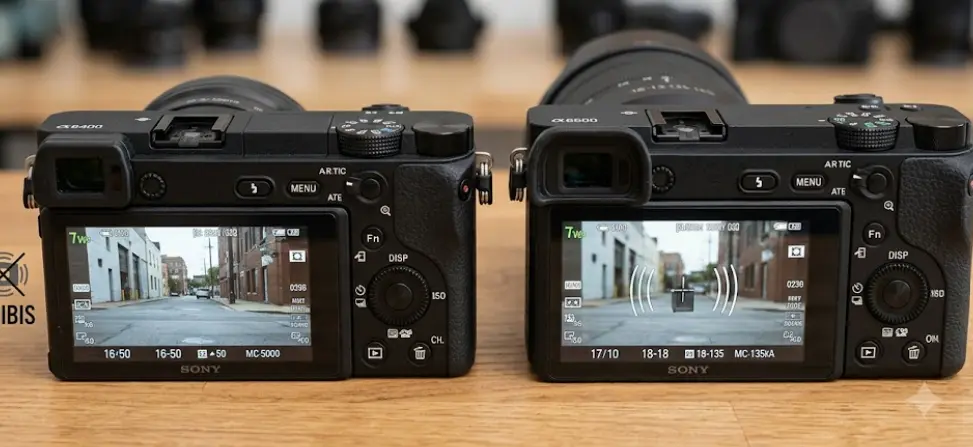
TL;DR The Sony A6400 and A6600 remain closely matched in core image quality, autofocus, burst shooting, and 4K recording, but the A6600 adds 5-axis in-body image stabilization, a larger NP-FZ100 battery, a deeper grip, and a headphone jack. Sony rates the A6600's stabilization at up to 5.0 stops under its stated test conditions. The A6400 is lighter at about 403g, while the A6600 weighs about 503g with battery and memory card. For handheld low-light photography, stabilized prime lenses, and video work, the A6600's IBIS can be genuinely useful. For daylight photography, action shooting, or buyers already using optically stabilized lenses, the A6400 can still offer most of the core experience for less money.
Sony A6400 vs A6600: Key Differences
The Sony A6400 and A6600 are built around the same basic APS-C platform, with both cameras using a 24.2MP Exmor CMOS sensor, Sony E-mount compatibility, Fast Hybrid AF, and 425 phase-detection and 425 contrast-detection AF points. Both can shoot at up to 11fps and record 4K video, so the A6600 does not represent a dramatic jump in basic image quality or shooting speed. The important differences are concentrated around stabilization, battery capacity, handling, and video-oriented features.
Specification Comparison
The biggest specification difference is image stabilization. Sony lists the A6400 as having no in-body stabilization, with stabilization instead depending on a compatible stabilized lens. The A6600, in contrast, has a 5-axis optical image stabilization system, with Sony specifying a compensation effect of 5.0 stops under its stated conditions. This means the A6600 can stabilize the camera body even when you attach an unstabilised lens, although IBIS cannot freeze movement from your subject.
The battery difference is almost as important for people who shoot for long periods. Sony rates the A6400 at approximately 410 shots using the LCD or 360 shots through the viewfinder, while the A6600 is rated at approximately 810 LCD shots or 720 viewfinder shots under CIPA conditions. The A6600 also uses the larger NP-FZ100 battery instead of the A6400's NP-FW50. This makes the A6600 particularly attractive for travel, events, wildlife, and long video sessions where carrying spare batteries is inconvenient.
| Feature | Sony A6400 | Sony A6600 |
|---|---|---|
| Sensor | 24.2MP APS-C | 24.2MP APS-C |
| In-Body Stabilization | No | 5-axis IBIS |
| Maximum Burst | 11fps | 11fps |
| AF Points | 425 phase / 425 contrast | 425 phase / 425 contrast |
| Battery Rating | Up to 410 shots LCD | Up to 810 shots LCD |
| Battery | NP-FW50 | NP-FZ100 |
| Weight | Approx. 403g | Approx. 503g |
| 4K Video | Yes | Yes |
The table makes the upgrade easier to understand. The A6600 is not simply a faster A6400. Instead, it adds features designed to make handheld shooting and extended use more comfortable. At the same time, that larger battery and deeper body add about 100g, so buyers who value a lightweight setup may actually prefer the A6400.
Is IBIS Worth the Upgrade?
For many photographers, IBIS is the single most important reason to choose the A6600 over the A6400. In-body stabilization moves the sensor to counter certain types of camera shake, allowing you to use slower shutter speeds when the subject itself is relatively still. This can be useful for handheld night photography, interiors, landscapes, street photography, and portraits in lower light. Sony rates the A6600's stabilization at 5.0 stops under its specified test setup, although real-world results vary with focal length, technique, and shooting conditions.
When IBIS Makes a Difference
The advantage becomes particularly obvious when you pair the A6600 with a fast but unstabilized prime lens. A photographer using an unstabilised 35mm, 50mm, or similar lens can benefit from having stabilization built directly into the camera. With the A6400, the camera itself cannot provide that stabilization, so you need a lens with optical stabilization or a sufficiently fast shutter speed to reduce camera shake. This gives the A6600 more flexibility if you plan to build a collection of compact prime lenses.
However, IBIS does not solve every type of blur. If you are photographing a moving person, child, animal, or sports subject, you still need a sufficiently fast shutter speed to freeze the subject's movement. IBIS primarily helps counter movement caused by the photographer holding the camera. That distinction is important because some buyers assume that a stabilized camera will automatically produce sharper images in every situation. It will not replace good shutter-speed choices or appropriate lens selection.
| Shooting Situation | A6400 | A6600 |
|---|---|---|
| Daylight Street Photography | Very Good | Very Good |
| Low-Light Handheld Shooting | Lens Dependent | Advantage |
| Unstabilized Prime Lens | Limited Stabilization | Strong Advantage |
| Moving Subjects | Similar Core AF Performance | Similar Core AF Performance |
| Handheld Video | Lens Dependent | Advantage |
| Tripod Photography | Usually Sufficient | IBIS Less Important |
For video creators, the A6600's stabilization can also make handheld footage easier to manage, particularly when using lenses without optical stabilization. It does not turn the camera into a gimbal replacement, and walking footage can still show movement, but having sensor-based stabilization provides another layer of correction. For photographers who mostly shoot outdoors in good light or already own several optically stabilized lenses, the difference becomes much less significant.
Battery Life and Everyday Handling
The A6600's larger battery is one of the upgrades that is easy to underestimate when comparing specifications. Sony rates it for approximately 810 shots using the LCD and 720 shots using the viewfinder, compared with approximately 410 and 360 shots respectively for the A6400. These are CIPA ratings rather than a guarantee of exactly how many photographs you will capture, but the difference is large enough to matter when you are spending a full day shooting.
Size and Weight
The A6400 has another advantage that should not be ignored. At approximately 403g with battery and memory card, it is about 100g lighter than the A6600, which weighs approximately 503g in the same measurement. That difference may sound small on paper, but it becomes noticeable when you add a lens and carry the camera for several hours. Travelers, students, and street photographers who prioritize a compact setup may find the A6400 easier to carry.
The A6600's larger body is not simply extra weight without purpose. The camera uses a larger grip and houses the bigger NP-FZ100 battery, giving it a more substantial feel in the hand. It also includes a headphone terminal in addition to a microphone terminal, which makes it more useful for creators who want to monitor recorded audio. The A6400 has a microphone input but does not provide the same headphone-monitoring option.
If you mainly shoot short trips, family photographs, casual portraits, and everyday street images, the A6400's smaller body can actually be the more practical choice. If your work involves long shooting days, extended video sessions, or travel where battery changes are inconvenient, the A6600's larger battery becomes a major advantage. In other words, the A6600's value is not just about IBIS. Its battery and handling improvements are part of the reason it was positioned as the more premium APS-C body.
Autofocus, Image Quality, and Video
The A6400 and A6600 are much closer in autofocus performance than their model numbers might suggest. Both cameras use 425 phase-detection and 425 contrast-detection AF points, support Fast Hybrid AF, and can shoot at up to 11fps. Sony also lists Real-time Tracking and Real-time Eye AF features on both generations, so upgrading to the A6600 does not mean you are moving to a completely different autofocus system.
Similar Core Performance
Both cameras also use a 24.2MP APS-C sensor, meaning you should not buy the A6600 expecting a major jump in resolution or basic image quality. Lens choice, exposure, lighting, and shooting technique will generally have a much larger influence on the final photograph. The A6600's advantage comes from the supporting features around that sensor, especially IBIS and battery life, rather than from a dramatically different imaging engine.
Video performance is similarly close. Both cameras support 4K recording, and Sony positions the A6600 around 4K HDR recording with HLG and its broader movie feature set. The A6600's stabilization and headphone output make it more attractive to serious handheld video shooters, while the A6400 remains capable for creators who use a tripod, gimbal, or optically stabilized lenses. Neither camera should be evaluated purely on the basis of the word "4K," because the shooting setup matters just as much.
The practical result is that the A6400 remains surprisingly competitive for photographers who care about autofocus and image quality but do not need body stabilization. The A6600 becomes more compelling when those basic capabilities are combined with long battery life, handheld shooting, and audio monitoring. If your photography is mostly fast-moving subjects in bright conditions, IBIS will not necessarily improve your keeper rate because shutter speed remains the more important factor for freezing subject motion.
Which Camera Should You Buy in 2026?
The A6400 makes more sense for buyers who want a relatively lightweight APS-C camera and are comfortable choosing stabilized lenses when necessary. It still offers a 24.2MP sensor, 425 phase-detection and 425 contrast-detection AF points, up to 11fps continuous shooting, and 4K recording. Those are not entry-level capabilities, and they remain sufficient for travel photography, portraits, street photography, family shooting, and many creator workflows.
Match the Camera to Your Shooting Style
The A6600 is the better choice if you regularly shoot handheld in lower light, use unstabilized prime lenses, record handheld video, or spend long days away from a charger. Its 5-axis IBIS gives it a genuine technical advantage, while the NP-FZ100 battery provides roughly twice the CIPA-rated LCD battery life of the A6400. The headphone jack is another practical advantage for creators who need to monitor audio during recording.
| Buyer Type | Better Choice | Main Reason |
|---|---|---|
| Travel Photographer | A6400 | Lower weight |
| Street Photographer | A6400 or A6600 | Depends on low-light needs |
| Low-Light Photographer | A6600 | 5-axis IBIS |
| Prime Lens User | A6600 | Body stabilization |
| Long-Day Shooter | A6600 | Larger battery |
| Casual Photographer | A6400 | Core features are still strong |
| Video Creator | A6600 | IBIS and headphone output |
| Budget-Conscious Buyer | A6400 | Stronger value if IBIS is unnecessary |
The most important point is that the A6600 is not a universal replacement for the A6400. If the price difference is substantial, you should ask whether you will actually use IBIS, the larger battery, and headphone monitoring. If the answer is no, the A6400 can be the smarter purchase. If you frequently shoot handheld with unstabilised lenses, the A6600's stabilization can justify the upgrade and make the higher-end body easier to live with.
Frequently Asked Questions
Q. Does the Sony A6400 have in-body image stabilization? No. Sony specifies that image stabilization is not supported in the A6400 body, so stabilization depends on the lens being used.
Q. Does the Sony A6600 have IBIS? Yes. The A6600 has 5-axis optical in-body image stabilization, with Sony specifying a compensation effect of 5.0 stops under its stated test conditions.
Q. Is the A6600 better than the A6400 for low-light photography? It can be, particularly when handheld and using an unstabilised lens, because IBIS can help reduce camera shake at slower shutter speeds. It does not freeze moving subjects.
Q. Do the A6400 and A6600 have the same sensor? Both use a 24.2MP APS-C Exmor CMOS sensor, so the A6600 does not provide a major resolution upgrade over the A6400.
Q. Which camera has better battery life, the A6400 or A6600? The A6600 has substantially better rated battery life. Sony rates it at up to approximately 810 LCD shots, compared with approximately 410 LCD shots for the A6400.
Q. Is the Sony A6600 heavier than the A6400? Yes. The A6400 weighs approximately 403g with battery and memory card, while the A6600 weighs approximately 503g.
Q. Do both cameras shoot at 11fps? Yes. Both the A6400 and A6600 can shoot at up to 11fps in their respective Hi+ continuous shooting modes.
Q. Which is better for video, the Sony A6400 or A6600? The A6600 has the advantage for handheld video because of IBIS and also provides a headphone terminal for audio monitoring. The A6400 remains capable for creators using stabilized lenses, tripods, or gimbals.
Q. Is the A6600 worth upgrading to from an A6400? It is worth considering if you need IBIS, the larger battery, or headphone monitoring. If you are satisfied with stabilized lenses and the A6400's battery life, the upgrade is less compelling.
Q. Which camera should a beginner buy, the A6400 or A6600? The A6400 can be the better starting point if keeping the setup light and affordable matters most. The A6600 is worth choosing if you already know that you need body stabilization or longer battery life.
Final Recommendation
The Sony A6400 remains the better choice for buyers who want a lightweight APS-C camera with strong autofocus, 24.2MP image output, 11fps shooting, and 4K recording without paying specifically for features they may not use. Its lack of IBIS is a genuine limitation, but it is not automatically a deal-breaker because stabilized E-mount lenses can provide optical stabilization.
The Sony A6600 is the more complete camera if you shoot handheld regularly. Its 5-axis IBIS, 810-shot LCD battery rating, larger grip, and headphone terminal make it better suited to long shooting days, low-light work, unstabilised lenses, and more serious video production. The extra weight is the trade-off, so portability should remain part of the decision.
For most buyers in 2026, the deciding question should therefore be simple: will you actually use IBIS? If you frequently shoot handheld in low light, use unstabilized prime lenses, or record handheld video, choose the A6600. If you mainly shoot in good light, use optically stabilized lenses, or prioritize a lighter camera, the A6400 remains the smarter value-oriented option.