
Sony A6300 vs A6500: What Actually Changed?
Sony A6300 vs A6500: Compare the sensor, autofocus, stabilization, touchscreen, burst shooting, video, battery, and design to see whether the A6500 is worth choosing.

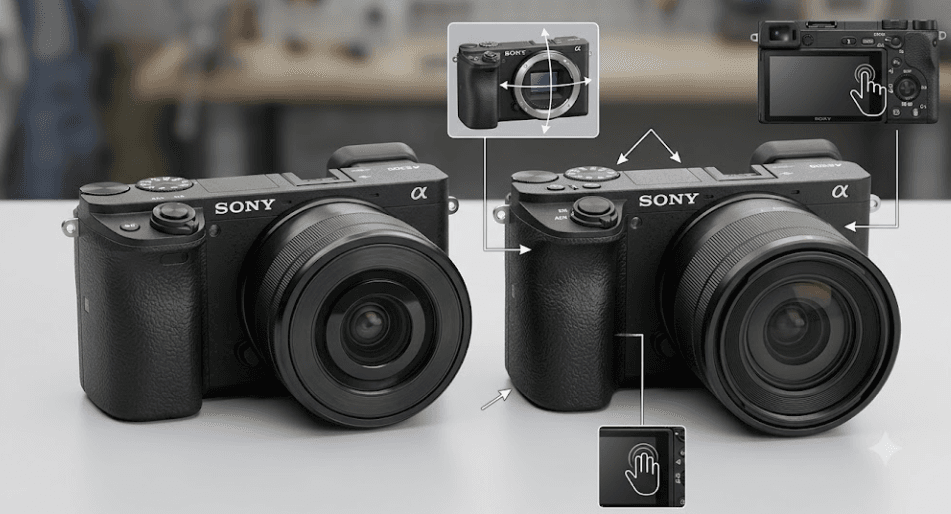
TL;DR The Sony A6300 and A6500 look remarkably similar on paper because both are compact APS-C mirrorless cameras with a 24.2MP sensor, 4K video, 425 phase-detection autofocus points, and burst shooting at up to 11 frames per second. The important differences are hidden in how the cameras handle stabilization, shooting buffers, controls, and extended use. The A6500 adds 5-axis in-body image stabilization, touchscreen focus control, a significantly deeper continuous-shooting buffer, and a slightly heavier body. The A6300, meanwhile, keeps the same basic imaging resolution and core autofocus system while remaining lighter. That makes the choice less about image quality alone and more about whether the A6500's extra features justify choosing it over the A6300.
Sony A6300 Vs A6500: Key Differences
The Sony A6300 was introduced as a major step forward from the A6000, bringing a 24.2MP APS-C sensor, fast hybrid autofocus with 425 phase-detection points, 4K recording with full-pixel readout, and continuous shooting at up to 11fps. The A6500 arrived later with much of that same foundation rather than replacing it with an entirely different sensor or autofocus architecture. Sony retained the 24.2MP APS-C sensor and 425 phase-detection autofocus points, so the basic image-making capability remained closely related between the two cameras.
The biggest functional change was stabilization. The A6300 does not have sensor-shift image stabilization, so stabilization depends on using a lens with optical stabilization. The A6500 introduced a five-axis sensor-shift stabilization system rated by Sony at up to five stops under its specified testing conditions. This makes the A6500 considerably more flexible when shooting handheld, particularly with lenses that do not have optical stabilization. It can also be useful for still photography at slower shutter speeds and for reducing camera shake when recording handheld video.
The A6500 also introduced touchscreen focus control and a much larger shooting buffer. Both cameras can reach 11fps, but the A6500 is designed to sustain high-speed continuous shooting for much longer. Sony's specifications list substantially higher recordable-frame figures for the A6500, while the A6300's buffer is considerably smaller. For action, wildlife, sports, or other situations where you hold the shutter down for a sequence, this difference can matter more than the headline 11fps figure.
Sensor And Image Quality
Same 24.2MP APS-C Foundation
The first thing to understand in the Sony A6300 vs A6500 comparison is that neither camera has a major resolution advantage. Both use an APS-C Exmor CMOS sensor with approximately 24.2 effective megapixels. That means you should not expect the A6500 to automatically produce dramatically higher-resolution photographs simply because it is the more expensive model. The core sensor resolution is essentially the same, and both cameras can produce 6000 x 4000-pixel images in their standard 3:2 format.
The A6300 already offered a strong imaging platform for its generation. Sony equipped it with the BIONZ X image processor, an ISO range of 100 to 25,600 with expansion to ISO 51,200 for still photography, and 14-bit RAW output. The A6500 retains the same broad sensor-resolution approach and also supports an expanded ISO range up to 51,200. For photographers comparing the two cameras primarily for image quality, the sensor itself is therefore not the main reason to choose the A6500.
The practical difference comes from what happens around the sensor. Because the A6500 has five-axis in-body stabilization, it can help keep images sharper when camera movement is the limiting factor. This does not make the sensor inherently better, and it does not freeze subject movement, but it can provide an advantage when you are shooting handheld at slower shutter speeds. With the A6300, achieving similar stabilization depends more heavily on the lens you choose.
Image Quality Comparison
| Feature | Sony A6300 | Sony A6500 |
|---|---|---|
| Sensor | APS-C Exmor CMOS | APS-C Exmor CMOS |
| Effective Resolution | 24.2MP | 24.2MP |
| RAW | Yes | Yes |
| ISO Range | 100-25,600, expandable to 51,200 | 100-25,600, expandable to 51,200 |
| In-Body Stabilization | No | 5-axis |
| Lens Mount | Sony E-mount | Sony E-mount |
The important takeaway is simple: the A6500 does not win because it has more megapixels. It wins because it adds stabilization and other usability improvements around a very similar imaging platform. If you are using a stabilized lens and primarily photograph subjects in good light, the image-quality gap can be much smaller than the model names suggest.
Autofocus And Burst Shooting
Similar Autofocus, Better Sustained Shooting
Both cameras were built around Sony's Fast Hybrid AF system, with 425 phase-detection AF points and 169 contrast-detection points. The A6300 was already highly competitive for autofocus when it launched, so Sony did not need to completely redesign the system for the A6500. The A6500 instead refined tracking and processing while retaining the same fundamental 425-point phase-detection architecture.
Both cameras can shoot at up to 11fps, which means the A6500 does not offer a higher headline burst rate. That distinction is important because it is easy to assume the newer model must shoot substantially faster. The real advantage appears when you continue shooting. Sony gave the A6500 a much larger buffer, allowing it to maintain a burst for substantially more frames before the camera has to slow down while writing files.
For sports and wildlife photographers, this can be a meaningful upgrade. A short burst can be enough for a portrait or street photograph, but fast-moving subjects can require a longer sequence. The A6500's deeper buffer gives you more freedom to keep shooting through a decisive moment instead of waiting for the camera to clear its buffer.
Burst Shooting Comparison
| Feature | Sony A6300 | Sony A6500 |
|---|---|---|
| Maximum Burst Speed | 11fps | 11fps |
| Phase-Detection AF Points | 425 | 425 |
| Contrast-Detection Points | 169 | 169 |
| Buffer | Smaller | Much larger |
| Tracking AF | Yes | Yes |
So, if your question is whether the A6500 is faster than the A6300, the answer needs some nuance. It is not faster in maximum frames per second. It is better at sustaining high-speed shooting. That is one of the most meaningful changes between the two cameras.
Stabilization And Handling
The Biggest Hardware Upgrade
The A6500's five-axis in-body image stabilization is arguably the most important physical upgrade over the A6300. The A6300 relies on lens-based optical stabilization when available, while the A6500 can shift its sensor to compensate for camera movement. Sony rates the A6500's stabilization at up to five stops under specified conditions.
This matters when you are using prime lenses or older E-mount lenses without optical stabilization. Instead of needing to select a stabilized lens every time you want handheld stabilization, the A6500 provides stabilization at the camera-body level. It can therefore make a wider range of lenses more practical for handheld photography.
The A6500 also adds a touchscreen, allowing you to select the focus point directly on the LCD. Sony additionally supports Touch Pad operation, allowing focus-point movement while looking through the electronic viewfinder. The A6300 does not offer the same touchscreen focus system. These changes do not transform the camera's image quality, but they can make the A6500 quicker and more intuitive to operate.
Design, Weight And Battery
A6300 Is Lighter
The two cameras share a very similar physical footprint, but the A6500 is heavier. Sony lists the A6300 at approximately 404g with battery and memory card, while the A6500 weighs approximately 453g with battery and memory card. That is roughly a 49g difference, which is noticeable if portability is a major priority.
The A6300's lighter body can therefore make sense for travel photographers, casual shooters, and anyone building a small lens kit. The A6500's additional weight comes with meaningful hardware, particularly its stabilization system and the changes made to its internal processing and control system. Whether that extra weight matters depends on how you shoot.
Battery performance is not an area where the A6500 produces a dramatic advantage. Both cameras use the NP-FW50 battery. Sony rates the A6300 at approximately 350 shots using the viewfinder or 400 shots using the LCD under CIPA conditions. The A6500 is rated at approximately 310 shots using the viewfinder or 350 shots using the LCD. Actual battery life varies with shooting conditions, temperature, display use, and other settings.
Size And Battery Comparison
| Feature | Sony A6300 | Sony A6500 |
|---|---|---|
| Weight With Battery And Card | Approx. 404g | Approx. 453g |
| Battery | NP-FW50 | NP-FW50 |
| CIPA Still Shots, EVF | Approx. 350 | Approx. 310 |
| CIPA Still Shots, LCD | Approx. 400 | Approx. 350 |
| Body Stabilization | No | Yes |
This makes the A6300 the better choice if minimum weight is important. The A6500 makes more sense if you are willing to carry a slightly heavier body in exchange for stabilization and a deeper shooting buffer.
Video Features And Connectivity
Both Cameras Record 4K
The A6300 and A6500 are both capable 4K cameras. Both can record 4K video using Sony's XAVC S format, with 3840 x 2160 recording available at up to 30p in NTSC configurations. Both cameras also support Full HD recording at up to 120fps, making slow-motion capture possible.
Neither camera has the modern video features found in newer Sony APS-C models, so it is important not to judge them by today's standards. However, for photographers buying either camera at a lower used-market price, their 4K capabilities remain useful for basic filmmaking, travel videos, interviews, and hybrid photo-video work.
The A6500's stabilization gives it a practical advantage for handheld video. Sensor-shift stabilization can help reduce camera shake, although stabilization does not replace a gimbal or tripod in every situation. The A6300 can still produce excellent video, particularly when paired with a stabilized lens or used on a support system.
Sony A6300 Vs A6500: Which Should You Buy?
Choose The A6300 For Value
The A6300 remains a strong choice if you want the essential Sony APS-C experience without paying extra for features you may not use. It offers a 24.2MP sensor, 425 phase-detection AF points, 11fps continuous shooting, 4K video, an electronic viewfinder, and the same Sony E-mount lens ecosystem as the A6500.
It is particularly attractive for travel and everyday photography because it is lighter. If you are already planning to use stabilized lenses, the absence of in-body stabilization is less problematic. The camera can also make sense for beginners who want a capable interchangeable-lens camera without immediately moving to a more expensive body.
The biggest limitation is its smaller buffer and lack of touchscreen control. For casual photography, those limitations may not matter. For sports, wildlife, or fast-moving subjects, however, the A6300's smaller buffer can become a genuine constraint.
Choose The A6500 For Features
The A6500 is the better choice if you specifically need the features Sony added to this model. Its five-axis stabilization is the biggest reason to choose it, particularly if you use unstabilised lenses. The deeper buffer is another major advantage for continuous shooting, while touchscreen focus makes operation more convenient.
The A6500 is therefore a better fit for photographers who shoot action, handheld low-light scenes, or video and want stabilization built into the camera. It also makes more sense if you regularly shoot long bursts and need the camera to keep writing images without slowing down as quickly.
However, you should not expect a dramatic jump in basic image quality. Both cameras share the same 24.2MP APS-C resolution, so the A6500's premium is primarily about functionality and handling rather than a completely different sensor.
Comparison At A Glance
| Category | Winner | Why |
|---|---|---|
| Sensor Resolution | Tie | Both use 24.2MP APS-C sensors |
| Basic Image Quality | Tie | Similar core imaging platform |
| Autofocus Points | Tie | Both have 425 phase-detection points |
| Maximum Burst Speed | Tie | Both reach 11fps |
| Shooting Buffer | A6500 | Much deeper buffer |
| Stabilization | A6500 | 5-axis in-body stabilization |
| Touchscreen | A6500 | Touch focus and Touch Pad |
| Portability | A6300 | Lighter body |
| Battery Rating | A6300 | Higher CIPA still-shot rating |
| Overall Features | A6500 | More advanced handling and stabilization |
Frequently Asked Questions
Q. Is the Sony A6500 better than the A6300?
Yes, overall, the A6500 is the more feature-rich camera. Its biggest advantages are five-axis in-body stabilization, touchscreen focus, and a much deeper buffer. However, both cameras share a 24.2MP APS-C sensor and 11fps maximum burst speed, so the A6500 is not dramatically better in basic image quality.
Q. Does the Sony A6300 have image stabilization?
No. The A6300 does not have sensor-shift image stabilization. Stabilization depends on the lens when using an optically stabilized Sony E-mount lens.
Q. Does the Sony A6500 have IBIS?
Yes. The A6500 has a five-axis sensor-shift in-body image stabilization system. Sony rates its compensation at up to five stops under specified test conditions.
Q. Do the A6300 and A6500 have the same sensor?
They have essentially the same sensor resolution and sensor format. Both use a 24.2MP APS-C Exmor CMOS sensor. Therefore, the A6500's higher model number does not mean it has a higher-resolution sensor.
Q. Is the A6500 faster than the A6300?
Both cameras can shoot at up to 11fps. The A6500's advantage is its substantially deeper buffer, which allows it to sustain long bursts more effectively.
Q. Does the Sony A6500 have a touchscreen?
Yes. The A6500 has a touchscreen LCD with touch focus and Touch Pad functionality. The A6300 does not have touchscreen operation.
Q. Are the Sony A6300 and A6500 good for video?
Yes. Both support 4K recording and Full HD recording at up to 120fps. The A6500 has an advantage for handheld shooting because of its built-in five-axis stabilization.
Q. Which is lighter, the A6300 or A6500?
The A6300 is lighter. Sony lists the A6300 at approximately 404g with battery and memory card, compared with approximately 453g for the A6500.
Q. Which camera is better for sports and wildlife?
The A6500 is generally the better choice because both cameras reach 11fps and have 425 phase-detection AF points, but the A6500 has a much deeper buffer. That makes it more suitable for sustained bursts when tracking fast-moving subjects.
Q. Is the A6500 worth choosing over the A6300?
The A6500 is worth choosing when its five-axis stabilization, touchscreen, and deeper buffer are useful to your photography. If you mostly shoot with stabilized lenses, do not use long bursts, and prioritize lower weight, the A6300 can provide most of the core imaging and autofocus experience for less.
Final Recommendation
The Sony A6300 vs A6500 comparison is ultimately about features rather than a major leap in image quality. Both cameras deliver a 24.2MP APS-C sensor, 425 phase-detection autofocus points, 11fps continuous shooting, and 4K video. The A6500's real upgrades are its five-axis in-body stabilization, touchscreen focus control, and substantially larger buffer.
For most photographers choosing between the two at comparable used-market prices, the A6500 is the better overall camera because its additional features directly improve handheld shooting, action photography, and everyday operation. If portability and value matter more, or if you already use stabilized lenses, the A6300 remains the smarter budget option.
The simplest recommendation is therefore to choose the A6500 for stabilization, long bursts, and greater usability, while choosing the A6300 for lower weight, simpler shooting, and better value. The A6500 is an upgrade in functionality, but not a completely different class of image quality.






