Rugged Android Phones With Pop-Out Action Cams: Are They Any Good?
Rugged Android phones are built for durability, while pop-out action cameras add unusual shooting flexibility. But in 2026, these features rarely come together in one phone.

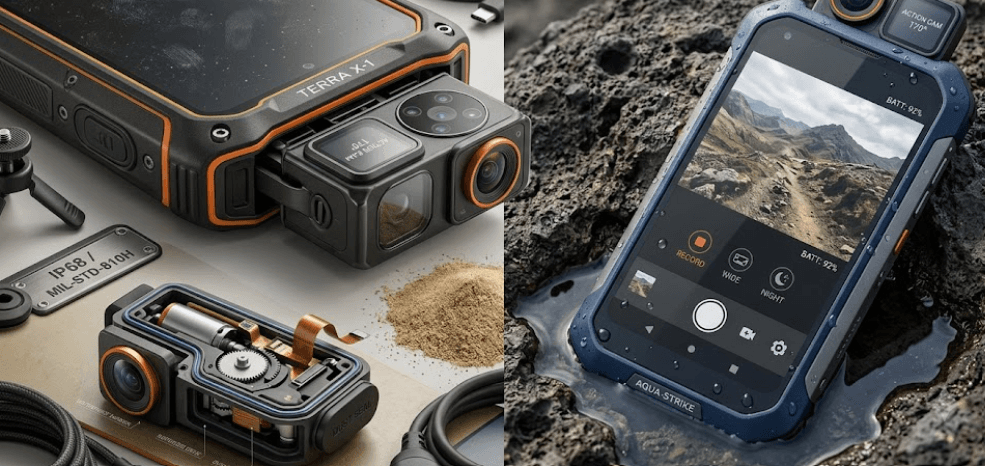
TL;DR Rugged Android phones and pop-out action cameras are both interesting smartphone trends, but they have not yet become a common combination in 2026. The clearest example of a pop-out, motorized camera is the HONOR Robot Phone, which launched in China in August 2026 with a gimbal-powered camera that rises from the top of the phone and can rotate for different shooting angles. However, it is not a rugged phone and carries an IP54 rating. On the rugged side, phones such as the Ulefone Armor 34 focus on durability, a huge 25,500mAh battery, night vision, and lighting features, but use conventional fixed rear cameras. This means buyers should be careful with claims about "rugged phones with pop-out action cams." The technology is real, but the rugged version of it remains a niche concept rather than an established category.
What Makes A Phone Rugged?
A rugged Android phone is designed around durability rather than simply adding a protective-looking exterior. Manufacturers typically use reinforced frames, protected ports, stronger display glass, and resistance ratings intended for environments where ordinary smartphones can be vulnerable. Water and dust resistance are commonly described through IP ratings, while some rugged phones also advertise testing against MIL-STD-810H. These ratings are useful, but they should not be interpreted as making a phone indestructible. The exact test conditions matter, and resistance can decrease with normal wear over time. Ulefone, for example, lists IP68, IP69K, and MIL-STD-810H certification for the Armor 34.
The Ulefone Armor 34 shows how far the rugged-phone concept can go without using a moving camera. It has a 6.95-inch FHD+ display with a 120Hz refresh rate, a 25,500mAh battery, and a 763-gram body. Its rear camera system combines a 50MP primary camera, a 64MP infrared night-vision camera, and a 50MP ultra-wide camera. It also includes a powerful rear LED light designed for outdoor use. These features make the phone more relevant to field workers, travellers, campers, and people who regularly work in demanding environments than a conventional flagship would be.
That approach also highlights an important point about rugged smartphones. Durability is only one part of the package. Weight, battery size, camera performance, software support, charging, connectivity, and physical dimensions all affect whether a rugged phone is practical every day. A 25,500mAh battery sounds impressive, for example, but the Armor 34 weighs 763 grams and is more than 32mm thick. That is considerably different from a conventional smartphone designed to disappear into a pocket. Rugged phones therefore make the most sense when their durability features solve a real problem rather than simply looking impressive on a specification sheet.
Rugged Phone Features At A Glance
| Feature | What It Means |
|---|---|
| IP68 | Protection against dust and specified water immersion |
| IP69K | Resistance to high-pressure, high-temperature water testing |
| MIL-STD-810H | A military-standard testing framework covering specified environmental conditions |
| Reinforced body | Greater protection against drops and physical impact |
| Large battery | Longer runtime, but often adds weight and thickness |
| Night vision | Useful for low-light or specialist outdoor situations |
How Pop-Out Action Cameras Work?
A pop-out action camera takes a very different approach from the fixed camera systems used by most smartphones. Instead of keeping the camera permanently behind the phone, a motorized mechanism can move the camera out of the body and change its orientation. The HONOR Robot Phone is the most notable 2026 example. Its camera rises from the top of the phone and uses a gimbal mechanism that can move and rotate, giving creators more flexibility when recording themselves or tracking a subject.
The concept is particularly interesting for people who record themselves without another person holding the phone. A motorized camera can potentially change its viewing angle while the phone remains stationary, making it easier to create walking shots, talking-head videos, and other content without constantly repositioning the device. HONOR's Robot Phone combines this mechanism with subject tracking, voice controls, and dedicated cinematic features. That makes the camera mechanism more than a novelty, although its usefulness will depend heavily on software execution and the reliability of the moving hardware.
There is an obvious reason this technology has not become standard on rugged smartphones. A moving camera introduces another mechanical component that has to operate reliably while the phone is exposed to dust, moisture, impacts, and everyday wear. The HONOR Robot Phone itself demonstrates this trade-off because its IP54 rating is much less protective than the IP68 and IP69K ratings found on rugged devices such as the Ulefone Armor 34. In other words, the current examples show that extreme durability and complex moving camera hardware are still difficult to combine.
Pop-Out Camera Vs Fixed Rugged Camera
| Feature | Pop-Out Camera | Fixed Rugged Camera |
| Camera movement | Motorized movement possible | Fixed position |
| Self-filming | Potentially more flexible | Usually requires phone positioning |
| Mechanical complexity | Higher | Lower |
| Durability challenge | Higher because of moving parts | Easier to seal and protect |
| Outdoor reliability | Depends heavily on design | Generally easier to build for harsh environments |
| Current examples | HONOR Robot Phone | Ulefone Armor 34 |
Are Rugged Phones With Pop-Out Cameras Available?
This is where the answer needs to be very clear. As of August 2026, there is no well-established mainstream category of rugged Android phones that combines a genuinely rugged construction with a motorized pop-out action camera. The HONOR Robot Phone proves that a commercial Android phone can use a motorized camera that rises from the body, but it is not marketed as a rugged phone and is currently a China-exclusive device. Meanwhile, rugged models such as the Ulefone Armor 34 use conventional fixed camera modules and focus on durability, battery capacity, lighting, and night vision.
This distinction matters because product descriptions can make unusual camera designs sound more common than they actually are. A phone can have an action-oriented camera, a rotating camera, a night-vision camera, or a rugged body without having all of those features together. The Armor 34, for example, is clearly built for demanding environments and offers underwater photography, night vision, a dedicated camera key, and a highly protective construction. None of those features means its camera physically pops out of the phone.
For buyers in India and other markets, availability creates another complication. The HONOR Robot Phone launched in China in August 2026, and current reporting says it remains China-exclusive. That makes it difficult to treat the phone as a straightforward recommendation for buyers looking for a rugged Android phone with an action camera. If your priority is durability today, an established rugged phone is the more realistic purchase. If your priority is an unusual motorized camera, the HONOR device is the more relevant technology showcase, but it should not be confused with a rugged handset.
What Actually Exists In 2026
| Phone | Rugged Design | Pop-Out Camera | Key Camera Feature |
| HONOR Robot Phone | No, IP54 | Yes | Motorized gimbal camera |
| Ulefone Armor 34 | Yes, IP68/IP69K | No | 64MP infrared night vision |
| Typical Rugged Android Phones | Often | Rare | Fixed multi-camera systems |
Benefits Of The Concept
The biggest advantage of combining rugged construction with a moving action camera would be versatility. A field worker could potentially use the same phone for navigation, communication, photography, and hands-free video without carrying another camera. A traveler could benefit from a durable body while using the moving camera for unusual perspectives. For content creators working outdoors, the ability to change the camera's orientation could make solo filming easier than using a conventional rear camera. These are meaningful advantages, but they remain more theoretical until manufacturers successfully combine the two technologies in a durable commercial design.
A rugged phone could also provide a useful foundation for action-focused photography because its hardware is already designed around outdoor use. The Ulefone Armor 34 is a good example of this philosophy. Its camera system includes infrared night vision, while the phone also offers underwater photography and a physical camera key for quickly launching and capturing images. Its 25,500mAh battery and 1100-lumen rear light further reinforce the idea of a phone designed for situations where conventional smartphones may struggle.
The biggest potential benefit of a future rugged pop-out camera phone would therefore not simply be better image quality. It would be the combination of durability and shooting flexibility. A camera that can move could make different angles easier, while a rugged chassis could make the phone more suitable for outdoor work. The challenge is making that mechanism sufficiently reliable and sealed without making the device even heavier, thicker, or more expensive.
Drawbacks You Should Consider
The first drawback is mechanical reliability. A fixed camera module has very few moving parts, while a pop-out camera requires motors, hinges, or other mechanical components. Every additional moving component creates another potential failure point. That becomes especially important on a rugged phone because the device is expected to tolerate drops, dust, water, vibration, and temperature changes. The more complicated the camera mechanism becomes, the harder it is to maintain the same level of environmental protection.
The second issue is size. Rugged phones are already considerably larger than conventional smartphones because they need reinforced bodies and larger batteries. The Armor 34 is 32.7mm thick and weighs 763 grams, showing just how substantial a rugged phone can become when manufacturers prioritize durability and battery capacity. Adding a motorized camera system could require additional internal space and mechanical protection, potentially making the phone even thicker or heavier.
The third issue is value. A moving camera can look exciting in a specification list, but it does not automatically mean better photographs or videos. Sensor size, stabilization, image processing, lenses, microphones, and software can have a greater effect on the final result. A buyer who mainly needs a durable phone for work may get more practical value from a rugged model with strong battery life and night vision than from paying extra for a camera mechanism that they rarely use.
Who Should Consider One?
A rugged phone makes the most sense for people whose environment creates a genuine need for extra protection. Construction professionals, outdoor workers, hikers, travellers, delivery workers, and people who regularly work around water or dust can benefit from a phone designed around durability. The Ulefone Armor 34, for example, combines IP68 and IP69K protection with MIL-STD-810H certification, a large battery, night vision, and a bright rear light.
A pop-out camera is more relevant to a different type of buyer. Content creators, vloggers, solo travellers, and people who regularly record themselves could benefit from a camera that can change position without moving the entire phone. The HONOR Robot Phone is aimed specifically at this kind of use, with a motorized gimbal camera, subject tracking, voice control, and cinematic features. However, its current China-only availability and IP54 rating mean it should be treated as a creator-focused innovation rather than a rugged-phone recommendation.
If you need both durability and flexible video recording, it may currently be more sensible to use a rugged Android phone alongside a compact action camera or gimbal. That approach is less convenient than having everything inside one device, but it avoids forcing two very different engineering priorities into the same chassis. Until manufacturers can prove that a moving camera can survive the same conditions as a truly rugged phone, separating those roles can be the more practical choice.
Common Buying Mistakes
One common mistake is assuming that a phone is rugged simply because it looks rugged. Large protective frames, textured backs, and exposed screws can create the appearance of durability, but buyers should check the actual IP rating and any stated testing standards. The Ulefone Armor 34, for example, explicitly lists IP68, IP69K, and MIL-STD-810H, which provides much more useful information than appearance alone. Buyers should also remember that resistance ratings describe controlled testing conditions and are not a guarantee against every type of damage.
Another mistake is treating megapixel counts or unusual camera mechanisms as a guarantee of better photography. The Armor 34 has a 50MP primary camera and a 64MP infrared night-vision camera, but the value of its camera system comes from how those cameras are designed for particular situations rather than simply from their megapixel numbers. Likewise, a motorized camera can offer creative flexibility without automatically outperforming a high-end fixed camera system.
The final mistake is ignoring the physical cost of rugged design. A huge battery and reinforced construction can be valuable, but they also make a phone heavier and thicker. The Armor 34's 763-gram weight is a good reminder that rugged hardware involves real trade-offs. Buyers should therefore decide whether they actually need extreme durability before accepting the size and weight that often come with it.
Frequently Asked Questions
Q. Are there rugged Android phones with pop-out action cameras in 2026?
As of August 2026, there is no established mainstream rugged Android phone category combining a genuinely rugged chassis with a motorized pop-out camera. The HONOR Robot Phone has a motorized camera, but it is not a rugged phone and carries an IP54 rating.
Q. What Android phone currently has a pop-out camera?
The HONOR Robot Phone is the major current example. Its camera rises from the top of the phone and uses a gimbal mechanism that provides movement for different shooting angles. It launched in China in August 2026.
Q. Is the HONOR Robot Phone a rugged phone?
No. It is designed around its motorized camera and creator-focused features rather than rugged durability. Current reporting lists an IP54 rating, which is considerably different from the IP68 and IP69K protection offered by dedicated rugged phones.
Q. What is a good example of a rugged Android phone in 2026?
The Ulefone Armor 34 is a strong example of the current rugged-phone approach. It has IP68, IP69K, and MIL-STD-810H certification, a 25,500mAh battery, night vision, and a 1100-lumen rear LED light.
Q. Does the Ulefone Armor 34 have a pop-out camera?
No. Its cameras are fixed inside the rear camera system. It uses a 50MP main camera, 64MP infrared night-vision camera, and 50MP ultra-wide camera.
Q. Why are pop-out cameras difficult to combine with rugged phones?
A moving camera introduces mechanical components that must continue working while the phone is exposed to drops, dust, water, and other environmental conditions. Sealing and protecting those moving parts is more difficult than protecting a fixed camera module.
Q. Are rugged phones good for outdoor photography?
They can be useful for outdoor photography, particularly when they include specialist features such as night vision or underwater photography. The Armor 34, for example, supports both features alongside its rugged construction.
Q. Is a pop-out camera better than a normal smartphone camera?
Not automatically. A pop-out camera can provide more flexible shooting angles and movement, but final image quality still depends on the sensor, lens, stabilization, processing, and software. The main benefit is flexibility rather than a guaranteed improvement in image quality.
Q. Are rugged phones too heavy for everyday use?
Some are. Rugged phones often use larger batteries and reinforced bodies, which can substantially increase their size and weight. The Ulefone Armor 34, for example, weighs 763 grams, making it much heavier than a typical mainstream smartphone.
Q. Should I wait for a rugged phone with a pop-out action camera?
Only if you specifically need both features in one device. For most buyers, a proven rugged Android phone is the more practical choice today. If flexible video recording is important, a dedicated action camera or gimbal can provide that capability without compromising the phone's durability.
Final Recommendation
Rugged Android phones with pop-out action cameras sound like an ideal combination, but the market in 2026 has not quite reached that point. The two technologies currently exist in separate products. The HONOR Robot Phone demonstrates how far motorized smartphone cameras have come, with a gimbal-powered camera that rises from the phone and can move for creator-focused shooting. However, it is not rugged and is currently limited to China.
For buyers who genuinely need durability, a dedicated rugged Android phone such as the Ulefone Armor 34 is the more sensible choice. Its IP68 and IP69K ratings, MIL-STD-810H certification, 25,500mAh battery, infrared night vision, and outdoor-focused features are more useful for demanding environments than a novelty camera mechanism.
The idea of combining both technologies is still exciting, especially for travellers, vloggers, field workers, and outdoor creators. But until a manufacturer can deliver a moving camera with genuinely rugged protection without making the phone excessively large, heavy, or fragile, it is better to choose based on your actual priority. Choose a rugged Android phone for durability, a pop-out camera phone for creative flexibility, and do not assume that the two are already available as one mature category in 2026.