
Right to Repair India Guide: Consumer Rights
Right to Repair India empowers consumers with better access to repairs, spare parts, and product information instead of forced replacements. Learn about the policy framework, consumer rights, repair costs, environmental impact, and how it can help you save money and reduce e-waste.

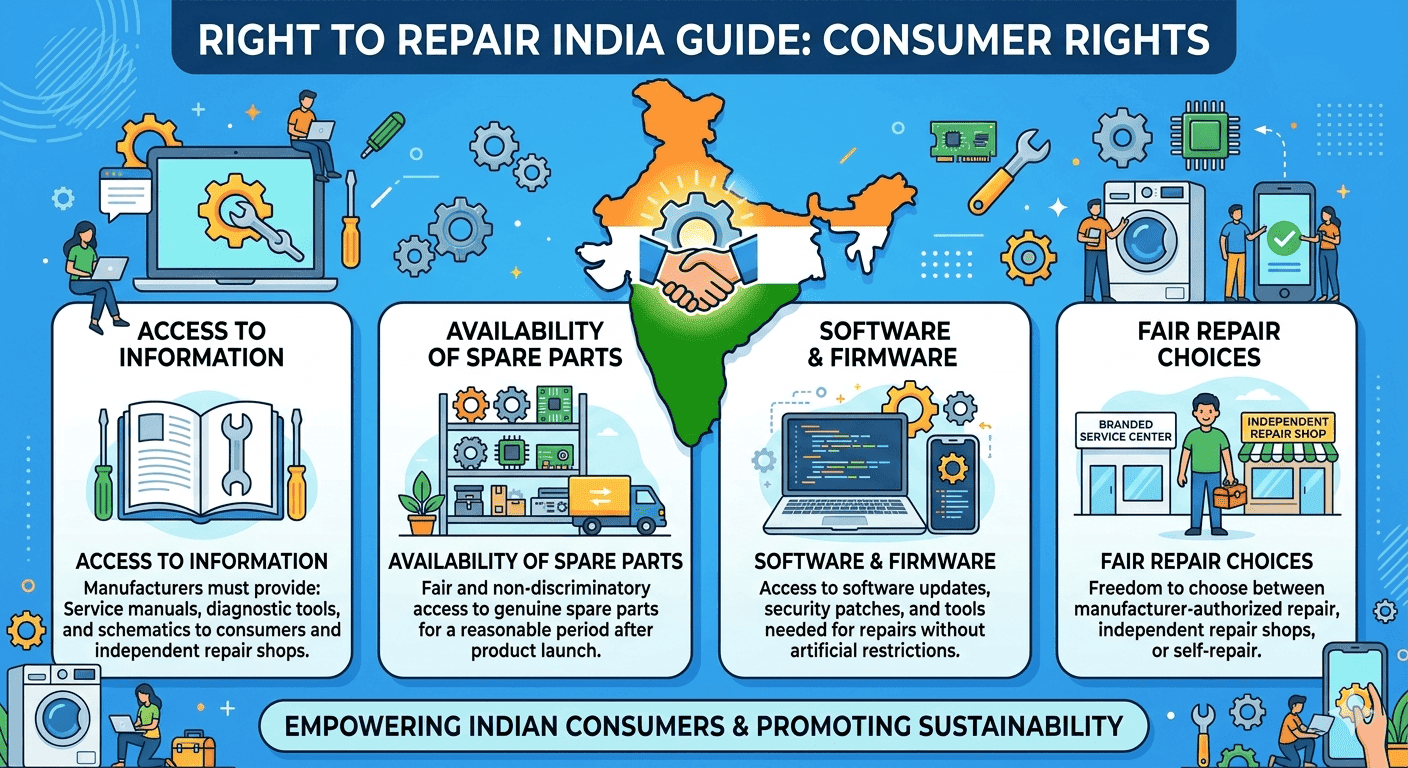
TL;DR Right to Repair India gives consumers a clearer path to repair instead of replacement, with the portal, repair information, and product access shaping real-world choices. The average electronic equipment repair is around ₹5,000, while AC drives and VFDs can range from ₹28,000 to ₹72,000, so diagnosis and repairability matter.
Understanding Right to Repair in India
The right to repair movement in India starts with a simple but powerful idea: if you own an electronic product, you should be able to repair or modify it without unnecessary barriers. That means access to repair information, permission to use parts and tools, and the ability to choose a repair path that makes sense for the owner. In real life, this matters when a device develops a fault but still has useful life left.
Instead of forcing a replacement, the movement argues for a repair-first approach that preserves value and reduces waste. The concept has gained traction because electronic waste keeps growing, and the old model of replacing products too quickly is becoming harder to justify. Proponents say the policy supports affordability, sustainability, and access to critical supplies, which are practical benefits for consumers and repair businesses.
Climate change activists have also supported the movement because every additional repair can delay another device from entering the waste stream. That makes right to repair India more than a technical debate; it is a policy response to a visible resource and disposal problem. The Right to Repair Portal is a major part of this shift because it gives consumers access to repair information for their products.
It is meant to help people repair items at a reasonable cost instead of replacing them, which is the kind of result many households actually need. The portal also matters because it is part of a broader social movement advocating for consumer rights, not just a static website page. In practice, that means the government is treating repair as a public-interest issue, not only a manufacturer service issue.
Why the Movement Matters?
The movement matters because ownership without repair access is incomplete ownership. If a product fails and the only easy route is a closed service channel, the owner loses bargaining power and often pays more. With repair information available, consumers can compare options, ask better questions, and avoid unnecessary replacement.
That is especially important in India, where repair culture already exists but often lacks formal support. The movement gives that culture a policy framework and a clearer consumer-rights basis. It also connects everyday repair decisions to broader sustainability goals.
Portal And Brand Participation
The portal gives the movement a visible origin point in government policy. It also shows that registered brands are starting to participate in the ecosystem, which makes the idea feel more real to consumers. Samsung India Electronics Pvt. Ltd. and Honda Motorcycle & Scooter India Pvt. Ltd. are examples of brands already listed under the initiative.
Their presence signals that repair access is moving into mainstream product support rather than staying on the margins. It also gives consumers a concrete sign that the framework is being adopted in actual product categories. That matters because policy only becomes useful when it reaches real ownership decisions.
Practical Meaning For Consumers
For the average owner, right to repair India means more choice when something breaks. You may be able to get a diagnosis, compare service options, and decide whether a repair is worth it before spending again. That is a meaningful shift because it changes the balance of power between the consumer and the manufacturer.
Instead of treating repair as a hidden process, the framework tries to make it visible, searchable, and easier to act on. The practical result is simple: better access, fewer surprises, and a stronger case for keeping products in use longer. If a repair can restore performance without creating additional cost or delay, the owner benefits immediately.
Key Consumer Rights and Challenges
The core consumer right in right to repair India is access. End users should be able to access original spare parts and necessary tools at fair market conditions, which gives them a realistic chance to repair products independently or through third parties. That sounds straightforward, but it changes the ownership experience in a major way.
When parts, tools, and information are available, a broken product becomes a repair decision instead of an automatic replacement problem. This right matters because it supports both self-repair and third-party repair. If a consumer can obtain the right components and the right tools, a local technician can often do the job at a lower cost than a locked-in manufacturer channel.
It also helps with simple faults where the issue is limited, and the performance loss is easy to diagnose. In those cases, access is the difference between a manageable fix and a long, expensive service cycle. It can also reduce avoidable errors in the repair process by making the needed information easier to obtain.
The biggest obstacles are equally clear. Common repair barriers include requirements to use only the manufacturer's maintenance services and restrictions on access to tools and components. Those limits reduce choice and can increase cost, especially when a product is still otherwise usable.
Security arguments are sometimes used to justify restrictions, but the consumer result is often the same: fewer options, slower service, more dependence on the original brand, and more errors caused by limited access. In practice, the consumer's right depends on whether access is real, not just promised.
What Consumers Should Expect?
Consumers should expect a repair system that is more open than the old closed-service model. That means being able to ask for product details, compare repair paths, and look for a fair market price before deciding. It also means the right to repair framework should make independent repair more realistic, not just theoretically allowed.
If a repair is safe and technically sound, the owner should not be forced into a single channel simply because the manufacturer controls the information. The practical test is whether the consumer can actually act on the right to repair. If access stays limited, the promise stays limited too.
Registered Brands And Real-World Access
Registered brands are important because they show the framework can work in actual product categories. Samsung India Electronics Pvt. Ltd. and Honda Motorcycle & Scooter India Pvt. Ltd. are both registered under the initiative, which gives consumers a concrete reference point. A Samsung user looking for support and a Honda owner dealing with a service issue are not facing the same device, but they are facing the same policy question: can repair happen without unnecessary barriers?
When brands participate, the answer becomes more practical. It also makes the policy easier to understand because consumers can connect it to products they already own. That connection helps turn a policy idea into a real ownership decision.
Legislation and Framework Governing Right to Repair
The legislative framework behind the right to repair India is centered on information sharing. The key policy direction is that manufacturers will need to share product details with customers so that self-repair or third-party repairs become possible. That is a major shift because many repair problems begin with missing information rather than missing skill.
When product details are available, technicians can diagnose faults faster, consumers can compare options, and the repair process becomes less opaque. The government timeline shows how quickly the issue moved from discussion to action. The Ministry of Consumer Affairs set up a committee in July 2022 to develop a comprehensive framework on the Right to Repair.
The Department of Consumer Affairs then launched the portal in December 2022, giving the policy a public-facing origin point. Those steps matter because the framework was not left as a vague idea; it was turned into a working government initiative. The Right to Repair framework also aims to empower consumers by allowing them to repair products at an optimal cost instead of buying new products.
That goal is important because affordability is not just about the sticker price of a device. It is also about the cost of keeping it running over time. If repair is too difficult or too expensive, consumers are pushed toward replacement even when the product still has useful life left.
What The Framework Changes
The framework changes the repair market by making information a required part of ownership support. That helps both consumers and repair teams because they can work from the same product details instead of guessing. It also creates a better basis for price comparison, which matters when a repair quote might be reasonable or might be inflated because of limited access.
In that sense, the policy is as much about transparency as it is about repair permission. It gives consumers a way to ask better questions before they commit to a repair, and it helps the market reward clearer support instead of closed service systems. That is a major shift for anyone comparing repair options.
Repairability Index And Buying Decisions
The Repairability Index is the part most buyers can use directly. It will rank products based on ease of repair, spare part availability, and repair costs. That makes it a practical comparison tool, not just a policy label.
For consumers, this matters before a fault ever happens. A product with stronger repairability can be easier to own over time, especially if parts and service support remain available. That is why the index belongs in the buying decision, not only in the repair conversation.
Electronic Waste and Environmental Impact
India’s e-waste numbers show why the issue is more than a consumer convenience. In 2022 alone, India produced 1,346,496.31 MT of e-waste, with 354,540.7 MT processed. Those numbers show a large gap between what is created and what is actually handled, which is exactly why repair policy has become so important.
The environmental logic is straightforward. Repair keeps products in use longer, which reduces pressure on recycling systems, raw material extraction, transport, and manufacturing energy. It also helps consumers get more life out of the devices they already own, which is a practical sustainability win rather than a symbolic one.
The Right to Repair movement has gained traction partly because the amount of electronic waste keeps increasing. Supporters argue that repair improves affordability and sustainability while preserving access to critical supplies. Climate change activists have also backed the movement because it offers a direct way to slow down waste growth.
In other words, repair is one of the few tools that can reduce the problem before disposal even begins. That is why the movement connects consumer rights with environmental policy so closely. The policy and the waste problem move together.
Why Repair Reduces Waste?
Repair reduces waste by extending product life. A phone battery replacement, a board-level fix, or a component swap can keep a device working for another cycle instead of sending it to scrap. That matters because the highest environmental cost often happens when a product is discarded too soon.
A repair-first culture keeps useful materials in circulation and lowers the number of additional devices that must be manufactured. It also reduces the number of items that need to move through disposal systems. For consumers, that repairs a practical sustainability choice.
What The Statistics Show?
The statistics also reveal a systemic problem. When only a portion of e-waste is processed, the rest remains a growing burden on collection and disposal systems. Repair does not replace recycling, but it reduces the volume that reaches it in the first place.
That is why the movement is tied so closely to sustainability policy and consumer education. Longer product life reduces pressure on raw materials and manufacturing. Support from activists has helped keep the issue visible in public policy.
Repair Cost Overview and Pricing Comparison
Repair pricing is one of the clearest places where the build becomes practical. The average price for electronic equipment repair varies, with many services costing around ₹5,000. That figure is important because it gives consumers a realistic baseline for everyday repair decisions.
If the fault is limited and the product still performs well, a ₹5,000 repair is often much easier to justify than replacing the item entirely. AC drives and VFDs sit in a much more expensive category. Repair costs for those systems typically range from ₹28,000 to ₹72,000, depending on the severity of the fault.
That spread shows that product type and fault complexity change the economics quickly. Premium repair pricing usually reflects more complex systems and more serious faults. Limited access to parts can also push a repair into a higher cost bracket.
The practical takeaway is simple. If your quote is near ₹5,000, compare it with the replacement price and the device’s remaining life. If you are dealing with AC drives or VFDs, the wide ₹28,000 to ₹72,000 range makes accurate diagnosis especially important.
| Repair category | Typical cost | What it usually signals |
|---|---|---|
| Electronic equipment repair | Around ₹5,000 | Common repairs with limited damage |
| AC drives and VFDs, lower fault severity | ₹28,000 | Higher-value systems with targeted repair needs |
| AC drives and VFDs, higher fault severity | ₹72,000 | Severe faults where replacement becomes a real comparison |
To Read A Repair Quote
A repair quote makes the most sense when you compare it with the product’s remaining life. A lower-cost repair can be a strong value if the device still has years of use left. A higher-cost repair needs more scrutiny, especially when the fault is severe or the system is specialized.
That is why diagnosis matters before approval. The better the information, the easier it is to tell whether repair or replacement is the smarter decision. In the build, that is exactly the kind of choice the framework is trying to improve.
Frequently Asked Questions
Q. What is right to repair, and why does it matter in India?
It is the idea that owners should be able to repair or modify their own electronic equipment without unnecessary barriers. In India, that matters because access to parts, tools, and repair information can lower costs and reduce e-waste. It also gives consumers more control when a device still has useful life left.
Q. Where can people look for the hardware portal?
The portal is the government-facing place where repair information is meant to be easier to find. It helps users look up product support details instead of relying only on a manufacturer's service chain. That makes it a practical starting point for diagnosis and repair planning.
Q. Is there a right to repair act India pdf or a right to service act India pdf?
People often search for those terms when they want a formal document they can read offline. The key point is that the framework centers on consumer access to repair information and service support. If you are comparing documents, look for the official policy language rather than summaries that leave out the details.
Q. Is the right to service act India different from the repair movement?
The service idea focuses on getting a product fixed, while the repair movement focuses on access, choice, and information. A service model can still be closed if only one channel can perform the work. The repair approach tries to open that process to owners and third-party technicians.
Q. What does right to Public Service Act, India, have to do with this topic?
People sometimes use that phrase when they are really asking about access to support and repair. The connection is that public-facing service systems should be understandable and usable by consumers. In this context, the repair framework is about making support more transparent and less restrictive.
Q. Is there a right to repair law in India, and how does it compare with the right to repair policy in India?
The policy framework is the clearest way to describe the current system, because it focuses on information sharing and consumer access. People also search for the right-to-repair law in India when they want to know whether the rules are formalized. The practical effect is the same either way: more visibility into repair options and fewer barriers to fixing products.
Who Benefits Most From the Right to Repair Framework
This framework helps consumers who want more control over repair decisions and technicians who need product details to diagnose problems accurately. For households, the biggest value is simple: a broken device does not automatically become a replacement purchase. That makes repair easier to choose and helps keep costs from rising unnecessarily.
The strongest long-term benefit is that it keeps useful products in use. It also reduces pressure on resources and the net amount of e-waste. That is why the build-to-rent conversation matters for both consumer budgets and environmental planning.
For readers comparing policy terms, the parts, right to repair movement in India, right to repair policy in India, right to repair act India PDF, right to service act India PDF, right to public service act India, and right to repair law in India all point back to the same basic question: who gets to control the repair process when a device fails? The answer matters most when a product still has value, and the repair quote needs a clear comparison.
The portal, the committee's work from July 2022, and the December 2022 launch all show that repair access is being treated as a real public issue. The e-waste figures also make the case clear: India produced 1,346,496.31 MT of e-waste in 2022, while only 354,540.7 MT was processed. That gap shows why repair matters before disposal becomes the only option.
If a repair is around ₹5,000, it may be easier to justify than replacement, while AC drives and VFDs at ₹28,000 to ₹72,000 need more careful diagnosis. Use the portal, check repairability details, and act early when a product shows signs of failure. That is the most practical way to make the framework work for you.
Ready to upgrade your tech?
Browse our collection of quality refurbished products at unbeatable prices.