
NVIDIA N1 AI PC Chips: RTX Spark and N1X
Explore NVIDIA N1 AI PC Chips, including RTX Spark and N1X, their AI performance, unified memory, Blackwell architecture, CUDA support, and how NVIDIA's new AI PC platform is shaping the future of Windows laptops and desktops.

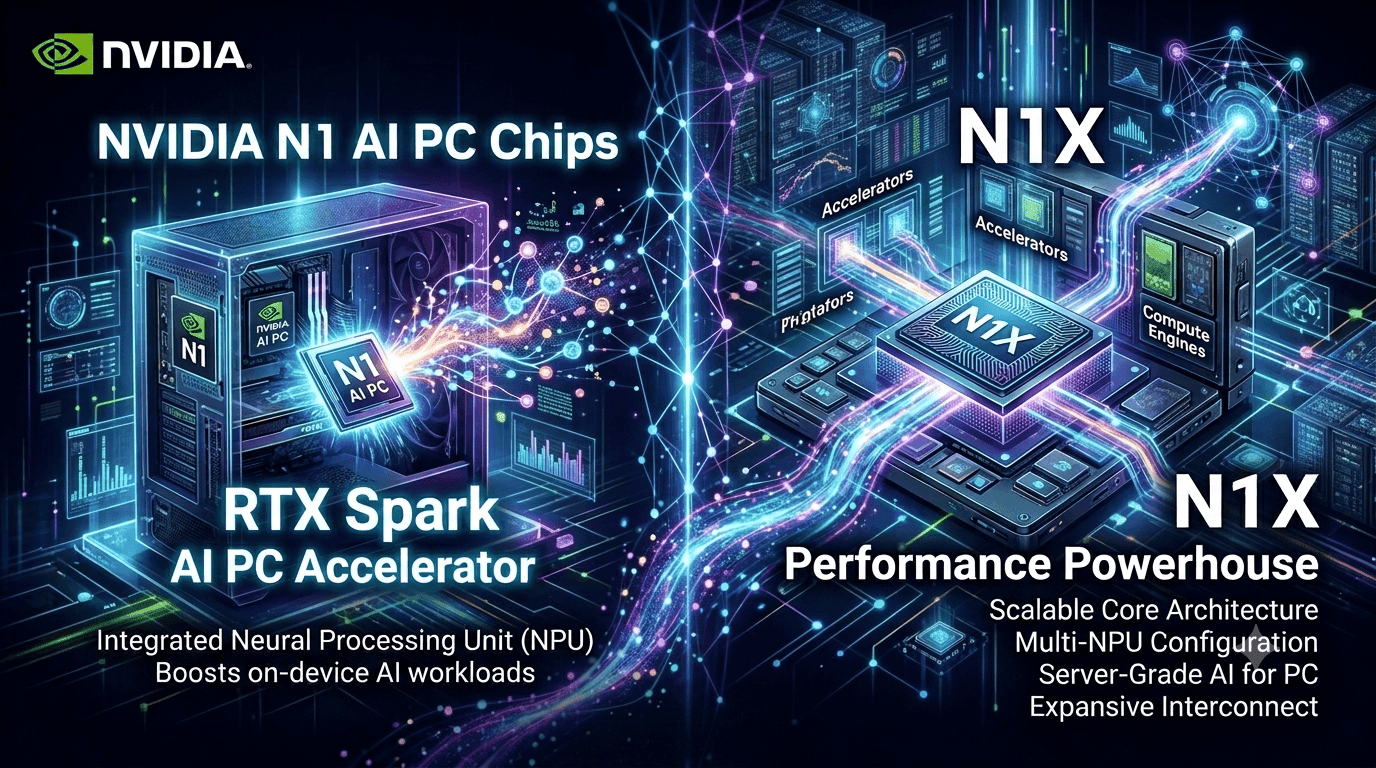
TL;DR NVIDIA N1 AI PC Chips are NVIDIA’s push into Windows PCs, led by RTX Spark and N1X. RTX Spark delivers up to 1 petaflop of AI performance, 6,144 CUDA cores, and 128GB of unified memory.
Understanding NVIDIA N1 AI PC Chips
NVIDIA N1 AI PC Chips are not one product; they are a family built around RTX Spark and N1X. That matters because the line-up covers both desktop-style systems and thinner laptops. NVIDIA is treating this as a new PC platform, not just another chip launch.
RTX Spark is the louder statement, and NVIDIA is planning more than 30 laptops and 10 desktops around it. N1X is the more conventional laptop chip, but it still carries the same basic ambition. Together, they give NVIDIA one stack for agentic AI, gaming, and creator work on Windows PCs.
The family also reaches across ASUS, Dell, HP, Lenovo, Microsoft Surface, and MSI. That spread matters because it gives the latest generation of NVIDIA products a real market presence instead of a single showcase system. CEO Jensen Huang is clearly using this launch to push NVIDIA deeper into personal computing, with AMD also in the broader conversation around PC chips.
What makes the line-up different?
RTX Spark is the superchip, and NVIDIA positions it as the most aggressive option. It combines a 20-core NVIDIA Grace CPU with a Blackwell GPU, so it is built for heavy local models and demanding applications. N1X is the laptop-focused chip, and it is the one most closely tied to mobile processors.
| Feature | RTX Spark | N1X |
|---|---|---|
| CPU cores | Up to 20 CPU cores | 20-core configuration |
| AI performance | Up to 1 petaflop | Designed for AI and gaming workloads |
| Memory support | 128GB unified memory | Up to 128GB LPDDR5X memory |
| Target devices | Laptops and desktops | Laptops |
Why the architecture matters in real use?
The architecture matters most when you run software that keeps the CPU, GPU, and memory busy at the same time. In Blender, the GPU can accelerate rendering while the CPU handles the rest of the scene. In Visual Studio Code, Docker, and a local agent, the CPU still needs to stay responsive while the model runs.
This is where NVIDIA DGX thinking shows up in a personal machine. DGX systems are usually associated with data centers, but the same design logic is visible here, especially in the way NVIDIA links CPU, GPU, and memory into one stack. That is also why NVIDIA DGX Spark feels like more than a marketing name, because it borrows the language of serious AI infrastructure.
- RTX Spark is the stronger fit for local model work.
- N1X is the better fit for laptop mobility with real AI headroom.
- Both chips use CUDA, which matters for software that already leans on NVIDIA tools.
- Both are built for agents that need fast response times and high memory bandwidth.
Blackwell, CUDA, and the software stack
Blackwell is an important part of the GPU story because it gives the family a newer generation foundation. That matters for developers who want to run inference locally, test AI agents, or keep their CUDA stack consistent across desktop and laptop hardware. It also makes the platform more credible for users who already work with NVIDIA RTX software.
The software angle is not abstract. If you use TensorRT, CUDA-aware tools, or a local model runner, the chip choice changes how much friction you feel. NVIDIA is betting that a tighter stack will matter more than raw CPU bragging rights, and that is a sensible bet for this market.
Memory, ARM, and NVIDIA AI PC Design
Memory is where NVIDIA N1 AI PC Chips become unusually interesting. RTX Spark includes 128GB of unified memory, N1 supports up to 64GB of LPDDR5X memory across 8 channels, and N1X supports up to 128GB of LPDDR5X memory across 16 channels. Those numbers matter because large models, creative projects, and multiple agents all eat memory fast, including workloads that push CPUs and GPUs at the same time.
Unified memory on RTX Spark is especially useful because the CPU and GPU can share the same pool. In practical terms, that reduces the friction of moving large data sets between components. If you run Photoshop with a huge file, a local coding agent, and a browser full of tabs, that shared pool keeps the system from feeling cramped.
It is also part of NVIDIA’s broader GB10-based design approach, something CEO Jensen has emphasized as part of the company’s AI PC direction.
What does the memory setup mean for you?
The memory bandwidth story is just as important as the raw capacity. Higher bandwidth helps when AI agents are pulling context, when Premiere Pro is scrubbing 4K footage, or when a local model is generating text while other apps stay open. NVIDIA is clearly aiming at users who will push the machine hard, not just open spreadsheets.
ARM also matters in this discussion because N1X is part of NVIDIA’s answer to ARM-based competition. The chip is designed to compete with Apple’s M-series chips, and that comparison is unavoidable. CEO Jensen has framed that competition as part of the broader shift in personal computing.
- RTX Spark uses unified memory to keep large workloads moving smoothly.
- N1X scales up to 128GB, which is useful for heavy local models.
- N1 gives lighter systems a more modest 64GB ceiling.
- ARM competition is part of the story, but NVIDIA is leaning on CUDA and RTX to differentiate itself.
Why 8 channels and 16 channels matter?
Channel count is not a flashy spec, but it shapes real performance. That is why N1X’s 16-channel design is more than a footnote. For developers, this also affects how smooth the machine feels under load.
You can compile code in Visual Studio, keep Microsoft Teams open, and still run a model without the whole system feeling starved. That is the kind of personal computing behaviour CEO Jensen is clearly chasing.
Who Should Consider RTX Spark and N1X?
RTX Spark makes the most sense for people who want the strongest local AI headroom and do not mind a larger system. Its 20-core NVIDIA Grace CPU, Blackwell GPU, 6,144 CUDA cores, and 128GB of unified memory point to heavier workloads. That includes local model work, creator tasks, and systems that need desktop-style flexibility.
N1X is the better fit if you want the same platform idea in a laptop-first design. Its 20-core configuration, up to 128GB of LPDDR5X memory, and 16-channel memory setup make it a strong option for mobile users who still want serious AI capability. It is also the more natural choice if portability matters more than maximum expansion.
If you are comparing the two, think about workload first and form factor second. RTX Spark suits users who want the most aggressive setup, while N1X suits people who need a thinner machine with enough room for AI, gaming, and creator tools. Both are built around the same broader NVIDIA stack, so the decision comes down to how much mobility you need.
Is NVIDIA N1 AI PC Chips Worth Watching in 2026?
NVIDIA N1 AI PC Chips are worth watching because they turn Windows PCs into more serious local AI machines. RTX Spark stands out with up to 1 petaflop of AI performance, 6,144 CUDA cores, and 128GB of unified memory, while N1X brings the same platform idea to laptops. Those specs make the family relevant for creators, developers, and users who want local AI without relying on the cloud.
If you want the most capable option, RTX Spark is the one to follow, especially in systems from ASUS, Dell, HP, Lenovo, Microsoft Surface, and MSI. If you want mobility with strong AI headroom, N1X is the more practical choice. The right move now is to watch how these systems arrive in real products, because the platform only matters if the hardware ships broadly.
For buyers, the decision is simple. Choose RTX Spark if you want the strongest local AI and desktop-style flexibility, and choose N1X if you want a laptop with up to 128GB of LPDDR5X memory and a 20-core configuration. If you are not ready to buy yet, keep tracking the first wave of systems, because that will show how well NVIDIA’s AI PC strategy holds up in everyday use.
Frequently Asked Questions
Q. What are NVIDIA N1 AI PC Chips?
NVIDIA N1 AI PC Chips are a family built around RTX Spark and N1X. The lineup covers both desktop-style systems and thinner laptops, and NVIDIA is planning more than 30 laptops and 10 desktops around RTX Spark. The family is aimed at agentic AI, gaming, and creator work on Windows PCs.
Q. What makes RTX Spark different from N1X?
RTX Spark combines a 20-core NVIDIA Grace CPU with a Blackwell GPU, and it delivers up to 1 petaflop of AI performance. N1X is the laptop-focused chip, and it uses a 20-core configuration with up to 128GB of LPDDR5X memory across 16 channels. RTX Spark is the more aggressive option, while N1X is the more mobile one.
Q. How much memory do these chips support?
RTX Spark includes 128GB of unified memory. N1 supports up to 64GB of LPDDR5X memory across 8 channels, and N1X supports up to 128GB of LPDDR5X memory across 16 channels. That range matters for large models, creative projects, and multitasking.
Q. Why does CUDA matter for these chips?
CUDA matters because it supports software that already leans on NVIDIA tools. If you use TensorRT, CUDA-aware tools, or a local model runner, the chip choice changes how much friction you feel. That makes the platform more useful for developers and users who already work in the NVIDIA ecosystem.
Q. Which chip is better for laptops?
N1X is the better laptop option because NVIDIA describes it as the laptop-focused chip. It still offers a 20-core configuration and up to 128GB of LPDDR5X memory, so it keeps strong AI headroom in a mobile form factor. RTX Spark is broader and more aggressive, but N1X fits portability better.
Q. Which chip should creators and developers watch first?
Creators and developers should watch RTX Spark first if they want the strongest local AI and desktop-style flexibility. N1X is still important because it brings the same platform idea into laptops with 16 memory channels and up to 128GB of LPDDR5X memory. Both chips matter, but the best starting point depends on whether you need maximum power or mobility.
Ready to upgrade your tech?
Browse our collection of quality refurbished products at unbeatable prices.






