
LTPO vs OLED vs AMOLED: Best Smartphone Guide
The Apple iPad Air M3 delivers near-Pro performance with Apple's powerful M3 chip, Apple Pencil Pro support, excellent battery life, and 11-inch or 13-inch display options. It offers one of the best balances of power, portability, and value in Apple's tablet lineup. (296 characters)

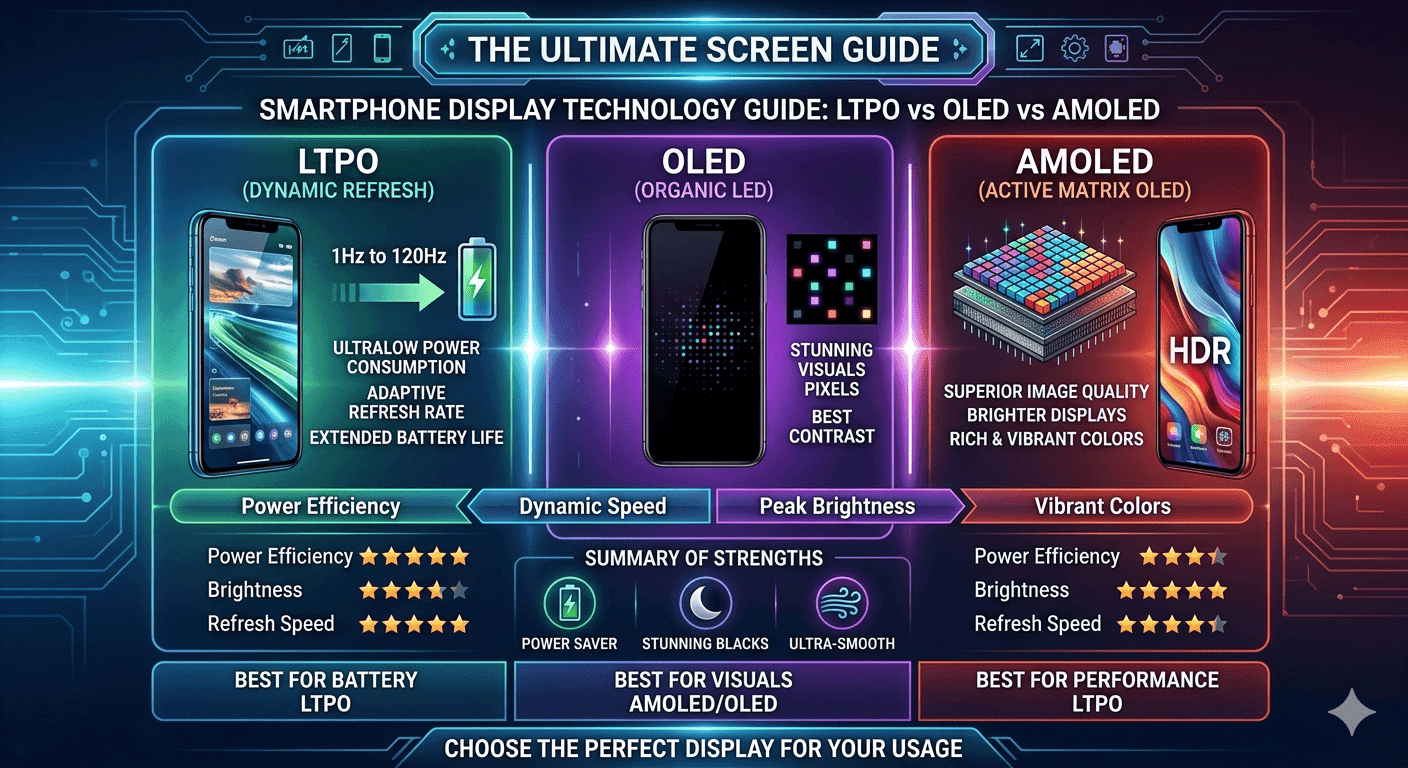
TL;DR LTPO vs OLED vs AMOLED comes down to how much refresh-rate control, battery efficiency, and premium tuning you want in a phone display. LTPO OLED is the best pick for flagship buyers, while AMOLED is the stronger mainstream choice for vivid brightness and wide availability.
Overview of LTPO, OLED, and AMOLED Displays
LTPO stands for low-temperature polycrystalline oxide, and it is not the light-emitting layer itself. It is a backplane technology for OLED displays, which means it helps control how the panel drives each pixel as the refresh rate changes over time. In an LCD comparison, that distinction matters because LTPO applies to OLED-based panels, not LCD panels.
AMOLED stands for Active Matrix Organic Light Emitting Diode, and it uses a thin-film transistor layer to control each pixel directly. That difference sounds technical, but in a smartphone, it decides how the screen behaves when you scroll, watch a video, or leave the phone idle. LTPO OLED technology is becoming the norm for flagship smartphones because it adds dynamic refresh behaviour on top of OLED.
The cleanest way to think about it is simple. OLED is the baseline category, AMOLED is a more active implementation, and LTPO adds adaptive control to OLED-based panels. If you want to understand the rest of the article, start with that hierarchy. The picture gets clearer once you see how each layer affects motion, battery use, and everyday feel.
Refresh Behaviour
LTPO OLED gives you better control over refresh behaviour than standard OLED, and that is the single biggest performance difference in daily use. The panel can switch between as low as 1 Hz and as high as 120 Hz, which means it can stay slow on static content and fast when you scroll or game. Standard OLED and AMOLED panels can still be smooth at 120 Hz, but they do not always have the same range of control.
That difference matters when you compare picture quality during motion and when the phone sits idle. A refresh rate is how many times per second the screen redraws, and LTPO OLED can move between 1 Hz and 120 Hz. That means it does not waste the same amount of power when you are reading an email in Gmail as it does when you are flicking through Instagram or scrubbing a YouTube timeline.
Brightness and Contrast
AMOLED displays offer high peak brightness and excellent contrast, and both AMOLED and LTPO OLED can achieve true black levels. That means dark scenes in Netflix, black backgrounds in Google Photos, and night mode in Chrome all look convincing because the pixels can shut off individually. The Apple iPhone 17 Pro Max uses a 6.9-inch 120Hz 3000 nits peak LTPO AMOLED display, while the Google Pixel 10a uses a 6.3-inch 120Hz 3000 nits peak AMOLED display, and the Samsung Galaxy A37 uses a 6.7-inch 120Hz 1900 nits peak Super AMOLED panel.
Those examples show a simple pattern. Brightness can be high on both technologies, but LTPO adds more control on top of that raw output. That is why the panel type matters as much as the brightness number on the spec sheet.
Power Efficiency
LTPO technology also allows for power efficiency while using high refresh rates, which is why it keeps showing up in premium phones. You get the smoothness of 120Hz without forcing the panel to behave like it is always in motion. That matters in apps like Google Maps, where the screen may stay static for long stretches, and in reading apps like Kindle, where the display does not need to redraw aggressively.
AMOLED is still efficient compared with many older panel types, but LTPO OLED is the more disciplined option when battery life and motion handling need to coexist. The hidden point most buyers miss is not how fast a panel can refresh. It is also how gracefully it can stop doing unnecessary work.
| Feature | LTPO OLED | OLED | AMOLED |
|---|---|---|---|
| Refresh rate range | 1 Hz to 120 Hz | Typically fixed or less adaptive | Commonly 120Hz on phones |
| Brightness behavior | Smooth brightness control | Good brightness, less adaptive | High peak brightness |
| Power efficiency | Strong at high refresh rates | Good, but less adaptive | Good, but less efficient than LTPO AMOLED |
| Control hardware | Dynamic backplane technology | Basic OLED driving | TFT-based active matrix control |
| Premium use | Flagship smartphones | Mid-range to premium | Mid-range to premium |
| Screen shapes | Curved and foldable support | Standard smartphone screens | Standard smartphone screens |
| Everyday feel | Most adaptable | Simple and effective | Bright and responsive |
Usage Scenarios and Practical Benefits of Each Display
AMOLED displays react instantly to touch and gestures, which is why they feel so natural in games and fast-moving apps. When you swipe in BGMI, drag layers in Figma, or scrub a timeline in Cap-Cut, the immediate response is part of the experience. In the LTPO vs OLED vs AMOLED comparison, that responsiveness is one of the first things people notice in daily use.
LTPO AMOLED goes a step further by lowering refresh rates when high motion is not needed, which helps reduce battery consumption during the boring parts of the day. That is also where the difference in picture quality becomes easier to notice in daily use. In the LTPO vs OLED vs AMOLED comparison, the trade-off is less about speed and more about how the screen behaves across a full day.
Gaming and Touch Responsiveness
That matters in rhythm games, shooters, and any app where finger timing affects the result. LTPO OLED can still be excellent for gaming, but its real strength is that it can stay fast when needed and calm down when the game ends. If you jump from a match in Call of Duty Mobile to a long session in Chrome, the screen behaviour changes with you instead of staying locked at one aggressive setting.
Battery Life and Power Savings
LTPO AMOLED panels can reduce battery consumption by lowering the refresh rate when the screen does not need to move quickly. That matters in real life because phones spend a surprising amount of time showing static content, from long email threads in Gmail to article reading in Pocket. A display that can slow itself down during those moments leaves more battery for the parts of the day that actually need power.
Longevity and Display Aging
AMOLED displays can lose quality over time due to aging, and that is the trade-off buyers should not ignore. Always-on display support is useful because it lets you glance at time and notifications without waking the whole phone, but that same always-visible behaviour can contribute to wear patterns over time. LTPO AMOLED does not remove aging concerns entirely, but it does reduce unnecessary high-refresh operation when the screen is static.
- Choose AMOLED if you want strong touch response for gaming and fast app interaction.
- Choose LTPO AMOLED if battery life matters more than keeping the screen at a fixed high refresh rate all day.
- Choose OLED if you want a capable panel and do not care about the more advanced adaptive behaviour.
- If you leave always-on display enabled, think about long-term aging rather than only day-one brightness.
- If your phone is a gaming device first, AMOLED is easy to like.
Market Trends and Pricing Comparison of Display Technologies
The display market has grown quickly, and that is part of why OLED-based panels now appear across so many smartphones. LTPO OLED technology is becoming the norm for flagship smartphones because it gives manufacturers a way to improve refresh control and power efficiency at the same time. That makes it a natural fit for premium phones that need to stand out.
The pricing story is just as important because the panel choice often tracks the whole device class. In India, mobile phones with OLED displays range from ₹8,999 to ₹1,39,997, which is a wide spread that covers budget smartphones through premium smartphones. That range matters because it shows OLED is not locked to expensive devices.
AMOLED phones can sit anywhere from affordable to premium, while LTPO OLED is mostly concentrated in flagship smartphones, where the price climbs because the display stack is more advanced. For a buyer, that means the display type often signals the phone’s broader class, not just the screen itself. Those price anchors make the trade-off easier to read.
Price Range Overview
The India price spread for OLED phones is broad enough that you can find both entry-level and near-flagship options. LTPO OLED is usually the premium choice, so you should expect it to appear in higher-priced flagships. OLED and AMOLED span the widest price range, which gives you more flexibility if budget matters.
If you want the most advanced screen behaviour, the price jump to LTPO OLED is often tied to the rest of the phone, not only the panel. The smartest way to read pricing is to treat LTPO OLED as a flagship signal, not a bargain feature. AMOLED and OLED give you more room to choose based on budget, while LTPO usually shows up when the rest of the phone is already expensive enough to support it.
Smartphone Pricing Examples
| Phone | Display Type | Price in India |
|---|---|---|
| Motorola Edge 70 | OLED | ₹27,390 |
| OnePlus Nord CE | OLED | ₹31,998 |
| Samsung Galaxy S25 | LTPO AMOLED | ₹90,091 |
| Samsung Galaxy A37 | Super AMOLED | Not listed |
| Google Pixel 10a | AMOLED | Not listed |
| Apple iPhone 17 Pro Max | LTPO AMOLED | Not listed |
Expert Opinions on Quality
AMOLED displays are of higher quality than OLEDs because they use an additional layer of TFTs and backplane technologies. That extra control hardware matters when the phone has to juggle animation smoothness, touch response, and brightness changes without making the screen feel unstable. In practice, that is why many buyers experience AMOLED phones as more polished even when the raw panel class is still OLED-based.
The difference is not magic, it is the way the panel is driven. That is why premium phones keep moving in that direction. LTPO builds on that idea by adding more adaptive control, which is why it keeps showing up in flagship devices.
Energy Efficiency Insights
LTPO AMOLED panels allow for high refresh rates and are more energy-efficient than standard AMOLED displays. If you keep asking LTPO vs AMOLED display, this is the core trade-off: LTPO is the smarter engineering choice, while AMOLED is the more common and easier-to-find choice. The right answer depends on whether you value adaptive behaviour or wider availability.
When to Skip Each Technology
- Skip LTPO if your budget is tight and you do not need adaptive refresh control.
- Skip LTPO if you mainly watch video and browse, because you may not notice the full benefit.
- Skip AMOLED if you want the most advanced battery-aware screen behaviour.
- Skip AMOLED if you are buying purely for the most premium flagship display tuning.
- Skip either one only if the phone’s total package, not the display, is the real reason you are shopping.
If you want the most efficient premium screen behaviour, LTPO OLED is the one to chase. If you want the safer, more common choice with strong visual quality, AMOLED is the cleaner pick. OLED is still useful when the phone is priced around a simpler panel stack and the rest of the device matters more.
Frequently Asked Questions
Q. What is LTPO in a smartphone display?
LTPO is the part that gives an OLED-based screen more control. Instead of holding one fixed refresh rate, an LTPO display can change dynamically, which is why LTPO OLED is becoming the norm for flagship smartphones. It also supports curved and foldable screens, so you see it in premium phones that need more flexible panel behaviour.
Q. What makes OLED different from LTPO OLED?
An OLED display uses organic light-emitting pixels, so each pixel can turn on and off independently. That gives you deep blacks because a black pixel is simply off, not dimmed behind a backlight. OLED is the broad category, and LTPO OLED sits inside it as a more advanced implementation.
Q. How does AMOLED differ from standard OLED?
An AMOLED display is a specific OLED implementation that uses active matrix control through TFT layers. Those TFTs help each pixel respond precisely, which is part of why AMOLED panels feel quick and look lively on phones from Samsung, Google, and Apple. The key point is simple: AMOLED adds active control hardware that standard OLED descriptions do not always emphasize.
Q. Which display type is better for outdoor visibility?
AMOLED is generally better for outdoor visibility than standard OLED because it can deliver strong brightness and contrast. LTPO AMOLED can match that visibility while also adding adaptive refresh behaviour, which makes it feel more complete in daily use. If outdoor readability is your main concern, AMOLED and LTPO AMOLED are the stronger options.
Q. Can AMOLED displays support always-on display features?
Yes, AMOLED displays support always-on display features, and that is one reason they are so common in smartphones. The feature works well because OLED-based pixels can stay lit individually without turning on a full backlight. LTPO OLED can do the same while also lowering refresh rates more aggressively when the screen is mostly static.
Q. Which display should most buyers choose?
Most buyers should choose LTPO OLED if they want the most efficient premium screen behaviour and can pay for a flagship phone. AMOLED is the better everyday compromise if they want vivid colour, fast touch response, and broader availability across price bands. OLED still makes sense when the phone’s overall value matters more than advanced adaptive display control.
Which Display Type Fits Your Smartphone Needs Best
LTPO vs OLED vs AMOLED comes down to how much screen intelligence you want, how much you want to pay for it, and how much you notice the difference in daily use. LTPO OLED is the most advanced of the three because it combines OLED’s per-pixel lighting with dynamic refresh control, which is why it keeps appearing in flagship smartphones. AMOLED is the more familiar high-quality option, with strong brightness, instant touch response, and wide adoption across mobile phones.
Standard OLED remains relevant, but it is the least feature-rich of the group when you compare adaptive behaviour and premium tuning. If you want a display that can move from 1 Hz to 120 Hz and save power during static tasks, LTPO OLED is the strongest fit. If you want a vivid screen without paying for the most advanced panel stack, AMOLED is the more practical choice.
For buyers who care most about battery behaviour, LTPO OLED deserves the first look. For buyers who care more about price flexibility and broad availability, AMOLED is easier to recommend. OLED still works well when the rest of the phone matters more than the panel itself, but it gives you fewer premium display features.
Best Smartphone Display Choice for Most Buyers in 2025
For most buyers, LTPO OLED is the best long-term display choice if the phone already sits in the flagship class. It combines per-pixel lighting with adaptive refresh control, so it can save power during static tasks while still delivering smooth motion when you scroll, game, or watch video. That makes it the most balanced option for people who want premium behaviour without thinking about the screen all day.
AMOLED is the smarter pick for shoppers who want vivid colour, strong brightness, and a display type that appears across more price bands. It gives you a polished experience without forcing you into the highest-priced phones. Standard OLED still has a place, especially when the rest of the device offers better value than the panel stack alone.
If you are deciding today, choose LTPO OLED for flagship-level efficiency and control, or choose AMOLED if you want a vivid screen without paying for the most advanced panel stack. If your budget is tighter, OLED remains a capable option and still covers the basics well. The best move is to match the display to how you use your phone, then pick the panel that fits your budget and daily habits.
Ready to upgrade your tech?
Browse our collection of quality refurbished products at unbeatable prices.






