LPDDR Memory vs Upgradeable RAM: Which Laptop Lasts Longer?
LPDDR memory and upgradeable RAM serve different purposes. LPDDR delivers better power efficiency and high-speed performance for thin laptops, while upgradeable RAM offers greater flexibility, repairability, and future expansion for users planning long-term upgrades.

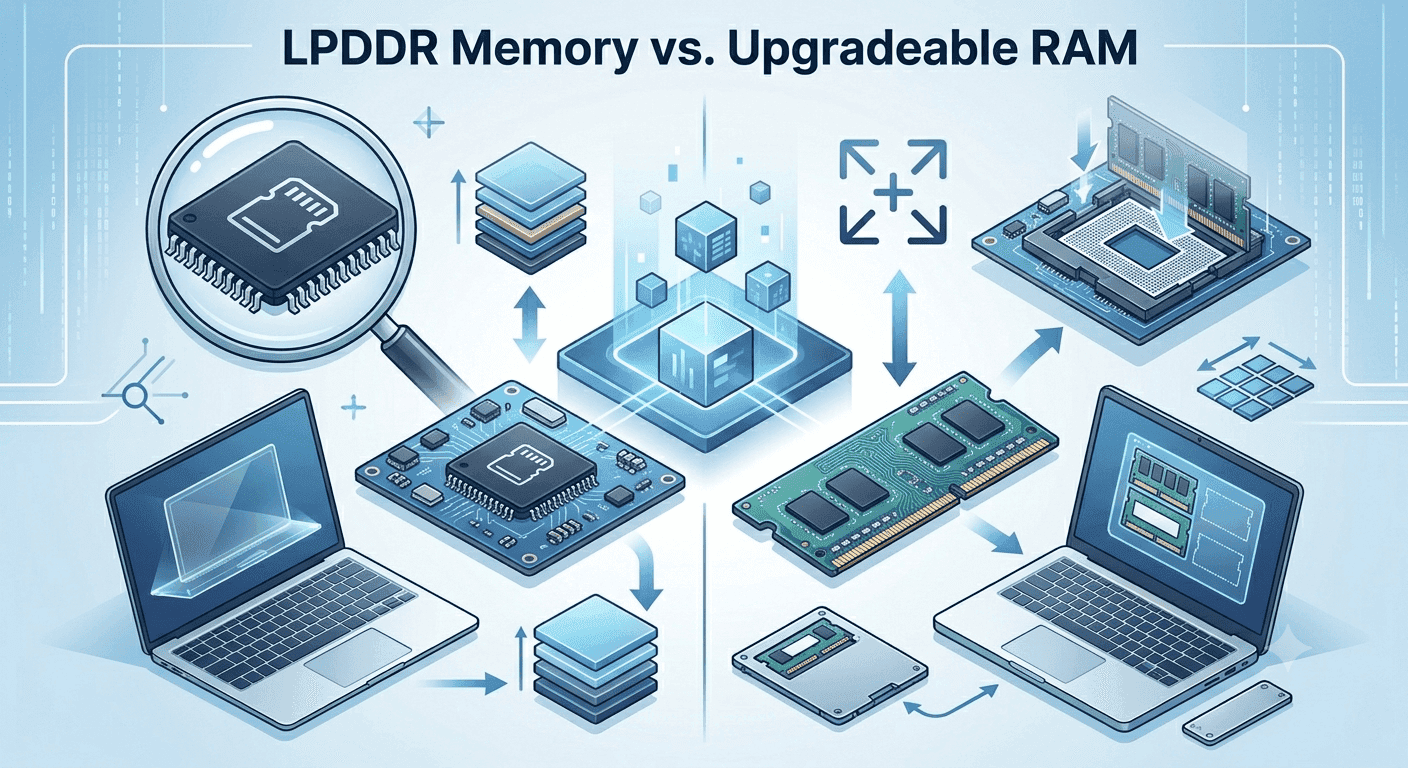
TL;DR LPDDR Memory vs Upgradeable RAM is a trade-off between efficiency and flexibility: LPDDR fits thin devices because LPDDR5X reaches 8533 Mbps with lower power use, while upgradeable RAM is better if you want later expansion and repairability.
LPDDR Memory and Upgradeable RAM Key Features
LPDDR stands for Low Power Double Data Rate, and the name is accurate. It is a DRAM standard tuned for low energy use, high bandwidth, and mobile computing devices that need to stay responsive without draining the battery. LPDDR5X pushes that idea further with data rates up to 8533 Mbps, which is why it shows up in smartphones, tablets, and ultra-thin laptops where every bit of power matters.
That speed is not just for benchmarks. It helps the CPU and GPU feed data quickly enough for app switching, camera pipelines, on-device AI inference, and smooth multitasking. If you edit in Adobe Premiere Pro, jump between Chrome tabs, and keep Slack open all day, the memory subsystem matters more than most people think.
Upgradeable RAM is the older, more flexible model most people picture when they think of memory. It uses traditional DDR5 modules that can be added, swapped, or expanded in desktops and some laptops. That makes it easier to extend device lifespan when your workload grows, especially if you move from light office work to Photoshop, Visual Studio, or local virtual machines.
The catch is simple: once LPDDR is soldered to the motherboard, you do not get that path back later. That is the central design trade-off in LPDDR Memory vs Upgradeable RAM, and it matters most when you keep a machine for years. A system that starts feeling cramped in year three is usually a memory problem before it is a CPU problem.
A major reason LPDDR behaves differently is that it is engineered around power management, not just raw capacity. LPDDR memory generally operates at a lower voltage than standard DRAM products, and it uses techniques such as Dynamic Voltage and Frequency Scaling to adjust power use based on demand. In practical terms, that helps devices stretch battery life during browsing, note-taking, and streaming, while still having enough bandwidth available when a workload suddenly spikes.
Why has low-power memory become the default in mobile design?
LPDDR is designed for mobile devices, so the memory package has to do more with less. The standard is maintained by JEDEC, which keeps the behaviour of LPDDR4, LPDDR4X, LPDDR5, and LPDDR5X consistent enough for device makers to build around it. That is why the category has become embedded in smartphones, tablets, and thin laptops instead of staying a niche option.
Samsung, SK Hynix, and other memory makers have pushed LPDDR forward because mobile platforms keep asking for more bandwidth without a matching jump in power draw. When a phone records 4K video, runs a camera command, or keeps an AI assistant active, the memory has to move data fast without wasting energy. That is the whole point of the design.
- LPDDR focuses on low power consumption and high bandwidth for mobile devices.
- Upgradeable RAM focuses on user flexibility, repairability, and later expansion.
- LPDDR5X reaches 8533 Mbps, which places it at the top of the low-power memory stack.
- LPDDR5X is the flagship low-power memory solution when a device needs the fastest speeds with the lowest practical power profile.
Why the Packaging Matters?
LPDDR is usually soldered using BGA, or Ball Grid Array, packaging. That matters because high-speed memory needs stable signal integrity, and direct board attachment helps keep the data path short and reliable at fast rates. The same packaging choice also removes socketed flexibility, so the memory becomes part of the device design instead of a removable component.
This is why LPDDR memory is typically fixed in place and is not designed for upgradeability. If a laptop uses LPDDR, the memory chips are part of the board layout, not a user-facing module. JEDEC, the Solid State Technology Association, maintains the LPDDR standard, which keeps the naming and electrical behavior consistent across generations.
In practical terms, the packaging choice affects repair, upgrade, and command latency in different ways. A removable DDR4 stick can be replaced in minutes. A soldered LPDDR chip usually cannot. The trade-off is simple: better integration now, fewer options later, including less room for future upgradeability.
LPDDR also uses self-refresh, which fits its low-power design.
What soldering changes for real-world ownership
Soldered memory favours compact design, but it locks in your memory capacity. That is a good fit for a thin laptop that lives on battery and sits in a backpack all day. It is a bad fit if you expect the machine to grow with heavier data work later.
The board-level approach also keeps the signal path short, which helps at high clock speeds. That is one reason LPDDR can reach strong data rate numbers while keeping voltage low. Compared with DDR4, the difference is not just packaging, but the memory is intended to be used differently.
- LPDDR is soldered directly to the motherboard, so it cannot be swapped like a normal module.
- Upgradeable DDR4 supports later replacement, which helps with repairability and long-term flexibility.
- Socketed memory is the safer choice if you want a machine that can grow with your workload.
Performance and Power Efficiency Comparison
LPDDR5 and LPDDR5X are not just incremental revisions. LPDDR4 tops out at 3200 Mbps, LPDDR5 reaches 6400 Mbps, and LPDDR5X goes even further. That jump matters when you move large app data, load camera pipelines, or keep multiple browser tabs and creative tools open at once, because memory bandwidth becomes a real bottleneck before the CPU does.
The power story is just as important. LPDDR memory can consume 50% to 70% less power than standard DDR memory of the same generation, and that is not a small optimization. In a phone or tablet, it directly affects how long the device stays usable between charges. In thin laptops, it also helps the chassis stay cooler during sustained multitasking.
Samsung and SK Hynix both build around this low-power model because modern mobile systems keep asking for more data movement without more heat. When a device handles a camera command, a spreadsheet refresh, or an AI prompt, the memory controller has to balance speed while keeping consumption under control. That is where LPDDR earns its place.
Voltage and dynamic control
LPDDR4 is designed to run at 1.1V, LPDDR4X can run at 0.6V, and LPDDR5 operates at 1.05V. Lower voltage is not just a spec-sheet detail. When you are idle in Slack or reading documents, the memory can stay quiet.
When you launch Premiere Pro or a heavy AI workload, it ramps up. That is why LPDDR uses refresh control, low voltage modes, and clock management more aggressively than older memory designs.
| Memory Type | Max Data Rate | Typical Voltage | Practical Use |
|---|---|---|---|
| LPDDR4 | 3200 Mbps | 1.1V | Older mobile and thin-device designs |
| LPDDR4X | 4266 Mbps class | 0.6V | Lower-power mobile systems |
| LPDDR5 | 6400 Mbps | 1.05V | Mainstream high-bandwidth mobile memory |
| LPDDR5X | 8533 Mbps | Lower-power flagship profile | Fastest low-power option |
| Typical DDR | Generation-dependent | Higher than LPDDR | Desktops and upgradeable systems |
What the numbers mean in real use?
A memory subsystem that wastes less energy gives you two things at once: more runtime and less heat. That matters if you spend long stretches in Google Sheets, Figma, or browser-heavy research work, because the device stays cooler and more consistent under load.
It also matters in thin laptops where thermal headroom is limited, and the memory cannot rely on large cooling systems to hide inefficiency. The bit width and channels also matter here. LPDDR uses wide, efficient data paths to move data quickly without the same overhead you see in older desktop-oriented designs.
In plain English, the memory can write data fast enough for modern mobile apps, but it does so with less electrical waste.
- LPDDR5 delivers a clear bandwidth jump over LPDDR4.
- LPDDR5X is the flagship low-power choice when you need the fastest LPDDR speeds.
- BGA soldering helps keep high-speed signaling stable in compact designs.
- Lower voltage and smarter refresh behavior are why LPDDR stays efficient under load.
Upgradeability and Design Constraints Compared
LPDDR changes the upgrade story because it is engineered as part of the system rather than as a user-serviceable component. That means the conversation around LPDDR Memory vs Upgradeable RAM is not just about capacity, it is also about how the device is built, cooled, and serviced over time.
LPDDR5X can reach data rates of up to 8533 Mbps, which is excellent for bandwidth-heavy tasks, but the trade-off is that the memory configuration is usually fixed at the factory. This design approach is tightly linked to low-power engineering. LPDDR, short for Low Power Double Data Rate, is optimized to deliver high bandwidth while using significantly less power than standard DDR memory.
It generally operates at lower voltages than conventional DRAM products, and that is a big reason it fits mobile devices so well. LPDDR3 followed the same low-power design philosophy, while newer generations like LPDDR5 and LPDDR5X pushed performance further. Traditional DDR memory sits in DIMM or SO-DIMM slots, so users can add capacity later, mix configurations within supported limits, or replace a failing stick without changing the entire board.
That flexibility matters in real workflows, such as a video editor using Adobe Premiere Pro and After Effects, or a developer running Docker, Android Studio, and a local PostgreSQL database at the same time. In a desktop or a repair-friendly laptop, that can extend the machine’s useful life in a very direct way.
Upgradeable RAM changes ownership
The maintenance difference is just as important as the upgrade difference. With upgradeable RAM, a bad module can often be isolated and replaced, which simplifies troubleshooting and can reduce downtime for systems used in business or content production.
With LPDDR, the memory is part of the mainboard assembly, so a memory fault may require board-level repair or a full motherboard replacement rather than a simple swap. That is why LPDDR is not designed for upgradeability and is rarely available in socketed form, despite its strong performance characteristics.
For owners who care about long-term serviceability, that limitation is one of the biggest practical drawbacks. It is also why a machine with LPDDR should be bought with future data needs in mind, not just today’s workload.
- LPDDR is fixed to the motherboard, so it cannot be swapped like a normal module.
- Upgradeable DDR4 supports later replacement, which helps with repairability and long-term flexibility.
- Socketed memory is the safer choice if you want a machine that can grow with your workload.
Where DDR still wins?
Upgradeability still matters in desktops, gaming towers, creator workstations, and some business laptops. If you use a local database, run virtual machines, or build a photo library in Lightroom, the ability to add memory later is often more useful than shaving a few watts off the power budget.
That is especially true when a workflow changes after purchase. LPDDR memory is often used in mobile devices because it is tuned for high bandwidth and low energy use, and some implementations can consume 50% to 70% less power than standard DDR of the same generation.
LPDDR3 and newer LPDDR generations reflect that same trade-off: efficiency and integration over user upgradeability.
Applications and Market Trends for Both Memories
Beyond the basic mobile vs. desktop split, the applications and market trends for LPDDR Memory vs Upgradeable RAM are being shaped by how devices are actually used day to day. LPDDR stands for Low Power Double Data Rate, and that low-power design is what makes it attractive in systems that stay active all the time, from always-connected laptops to compact industrial controllers.
In practice, LPDDR5X can reach data rates of up to 8533 Mbps, which gives device makers the bandwidth they need for modern multitasking, high-refresh displays, and on-device AI features. The clearest growth story for LPDDR memory is in product categories that prioritize thinness, battery life, and integrated design. That same approach is spreading into ultra-thin laptops, where manufacturers want a slimmer chassis and fewer internal components, even if that means the memory cannot be upgraded later.
In these environments, power efficiency and bandwidth are often more important than later expansion. A practical example is a content creator using Adobe Premiere Pro on a thin-and-light laptop for travel work. If the machine ships with LPDDR memory, the workflow benefits from efficient multitasking, smoother timeline scrubbing, and lower fan noise during exports, but the user has to choose the memory capacity carefully at purchase because the RAM is typically soldered to the motherboard and non-upgradable.
That is a major difference from a desktop running Blender or After Effects, where socketed DDR modules can be replaced or expanded later as projects become more complex.
Where LPDDR is spreading fastest?
The reason is simple. These systems need high bandwidth, low-voltage behavior, and compact packaging. They do not benefit much from removable memory if the rest of the machine is designed to be sealed and efficient.
September product cycles often highlight this shift because phone makers and laptop brands like to refresh their premium lines around that time. Samsung, in particular, has helped normalize LPDDR in flagship mobile platforms, and the broader market keeps moving in the same direction.
The trend is not about style, it is about managing power while keeping data moving quickly. The market numbers reflect that momentum. The LPDDR RAM market size is projected to hit USD 49457, and LPDDR5 units are also growing by over 43% year over year, which shows how quickly AI-enabled mobile processors are adopting the standard.
Python data analysis today and video editing next year, socketed DDR makes it easier to add capacity instead of replacing the entire system. That matters in organizations that standardize hardware but need room for different roles. A marketing team using Canva and Photoshop has very different memory needs from an engineering team running Visual Studio, MATLAB, or local virtual machines.
Upgradeable RAM gives both groups room to adapt without forcing a new purchase every time the workload changes. LPDDR does not offer that kind of room, which is why the choice is so important up front.
- LPDDR5 is strong when you want a fixed, efficient configuration.
- Lower voltage in LPDDR helps efficiency, but it does not create upgrade room.
- Samsung, SK Hynix, and other suppliers keep LPDDR moving deeper into mobile and AI hardware.
| Spec | LPDDR4 | LPDDR4X | LPDDR5 |
|---|---|---|---|
| Voltage | 1.1V | 0.6V | 1.05V |
| Peak Speed | 3200 Mbps | 4266 Mbps class | 6400 Mbps |
| Capacity Model | Fixed | Fixed | Up to 32GB module capacity |
Choosing Between LPDDR Memory and Upgradeable RAM
The right choice depends on what you value more, mobility or upgradeability. LPDDR gives you low power consumption, strong performance, and a cleaner fit for thin devices, while upgradeable RAM gives you flexibility, repairability, and the option to expand later.
LPDDR, short for Low Power Double Data Rate, is built around efficiency first. It is designed to deliver high bandwidth while using significantly less power than standard DDR, and that matters in devices that spend hours away from a charger. LPDDR5X can reach data rates of up to 8533 Mbps, which shows that soldered memory is not automatically slow or limited.
In many modern systems, LPDDR also uses lower operating voltages and power-management techniques such as DVFS, which helps extend battery life and reduce heat in compact chassis. That design choice makes it non-upgradable, and in many cases, it is also soldered in place.
Upgradeable RAM takes the opposite approach. Traditional DDR modules can be removed, replaced, or expanded later, which is a major advantage for users whose workloads may change. If you start with 32GB and later move into heavier projects, you can often install more memory instead of replacing the whole machine. Flexibility is the main advantage here, especially when your needs are changing.
Who Should Buy LPDDR or Upgradeable RAM?
LPDDR Memory vs Upgradeable RAM comes down to whether you want efficiency now or flexibility later. The market data also shows why LPDDR keeps spreading: the LPDDR RAM market size is projected to hit USD 49457, and LPDDR5 units are growing by over 43% year over year.
If you are buying for travel, battery life, and compact design, choose LPDDR. It fits thin laptops, smartphones, tablets, and other systems where low power use matters more than later expansion. If you are buying for long-term serviceability and future upgrades, choose upgradeable RAM. It fits desktops, gaming towers, creator workstations, and some business laptops where memory needs can grow over time.
For most buyers, the safest move is to match the memory type to the device’s real job. Choose LPDDR when the machine will stay portable and sealed, and choose upgradeable RAM when you expect the workload to change. Before you buy, check whether the memory is soldered or socketed, then decide based on how long you plan to keep the system.
Frequently Asked Questions
Q. What is the main difference between LPDDR Memory vs Upgradeable RAM?
LPDDR is designed for low power use and is usually soldered to the motherboard, while upgradeable RAM uses removable DDR modules. LPDDR5X can reach 8533 Mbps, which makes it fast enough for thin laptops and mobile devices. Upgradeable RAM is better when you want later expansion, repairability, or a longer upgrade path.
Q. Why do thin laptops often use LPDDR instead of socketed RAM?
Thin laptops use LPDDR because it supports compact design, lower voltage operation, and strong bandwidth in a sealed chassis. LPDDR4X can run at 0.6V, and LPDDR5X reaches 8533 Mbps, so manufacturers can achieve efficiency without sacrificing speed. The trade-off is that the memory is usually fixed at the factory.
Q. How much power can LPDDR save compared with standard DDR?
LPDDR memory can consume 50% to 70% less power than standard DDR memory of the same generation. That lower power draw improves battery life in phones and tablets and reduces heat in thin laptops. The savings are one reason LPDDR has become common in mobile platforms.
Q. Which option is better for long-term upgrades?
Upgradeable RAM is better for long-term upgrades because you can add or replace modules later. Traditional DDR in DIMM or SO-DIMM slots makes it easier to move from 32GB to a higher capacity if your workload grows. LPDDR does not offer that flexibility because it is soldered into the board.
Q. What LPDDR speeds should buyers know about?
The key numbers are 3200 Mbps for LPDDR4, 6400 Mbps for LPDDR5, and 8533 Mbps for LPDDR5X. Those speeds matter for multitasking, camera pipelines, and on-device AI features. If you want the fastest low-power option in this group, LPDDR5X is the top end.
Q. Where is LPDDR growing fastest in the market?
LPDDR is growing fastest in smartphones, tablets, ultra-thin laptops, and AI-focused mobile devices. The article notes that LPDDR5 units are growing by over 43% year over year, and the LPDDR RAM market size is projected to hit USD 49457. That growth reflects demand for efficient, integrated memory in compact systems.