
How Smartphone Cooling Systems Work: Vapor Chamber vs Graphite Sheets
Vapor Chamber vs Graphite Sheets: Vapor chambers offer superior heat transfer and sustained cooling for high-performance devices, while graphite sheets provide flexible, thin thermal spreading for compact electronics. The best choice depends on performance needs vs space constraints.

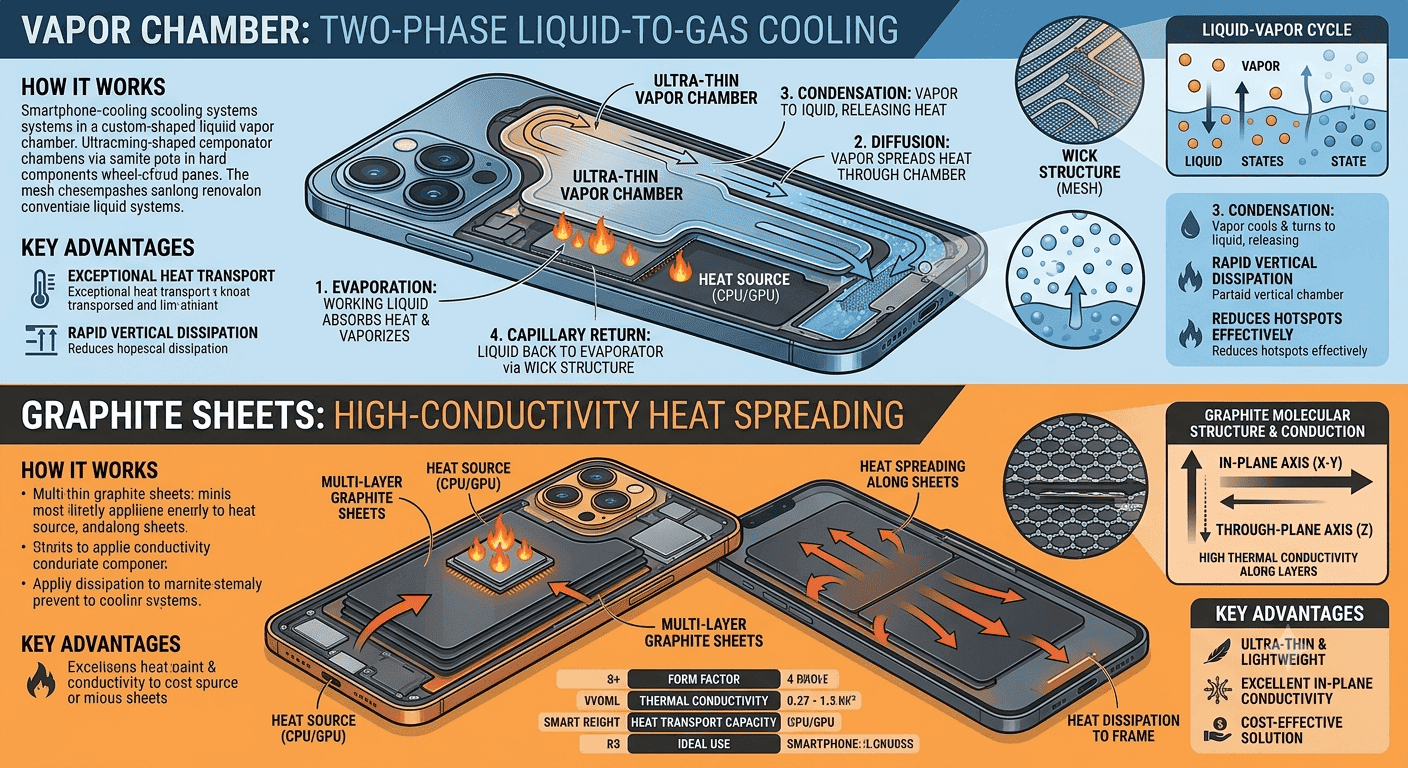
TL;DR Vapor Chamber vs Graphite Sheets comes down to a simple trade-off: vapor chambers move heat faster and farther, while graphite sheets fit better in thin, flexible device layouts. For sustained phone, laptop, and gaming workloads, the chamber usually wins on thermal performance, but graphite still makes sense when packaging space is tight.
Overview of Vapor Chambers and Graphite Sheets
Vapor chambers and graphite sheets both solve thermal bottlenecks, but they do it in different ways. In the Vapor Chamber vs Graphite Sheets discussion, the main distinction is that a vapor chamber uses a two-phase mechanism. Liquid inside the sealed chamber evaporates at the hot spot, moves as vapor, then condenses in cooler regions and returns by capillary action. That cycle gives it a very high heat transfer rate, and in practice vapor chambers can transfer heat more effectively than thermal straps.
Vapor Chambers Work
From a design standpoint, a vapor chamber is essentially a flat heat pipe with very high thermal conductance and flat surfaces on both the top and bottom sides. That geometry allows it to sit directly under a processor, camera module, or power-hungry RF section and spread heat across a much larger footprint. Industry data shows vapor chambers can match the power handling capacity of multiple heat pipes, from a few watts to over a kilowatt, and they are well-suited for electronics cooling where power density is roughly 20 W/cm² to 500 W/cm². Their effective thermal conductivity can reach up to 20,900 W/mK, which is far beyond what a typical solid sheet can do. They are also more effective than solid metal bases at reducing hot-spot temperatures across large heat sink footprints, which is one reason they are now common in high-performance phones, gaming consoles, CPUs, and graphics cards.
Where Graphite Sheets Fit
Graphite sheets take a different approach. Rather than using phase change, they spread heat across a broad plane and help equalize temperature across the device. In smartphones, laptops, and notebooks, this makes them useful for moving heat away from a localized chip and into the frame, rear cover, or other dissipation surfaces. Graphite sheets can deliver in-plane thermal conductivity around 800 W/mK, and some planar grades reach about 1500 to 1900 W/(m·K), with reported values up to 1950 W/(m·K). Even so, vapor chambers still offer superior thermal conductivity compared with commonly used graphite sheets in thin devices, and vapor chamber spreading can be at least 4 times better than graphite sheet spreading. That difference becomes very noticeable when a device is under sustained load rather than just short bursts of activity.
The thermal resistance story matters in real use. Vapor chambers also decrease cooling assembly thermal resistance by 50% in some implementations, which helps explain why they are increasingly popular in electronic devices such as computers, gaming consoles, and smartphones. They can also be made as wide as 150 mm, giving engineers a large surface area from which to dissipate heat. Typical thickness ranges from 2.5 to 4 mm, depending on how much power must be moved or spread, so they are not always the thinnest option, but they are often the most aggressive solution when the goal is to flatten temperature peaks quickly.
A practical example makes the trade-off clearer. Imagine editing a 4K timeline in Adobe Premiere Pro on a mobile workstation or running a sustained gaming session in Genshin Impact while screen brightness, modem activity, and GPU load all stay high. A vapor chamber can pull heat away from the SoC and distribute it fast enough to delay throttling, while a graphite sheet helps broaden the heat footprint across the chassis and reduce touch-point hot spots. In a laptop using a vapor chamber sheet-style assembly, the chamber often sits in place of the base plate in a standard metal heat sink or heat pipe design, while graphite sheets are layered elsewhere to manage secondary heat zones. That layered strategy is common because the two components are not interchangeable; they complement different parts of the cooling stack.
Graphite sheets still have unique advantages in many scenarios, and that is why they remain relevant instead of being replaced outright. They are commonly used in the electronics industry for thermal management in smartphones, and they are also found in laptops and notebooks, where flexible integration and thin packaging are important. In some applications, graphite sheets are the better or only choice because the layout, weight budget, or assembly constraints make a vapor chamber impractical. They are also used in non-device thermal applications such as flange gaskets, which shows how versatile the material can be.
Heat Transfer Efficiency and Thermal Performance Comparison
The thermal numbers make the hierarchy obvious. Vapor chambers can reach an effective thermal conductivity of up to 20,900 W/mK. Graphite sheets are typically reported around 800 W/mK in-plane and 1500 to 1900 W/(m·K) in the planar direction. Some sources place them as high as 1950 W/(m·K). That gap is why vapor chambers are treated as the stronger heat transfer solution in thin devices with copper components and tightly packed pipes and vapor paths.
They do not just move heat. They spread it aggressively across the cooling surface. A key detail often missed in casual comparisons is spreading performance, not just conductivity. Vapor chamber spreading is at least 4 times better than graphite sheet spreading. That means heat does not stay trapped near the source for as long. That matters in phones because the source area is tiny. The user feels the temperature rise quickly if heat cannot move sideways fast enough. A vapor chamber sheet can therefore reduce localized hot spots more effectively than a simple graphite layer.
Side-by-side thermal comparison
| Feature | Vapor Chamber | Graphite Sheet |
|---|---|---|
| Effective thermal conductivity | Up to 20,900 W/mK | Around 800 W/mK in-plane, 1500 to 1900 W/(m·K) planar, up to 1950 W/(m·K) |
| Heat spreading | At least 4 times better than graphite sheet | Good planar spreading, but lower than vapor chambers |
| Thermal resistance | Lower in cooling assemblies | Higher than vapor chambers in comparable thin-device use |
| Heat transfer behavior | High heat transfer rate with slight temperature difference between hot and.. | Spreads heat across a flat area, but with less force than vapor chambers |
| Structure | Flat heat pipes with top and bottom surfaces | Planar sheet material |
| Best thermal role | Rapid diffusion and dissipation | Surface spreading in compact devices |
| Relative capability | Superior thermal conductivity in thin devices | Useful, but less aggressive |
What those numbers mean in real use?
A phone with graphite sheets can still keep surface temperatures more manageable, especially when the chassis is thin and the cooling stack has little depth. A device that only needs moderate thermal control may not require the added complexity of a chamber-based stack. The practical verdict from the performance side is direct: vapor chambers win on heat transfer and thermal conductivity, and graphite sheets win only when the device design cannot accommodate a chamber.
In many products, the choice depends on how vibration is managed inside the assembly and how the working fluid is contained within the cooling stack. That is one reason engineers often treat the two materials as part of a broader thermal system rather than as direct substitutes. The result is usually a design that balances peak heat movement with structural limits.
Vapor Chamber Use Cases
In the Vapor Chamber vs Graphite Sheets discussion, the biggest deciding factor is not just raw thermal conductivity, but how heat has to move inside the device. Vapor chambers are flat heat pipes with high thermal conductance on both sides, so they can take heat from a concentrated source and spread it quickly across a larger footprint. That makes them especially effective when a chip produces a hot spot under sustained load, because they can move large amounts of heat with only a slight temperature difference between the hot and cold ends.
In practical terms, vapor chambers can match the power handling capacity of multiple heat pipes, from a few watts to over a kilowatt, and they are well suited for electronics cooling where power density is roughly 20 W/cm² to 500 W/cm². This is why premium gaming phones, creator phones, and compact devices with aggressive performance tuning are the most natural fit for a vapor chamber. If a handset is running a long Genshin Impact session, recording 4K or 8K video, or processing AI-based image enhancements after capture, the thermal load is not brief; it is sustained and concentrated.
A vapor chamber sheet can reduce thermal resistance across the entire cooling stack, and industry sources note that vapor chambers can decrease cooling assembly thermal resistance by 50% while being more effective than solid metal bases at reducing hot-spot temperatures across large heat sink footprints. That makes them a strong choice when the device must hold performance for longer periods without creating a single hot spot on the frame or back cover.
Graphite Sheet Fit
By contrast, graphite sheets continue to make sense in devices where geometry and packaging dominate the decision. They can be cut, layered, and shaped to cover uneven surfaces, antenna cut-outs, battery edges, and camera modules without forcing a redesign of the internal stack. That flexibility is a major reason they remain common in ultra-thin phones, where even a 2.5 to 4 mm cooling structure can be difficult to accommodate, especially when the chassis already has to hold a large battery, multiple sensors, and a dense board layout.
Those are strong numbers, but vapor chambers still offer superior thermal conductivity in thin devices, and vapor chamber spreading is reported to be at least 4 times better than graphite sheet. That difference becomes important when the device has a high-power application processor or when the thermal source is small and intense, because graphite helps move heat laterally while the chamber can redistribute it more broadly across the enclosure. A useful way to think about the choice is by the software workload that drives heat generation. For example, a phone used for Adobe Lightroom mobile edits, CapCut exports, or a long recording session in the native camera app may require a cooling system that can handle repeated bursts and extended load without saturating.
- Vertical space matters because a few millimeters can decide whether the battery fits properly.
- Surface area matters, because a wider chamber can spread heat over more of the chassis.
- Component layout matters because cameras, antennas, and boards all compete for the same internal volume.
For smartphone cooling, this means the best thermal solution is not the largest one. It is the one that matches the heat source, the available stack height, and the performance target. If you are building a device around a high-wattage processor or a sustained gaming workload in apps like Fortnite Mobile or LumaFusion, the chamber geometry makes sense. If you are working inside a thin industrial design envelope, graphite sheets are easier to place and easier to keep.
Market Trends and Expert Insights on Cooling Technologies
Vapor Chambers in Premium Devices
Market trends in the Vapor Chamber vs Graphite Sheets debate point to a clear split in how smartphone makers are thinking about thermals. Vapor chambers are increasingly treated as a performance enabler, while graphite sheets remain a dependable, layout-friendly material for everyday thermal spreading. Manufacturers are not replacing one with the other across the board, they are matching the cooling part to the device class, internal space, and sustained workload target.
The technical reason vapor chambers are getting more attention is straightforward. They provide a high heat transfer rate and can move heat more effectively than thermal straps, while also offering superior thermal conductivity compared with commonly used graphite sheets in thin devices. Because vapor chambers are composed of flat heat pipes with very high thermal conductance and flat top and bottom surfaces, they can transport large amounts of heat with only a slight temperature difference between the hot and cold ends. That makes them especially useful when the device must keep peak temperatures under control without creating a single hot spot on the frame.
Expert commentary consistently points to thermal resistance as the key design metric. Vapor chambers decrease cooling assembly thermal resistance by 50%, and they are more effective than solid metal bases at reducing hot-spot temperatures across large heat sink footprints. This is why they are often used in place of the base plate in a standard metal heat sink or heat pipe in a two-phase heat sink design. In smartphones, that translates into better sustained performance during long gaming sessions, 4K video capture, or AI-heavy workloads such as on-device photo enhancement. A chamber can also match the power handling capacity of multiple heat pipes, from a few watts to over a kilowatt, which helps explain why it is showing up not just in phones but also in CPUs, graphics cards, gaming consoles, and other high-density electronics.
Graphite Sheets in Mainstream Designs
Graphite sheets still have a meaningful place in the market because they solve a different problem very well. They are commonly used in smartphones, laptops, and notebooks for thermal management, and they remain a practical option where thickness, flexibility, and broad-area heat spreading matter more than maximum heat transfer intensity. Their planar thermal conductivity can be very high, with reported values around 800 W/mK and in some cases 1500 to 1900 W/(m·K), which is why they continue to serve as a reliable background layer in many phone designs.
In other words, graphite sheets are not a fallback technology so much as a layout-efficient one. A real-world example shows both materials are used together in product development. In a smartphone thermal simulation workflow using ANSYS Icepak or COMSOL Multiphysics, an engineer might model the SoC, battery, display stack, and midframe, then compare a graphite-sheet-only design against a design that adds a vapor chamber over the main board. The simulation often shows that the chamber lowers peak junction temperature more effectively during a sustained benchmark or a 20-minute 4K recording session, while the graphite layer helps spread residual heat toward the rear housing and side rails. That kind of workflow is common because product teams care about both thermal performance and mechanical constraints, not just one metric in isolation.
The most useful expert takeaway is that the market is segmenting rather than converging on a single winner. Vapor chambers are increasingly popular in electronic devices where heat dissipation is crucial, especially when power density falls roughly between 20 W/cm² and 500 W/cm² and the design needs to support sustained high load. Graphite sheets, meanwhile, remain deeply embedded in mainstream mobile thermal stacks because they are easy to integrate and still provide dependable heat spreading across large surface areas. Each has advantages and disadvantages, and the choice depends on the device tier, available space, and thermal target.
Choosing Between Vapor Chambers and Graphite Sheets
When Vapor Chambers Win
The cleanest answer is that vapor chambers are better at moving heat, but graphite sheets are better at fitting real smartphone constraints. In thin devices, that matters because the hottest area is often not the entire chassis but a small zone around the SoC, modem, or power delivery circuitry. Compared with commonly used graphite sheets in thin devices, vapor chambers offer superior thermal conductivity and can transport large amounts of heat with only a slight temperature difference between the hot and cold ends. That is why the real decision in the hardware is not just performance, but performance under packaging limits.
From a pure thermal standpoint, vapor chambers are the stronger engineering tool. They can match the power handling capacity of multiple heat pipes, ranging from a few watts to over a kilowatt, and are well suited for electronics cooling where power density falls roughly between 20 W/cm² and 500 W/cm². Their effective thermal conductivity can reach up to 20,900 W/mK, which helps explain why they are so effective at flattening temperature spikes during sustained workloads. That is a major reason they are favoured when hot-spot control matters more than absolute simplicity.
Why Graphite Sheets Still Matter
Graphite sheets still retain unique advantages in many scenarios because they are easy to integrate into crowded device stacks. They are commonly used in smartphones, laptops, and notebooks for thermal management, especially when the design needs a flexible layer that can conform around batteries, antennas, camera modules, and board cut-outs. A graphite sheet can be laid into narrow gaps and curved internal layouts without forcing the chassis to absorb a thicker cooling component. In a compact handset, that can be the difference between a workable thermal path and a design that becomes too difficult to assemble.
For devices with moderate heat output, graphite often provides enough diffusion to keep surface temperatures comfortable without adding mechanical complexity. A useful way to think about the split is workload intensity. Vapor chambers are particularly useful in devices such as graphics cards and CPUs, where heat dissipation is crucial, and the same logic carries over to premium smartphones that run long gaming sessions, 4K video capture, or AI-enhanced camera processing. Vapor chambers are more effective than thermal straps and can outperform solid metal bases at reducing hot-spot temperatures across large heat sink footprints, but that advantage only matters if the product can physically accommodate the part.
In other words, a chamber solves a heat problem, while a graphite sheet solves a space problem. A practical example is a smartphone thermal validation workflow in ANSYS Icepak or Cadence Celsius Thermal Solver. An engineer might model a Snapdragon-based board under a gaming load from Call of Duty Mobile, compare the SoC junction temperature with a graphite-sheets-only stack, then replace the sheet with a vapor chamber sheet and rerun the transient simulation. The chamber often lowers the peak temperature and smooths the gradient between the processor and the midframe, which can reduce throttling during long sessions. If the device is already close to its thickness target, though, the extra 2.5 to 4 mm thermal component can be hard to justify structurally. That is where the vapor chamber sheet becomes a limited premium thermal option, while graphite remains the easier integration path.
The best choice also depends on how heat is distributed inside the enclosure. Vapor chambers can be as wide as 150 mm, giving them a large surface area from which to dissipate heat, which is useful in larger handsets and tablets where the goal is to spread heat away from a concentrated source. Graphite sheets, by contrast, are especially effective as planar spreaders in the exact areas where designers need a thin, lightweight thermal layer. Some modern builds even combine both: a vapor chamber near the processor to handle the main thermal load, plus graphite film or sheet material to move residual heat toward the frame and back cover. That hybrid approach is common because it balances high-performance cooling with packaging flexibility.
- Choose vapor chambers when sustained heat and hot spots are the main problem.
- Choose graphite sheets when thickness and layout flexibility matter more than peak cooling.
- Skip vapor chambers in ultra-thin devices that cannot spare the height.
- Skip graphite sheets when the device needs aggressive thermal spreading under heavy load.
Vapor Chamber Basics
A vapor chamber is a flat, sealed two-phase heat spreader with very high thermal conductance, built to move heat quickly across a broad area. Graphite sheets, by contrast, are a practical thermal spreader for tight stacks, helping move heat away from hotspots without demanding much vertical space. The reason the vapor chamber stands out is that it can handle serious thermal loads with very low temperature difference between the hot and cold ends.
Industry references note that vapor chambers can match the power handling capacity of multiple heat pipes, from a few watts to over a kilowatt, and they are well-suited for electronics cooling in the rough range of 20 W/cm² to 500 W/cm². Their effective thermal conductivity can reach up to 20,900 W/mK, which explains why they are often chosen when a device must sustain performance under long gaming sessions, 4K video recording, or AI processing. In that sense, the chamber is not just a spreader; it is a high-capacity heat transport system.
Graphite Sheets in Practice
Graphite sheets still matter because smartphones are not built around thermal performance alone. A graphite sheet can be cut, layered, and placed around cameras, batteries, antennas, and flex cables in a way that a thicker chamber cannot always match. Typical planar thermal conductivity can reach around 1500 to 1900 W/(m·K), and some sources place in-plane conductivity near 800 W/mK or even up to 1950 W/(m·K), which is strong enough to help flatten temperature spikes in everyday use.
A practical smartphone example makes the difference clearer. Suppose a device runs a Snapdragon or Dimensity chipset while recording 4K video in the Camera app, editing clips in CapCut, and uploading through Google Photos at the same time. A vapor chamber can spread the heat more effectively across the midframe and reduce the chance of a localized hotspot near the processor. For sustained workloads, that thermal headroom can help the phone hold clocks longer before throttling.
Graphite sheets, however, are not a fallback technology in the negative sense. They are widely used because they fit the physical realities of modern handset design, where camera bumps, battery shapes, wireless charging coils, and antenna lines all compete for space. In many smartphones, the graphite layer acts as a vapor chamber sheet-style spreader across the battery cover or internal frame, helping distribute heat from the SoC, PMIC, and charging circuit into the chassis. This is especially valuable in devices that spend most of their time in messaging, navigation, streaming, and social apps, where the goal is stable surface temperature rather than maximum sustained benchmark performance.
Packaging and Workload
From an engineering perspective, the choice often comes down to packaging and workload, not brand prestige. Vapor chambers are typically used in place of the base plate in a standard metal heat sink or heat pipe in a two-phase heat sink, and they can be made as wide as 150 mm with a typical thickness of about 2.5 to 4 mm, depending on how much heat must be moved. That makes them increasingly popular in computers, gaming consoles, and smartphones, where heat dissipation is crucial.
Graphite sheets, meanwhile, remain common in thin devices because they are easier to integrate into layered assemblies and can be placed exactly where the thermal path is needed most. A real-world workflow shows this plays out in product development. In a CAD and thermal simulation stack like SolidWorks for mechanical layout and ANSYS Icepak or FloTHERM for heat-flow modelling, an engineer may test whether a vapor chamber can cover the chipset and camera ISP area without interfering with the battery swell envelope. If the design is a slim midrange phone, the team may instead rely on a graphite sheet and tune the internal layout to spread heat into the frame and back cover.
For buyers, the most useful question is how the phone behaves under sustained load, not which cooling layer sounds more advanced. If the phone is built to stay slim, fit crowded internals, and still manage normal daily heat, graphite sheets are still doing essential work. From a thermal design standpoint, the decision is clear: vapor chamber for peak heat movement, graphite sheets for efficient integration where space is tight.
- Vapor chambers are the better thermal choice when heat load is the main concern.
- Graphite sheets are the better packaging choice when thickness is the main constraint.
- The right selection depends on how hot the device runs and how much internal space it has.
Frequently Asked Questions
Q. Which cooling material wins in a direct comparison?
Vapor chambers are the better overall choice when the goal is maximum heat transfer, because they can reach an effective thermal conductivity of up to 20,900 W/mK and spread heat at least 4 times better than a graphite sheet. They also reduce cooling assembly thermal resistance by 50% in some implementations, which is a concrete reason they outperform graphite in sustained workloads and hot-spot control. Graphite sheets still matter when the device is too thin for a 2.5 to 4 mm chamber or when flexible integration is the priority. If you are choosing for a high-performance phone, gaming device, or compact system that runs hot, pick the vapor chamber; if you are working inside a tight packaging envelope, choose graphite sheets.
Q. When does a graphite sheet make more sense than a vapor chamber?
A graphite sheet makes more sense when thickness, flexibility, and layout control matter more than maximum heat transfer. The article notes that graphite sheets are commonly used in smartphones, laptops, and notebooks because they can be cut and layered around batteries, antennas, and camera modules. They also fit better in ultra-thin devices, where even a 2.5 to 4 mm chamber is hard to justify. In those cases, graphite still provides useful thermal spreading, especially for moderate workloads and everyday use.
Q. How much better is vapor chamber spreading than graphite sheet spreading?
Vapor chamber spreading is reported to be at least 4 times better than graphite sheet spreading. That matters most when the heat source is small and intense, such as a SoC, modem, or power delivery circuit under sustained load. The article also says vapor chambers can lower cooling assembly thermal resistance by 50% in some implementations. Those two facts explain why chambers are favored for hot-spot control in premium phones and other dense electronics.
Q. What device types benefit most from vapor chambers?
Vapor chambers are most useful in premium gaming phones, creator phones, CPUs, graphics cards, and gaming consoles. The article also says they are well-suited for electronics cooling, where power density is roughly 20 W/cm² to 500 W/cm². Their ability to handle from a few watts to over a kilowatt makes them a strong fit for sustained performance workloads like long gaming sessions, 4K recording, and AI-heavy processing. If the device needs to hold performance under load, the chamber is usually the better thermal tool.
Q. Can both materials be used together in one device?
Yes, the article explains that some modern builds combine both materials. A vapor chamber can sit near the processor to handle the main thermal load, while graphite film or sheet material moves residual heat toward the frame and back cover. That hybrid approach works because it balances high-performance cooling with packaging flexibility. It is common in designs where the chamber handles peak heat, and building the graphite layer helps spread what remains.
Q. What is the main trade-off buyers should remember?
The main trade-off is performance versus packaging. Vapor chambers are the stronger thermal solution, with an effective thermal conductivity up to 20,900 W/mK and a width that can reach 150 mm, but they usually need more space. Graphite sheets are easier to fit into crowded internal layouts and can still deliver strong planar conductivity around 800 W/mK, with some grades reaching 1500 to 1900 W/(m·K). If the phone runs hot and has room, choose the chamber, but if the design is slim and tightly packed, graphite is the practical choice.
Which Cooling Solution Fits Your Device Best?
Vapor chambers are the better recommendation when your device needs the strongest possible heat movement, especially under sustained gaming, video recording, or AI processing. Their effective thermal conductivity can reach up to 20,900 W/mK, and they can reduce cooling assembly thermal resistance by 50% in some implementations. They also spread heat at least 4 times better than graphite sheet, which makes them the stronger option for hot-spot control and long performance runs.
Graphite sheets are the better recommendation when the device has tight thickness limits, crowded internals, or a layout that needs flexible thermal coverage. They can still deliver around 800 W/mK in-plane, with planar values reported around 1500 to 1900 W/(m·K), and they fit around batteries, antennas, and camera modules more easily. That makes them a practical choice for slim phones, laptops, and notebooks where the cooling stack has to stay compact.
If you are deciding between the two, start with the device's thermal load and available space. Choose vapor chambers for premium, sustained-load products, and choose graphite sheets for thinner designs that need reliable spreading without extra bulk. If you are evaluating a phone or laptop build, look at how it handles long sessions, then match the cooling material to that workload before you buy or design around it.






