How Much Storage Do You Really Need on a Smartphone? 128GB vs 256GB vs 512GB
Compare 128GB vs 256GB vs 512GB smartphone storage to find the best option for your needs. Learn which capacity suits photos, videos, apps, gaming, offline media, and long-term use, with practical buying advice for Indian users.

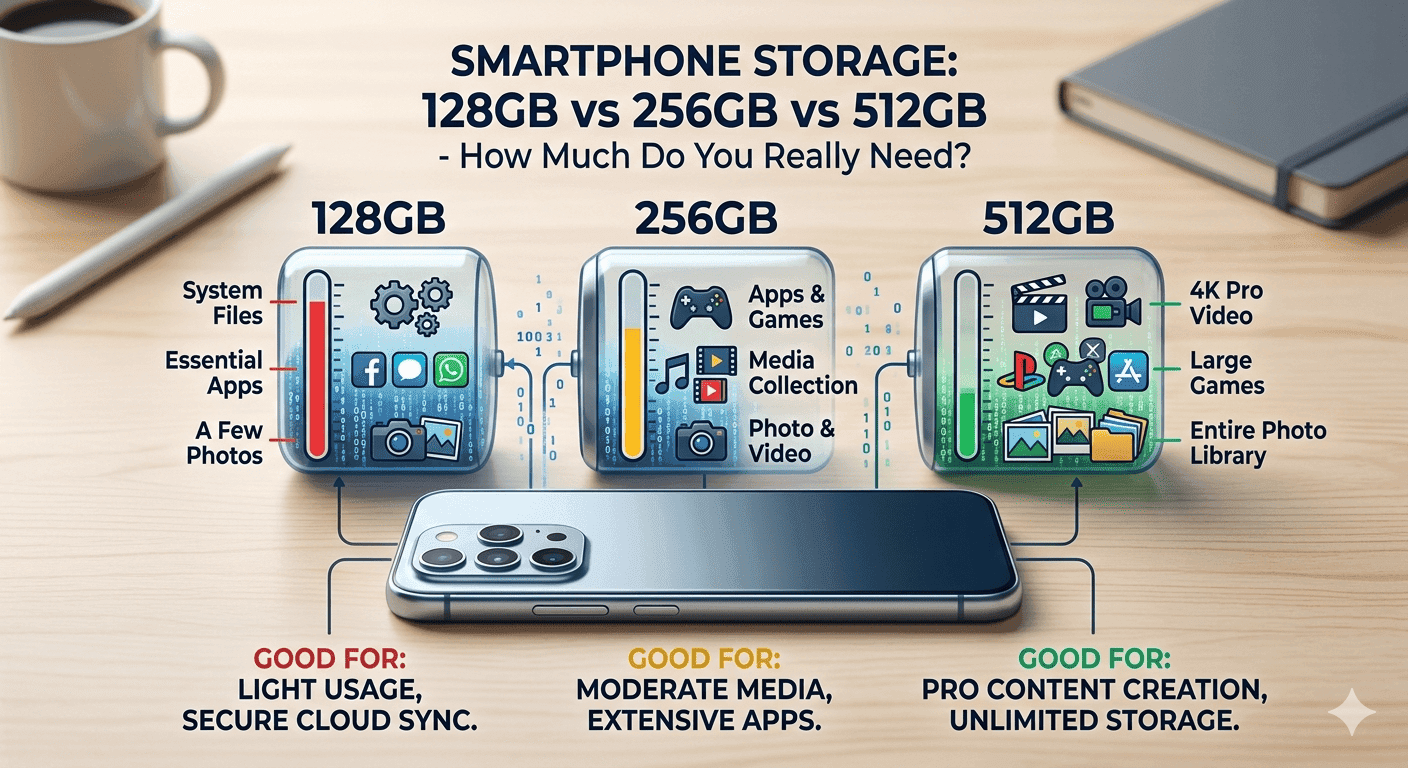
TL;DR 128GB vs 256GB vs 512GB comes down to how much you store on the phone, not just the upfront price. 128GB works for cloud-first, light users, 256GB is the safest a choice for most buyers, and 512GB fits heavy local media, games, and offline files.
Understanding Smartphone Storage Capacities
128GB, 256GB, and 512GB are the three storage tiers that matter most on a phone. The number on the box is only the starting point, because the operating system, preinstalled apps, camera files, games, downloads, and cached content all eat into that space.
On an iPhone, the operating system and standard apps already take about 12-20GB. That is why a phone that looks large on paper can feel smaller once you start loading photos, videos, and apps. For basic users, 128GB is suitable for light to moderate use and remains the best balance between price and storage for many buyers.
Coolblue says 128GB is suitable for basic use, while Supreme Mobiles adds that it can hold about 5,000 pictures and 20 hours of 1080p video. That makes 128GB workable if your photos live in iCloud or Google Photos, your music is mostly streamed, and your downloads are short-lived.
256GB is enough for the average user and is the point where storage starts feeling comfortable rather than carefully managed. Supreme Mobiles says it can hold about 10,000 pictures and 60 hours of 1080p video, which gives you far more breathing room. Grest says 256GB is ideal for users who capture 4K videos and work with heavy apps.
512GB is the tier for users who want to stop thinking about storage almost entirely. Coolblue says it allows users to store their entire photo, video, and movie collection, and Grest notes that it is typically reserved for Pro or Pro Max models. That makes it a premium option for people whose phone doubles as a media vault, work archive, or both.
If you keep 4K clips, big games, and offline downloads on the device, 512GB is the only tier that really removes the pressure. It is the largest option, and for some buyers it is the most practical one.
What the numbers mean in real use?
A 128GB phone can store approximately 900 photos, 60 minutes of UHD video, 1,000 songs, 100+ apps and games, and 20 movies. The same phone feels more forgiving if you mostly stream and delete old files.
The practical takeaway is that storage looks generous until your habits start filling it. Photos, videos, and apps do not stay small for long, especially if you record often or keep offline media on the device. That is why the right tier depends on how you actually use the phone day to day.
Key Factors That Affect Storage Choice
The biggest question is whether your phone is mainly a streaming and communication device, or whether it acts as a local archive for photos, videos, games, and files. Cloud-first users can make 128GB work, especially if their photos and videos are backed up automatically to iCloud or Google Photos.
Supreme Mobiles explicitly recommends choosing 128GB only if you are cloud-first, and ResearchGate data shows 55% of smartphone users still prefer 128GB storage capacity. That makes sense because many people use their phone for messaging, social media, and quick downloads, not for long-term file storage.
Usage patterns matter most
Gaming, photography, and video recording are the fastest ways to expose a storage mistake. Large games can take up a lot of space, and they often grow through updates and cached data. The same is true for 4K videos, which consume storage quickly if you record often and do not move files off the phone regularly.
If you shoot clips for YouTube or keep a library of short social media edits, 256GB is usually the safer floor. This is also the practical safety choice for people who want fewer storage surprises. For most people, 256GB is the safer pick because it handles normal growth without pushing you into premium pricing.
- Pick 128GB if you stream most content and store very little offline.
- Pick 256GB if you shoot lots of photos, keep heavy apps installed, or record 4K videos.
- Pick 512GB if you store lots of videos, big games, or offline downloads.
- If you use editing apps, 256GB is usually the safer floor.
The short version is that 128GB works for disciplined, cloud-first users, 256GB fits most people who want room to grow, and 512GB is for buyers with clearly heavy local storage needs. That rule holds whether you use an iPhone mini, an iPhone Pro Max, or a regular Android phone.
Long-term upgrade support and ownership length
How long you plan to keep the phone matters a lot. A phone that feels spacious on day one can feel cramped by year three if you shoot more video, install more apps, or keep more offline content.
Supreme Mobiles says the 256GB storage option is more future-proof and can last through multiple OS updates. It also recommends 256GB for users who plan to keep their phone for 3-4 years. That makes the middle tier especially attractive for buyers who do not upgrade often.
Quick decision checklist
- Think about how many files stay on the device after a week, not after a backup.
- Treat cloud storage as a helper, not a replacement for local space.
- Remember that 512GB only pays off when offline storage is genuinely heavy.
- Match storage to the way you already use your phone, not the way you hope to use it.
Market Trends and Storage Popularity in India
In India, 128GB is still the default storage standard, but the market is slowly moving upward. CMR India says 128GB smartphones were considered India’s default storage standard as of Q1 2023, and the 256GB category grew from just 7% market share in that same period.
That shift suggests buyers are becoming more aware of how quickly storage gets used up by photos, videos, games, and app data. A lot of users still buy phones based on upfront price, which keeps 128GB popular in entry-level and mid-range segments.
What the market data suggests
The market trend is not just about capacity; it is about behavior. Many users still buy phones based on upfront price, which keeps 128GB popular in entry-level and mid-range segments.
- 128GB remains the default because it covers basic daily use.
- 256GB is growing because users want less storage anxiety.
- 512GB stays premium because most people do not need a local media vault.
- Reddit-style discussions often reflect the same regret: buyers wish they had stepped up one tier.
This is why 128GB vs 256GB Reddit threads keep circling the same point. People usually do not regret buying more space, but they often regret buying too little and then having to delete files every few weeks.
Why 256GB is gaining ground
The 256GB tier is gaining attention because it fits the modern way people use smartphones. Photos, videos, work files, and offline media are all heavier than they used to be, and apps continue to expand.
Supreme Mobiles says 256GB is enough for the average user, while Maple store calls it the safest pick for most smartphone users. Those views line up with the market trend in India, where 256GB is becoming the capacity that feels sensible rather than excessive.
512GB is still a niche tier, but it serves a clear purpose. Grest says it is typically reserved for Pro or Pro Max models, and Supreme Mobiles recommends it for users who store lots of videos, big games, or offline downloads.
- 128GB is still the mass-market default in India.
- 256GB is the tier gaining momentum among practical buyers.
- 512GB is for premium users with large offline libraries.
- The more you store locally, the more the market trend favours 256GB or above.
The big picture is that India still buys a lot of 128GB phones, but the direction of travel is clear. As users keep more media on-device, 256GB becomes the smarter mainstream answer, while 512GB remains a specialist choice for high-storage lifestyles.
Pricing Comparison of Storage Variants in India
Price is one of the clearest ways to understand the storage trade-off in India. According to 91mobiles, 128GB mobile phones range from INR 7,999 to INR 1,99,900, while 256GB mobile phones range from INR 14,499 to INR 1,99,900.
512GB devices include models such as the Samsung Galaxy S26 Ultra priced at INR 1,24,999, which places that tier firmly in the premium bracket. The jump matters because storage capacity changes the kind of phone you can buy.
128GB remains the cheaper and more affordable starting point, which is useful if you are budget-conscious and comfortable relying on cloud storage. 256GB sits in the mid-range, but in value terms, it often behaves like the smarter buy because it gives you more room without jumping all the way to premium pricing.
India price ranges by storage tier
| Storage | India Price Range | Price Position | Typical Fit |
|---|---|---|---|
| 128GB | ₹7,999 to ₹1,99,900 | Cheapest, more affordable | Light users, cloud-first buyers |
| 256GB | ₹14,499 to ₹1,99,900 | Mid-range | Average, heavy, and long-term users |
| 512GB | Includes ₹1,24,999 models | Premium-priced | Pro buyers, offline media collectors |
What the price gap means for buyers?
If you buy 128GB, you are paying less up front, but you may also be accepting more storage management later. That trade-off is fine if you live in Google Photos, stream music, and rarely download large games.
- 256GB is the value tier because it balances price and long-term usability.
- 512GB is expensive because it solves a niche storage problem.
- The cheapest phone is not always the cheapest ownership experience.
- The extra money for 256GB often buys peace of mind, not just gigabytes.
This is especially important for users who keep their phones for 3-4 years. A lower upfront price can become less attractive if you later run out of storage and have to manage files constantly.
Budget versus comfort
The real decision is not simply whether you can afford 128GB or 256GB. If your budget is tight and you are fully cloud-first, 128GB remains a valid option.
If you want fewer compromises, 256GB is the safer middle ground. If you know your phone will carry a huge local library, then 512GB is the only tier that truly removes storage stress. In that case, iCloud storage can help with backup, but it does not replace having enough local space.
Common Mistakes When Choosing Smartphone Storage
The biggest storage mistake is buying for the first month instead of the full ownership period. A phone that seems spacious on day one can become cramped once apps grow, camera files pile up, and offline downloads start accumulating.
That is why 128GB vs 256GB vs 512GB should be judged by usage patterns, not by the biggest number that fits the budget. The mistake usually starts with assuming you will manage files better later than you do now.
One common error is choosing 128GB without a cloud-first habit. Supreme mobiles says 128GB should be chosen only if you are cloud-first, because local photos, videos, and downloads can fill it quickly.
If you do not back up regularly to iCloud, Google Photos, or another cloud service, the storage ceiling arrives much sooner than most people expect. That is especially true if you keep a lot of social media clips, WhatsApp media, or offline playlists.
Underestimating real usage
People often underestimate how much space modern apps and media consume. That is why 128GB can feel fine at first but frustrating later.
- Do not assume 128GB is enough just because it sounds large.
- Do not forget that system files already consume part of the storage.
- Do not expect to manage a growing photo library comfortably on 128GB.
- Do not ignore the impact of offline downloads and cached files.
This is where 128GB vs 256GB Reddit discussions often sound repetitive, because the same regret appears again and again. Buyers who choose 128GB without thinking through their habits often wish they had bought 256GB instead.
Ignoring long-term growth
Storage needs usually rise slowly, which is why future planning matters. A phone that works today can feel tight after a couple of OS updates and a few new apps.
- Choose 256GB if you want a safer long-term default.
- Choose 512GB only if your offline storage is already heavy.
- Choose 128GB only if you are disciplined about cloud backups.
The best decision is the one that avoids both regrets, too little space or too much wasted money. For most buyers, 256GB is the most balanced choice because it avoids the common mistakes on both sides.
Why 1TB is a different conversation?
That size is for very specific users who record a lot of video, keep huge game libraries, or use their phone as a working archive. For everyone else, 512GB is already a lot of space, and 256GB is enough for the average user.
The point is to buy the size you will actually use, not the biggest option available. If you want a quick course in storage choice, start with your real habits rather than the maximum spec.
How storage fills up over time?
When you compare 128GB vs 256GB vs 512GB, the real question is how much headroom you want as your phone fills up over time. A smartphone rarely stays empty for long because the operating system, preinstalled apps, cached media, and future updates all take space.
On iPhone, the operating system and standard apps already use about 12-20GB, so a 128GB model starts with a meaningful chunk already occupied before you add your own photos and videos. That is why storage space matters more than most people think.
128GB is the budget-friendly option and still makes sense for basic, cloud-first users. Coolblue says 128GB is suitable for basic use, while Supreme mobiles notes that it is ideal for light to moderate users who rely on cloud storage.
It can store about 5,000 pictures and 20 hours of 1080p video, and Samsung’s figures say it can also handle around 900 photos, 60 minutes of UHD video, 1,000 songs, 100+ apps and games, and 20 movies, depending on file sizes. That is enough for many people, but it is not a carefree amount of storage space.
Which size fits most people?
256GB is the safer all-around choice for most smartphone users. Maple store calls it the safest pick for most smartphone users, and Supreme mobiles says it is enough for the average user, with better long-term upgrade support and a recommendation for people who plan to keep their phone for 3-4 years.
It also fits heavier habits better, including 4K video capture, large apps, and more offline media. With about 10,000 pictures and 60 hours of 1080p video, 256GB gives you a much more comfortable buffer than 128GB.
In India, that matters because 128GB phones range from INR 7,999 to INR 1,99,900, while 256GB phones range from INR 14,499 to INR 1,99,900, so the jump is real but still manageable for many shoppers. If you are comparing value rather than sticker price, 256GB is often the smarter middle ground.
It also leaves more room for updates, backups, and everyday app growth without constant cleanup. 512GB is the premium answer for users who store lots of videos, big games, or offline downloads.
That makes it ideal for creators, mobile gamers, and users who want their phone to function like a local archive. It is also the most expensive tier, with 512GB devices including models priced at INR 1,24,999, so the extra room comes at a clear premium.
For that person, 128GB can become cramped quickly, 256GB is usually enough, and 512GB becomes attractive only if the device is also carrying long offline video libraries or large project files. For everyone else, the extra capacity is nice, but not necessary.
If you want the simplest rule, choose 128GB only if you are cloud-first and disciplined, choose 256GB if you want the safest and most balanced option, and choose 512GB if your phone stores a lot of media and files offline. That framework works for both iPhone and Android because the storage pressure comes from habits, not brand loyalty.
- 256GB is the safest all-round choice for most users.
- 512GB is for people who treat the phone like a local media vault.
The answer is usually yes on 256GB, sometimes yes on 128GB, and almost always yes on 512GB. The practical difference shows up when you edit in CapCut, save clips for offline viewing, and keep the file manager full of documents.
That is where storage size stops being abstract and starts changing how often you delete things.
Frequently Asked Questions
Q. Which storage tier should most people buy?
256GB is the safest choice for most buyers because it balances price, comfort, and long-term use. Suprememobiles says it is enough for the average user, and it is the better fit if you plan to keep the phone for 3-4 years. It also handles 4K videos, larger apps, and more offline media without forcing constant clean-up.
Q. When does 128GB make sense?
128GB makes sense for cloud-first users who stream most content and keep very little offline. Coolblue says it is suitable for basic use, and Suprememobiles says it can hold about 5,000 pictures and 20 hours of 1080p video. If you rely on iCloud or Google Photos and do not keep many games installed, it can still work well.
Q. Why do many buyers prefer 256GB over 128GB?
Many buyers prefer 256GB because it gives more breathing room without jumping into premium pricing. Suprememobiles says it can store about 10,000 pictures and 60 hours of 1080p video, which is a big step up from 128GB. In India, the price range starts at INR 14,499 for 256GB phones, so the upgrade often feels worth it.
Q. Who actually needs 512GB?
512GB is for people who keep lots of videos, big games, offline downloads, or work files on the phone. Grest says it is typically reserved for Pro or Pro Max models, and Coolblue says it can hold an entire photo, video, and movie collection. It is the right choice when your phone acts more like a local archive than a simple daily device.
Q. How much storage does an iPhone use before your files?
On an iPhone, the operating system and standard apps already take about 12-20GB. That means a 128GB model starts with a noticeable portion already used before you add your own photos, videos, and apps. This is one reason 256GB often feels like the safer middle ground.
Q. Is 256GB worth the extra cost in India?
For many buyers, yes, because 256GB sits in the middle of the India price range at INR 14,499 to INR 1,99,900 and offers much more comfort than 128GB. It is especially useful if you keep the phone for 3-4 years, shoot a lot of photos, or record 4K video. The extra money often buys peace of mind, not just more gigabytes.
Which Storage Size Makes the Most Sense for Your Phone?
128GB vs 256GB vs 512GB is not a technical puzzle, it is a habit check. The real question is how much storage you want to manage before it starts becoming a weekly concern.
For most buyers, 256GB is the most practical choice because it gives enough room for photos, videos, apps, and future growth without pushing you into premium pricing. It also fits the way most people actually use their phones, which is why it keeps showing up as the safer recommendation.
If you already know your phone carries a lot of local media, large games, or offline work files, 512GB makes sense because the extra room matches the way you actually use the device. If your needs are lighter and you are cloud-first, 128GB can still be enough, especially when you want the lowest upfront price.
The simplest way to decide is to match the storage to your routine, then move on. If you want fewer compromises, choose 256GB. If you want maximum headroom, choose 512GB. If you are disciplined and mostly live in the cloud, 128GB still has a place.