
EU Repairability Rules and Their Impact on Laptops and Smartphones
The EU Repairability Law strengthens consumers' right to repair by improving access to spare parts, repair services, and repair information. It also introduces a 12-month legal guarantee extension after eligible repairs, making laptops and smartphones easier and more economical to keep in use.

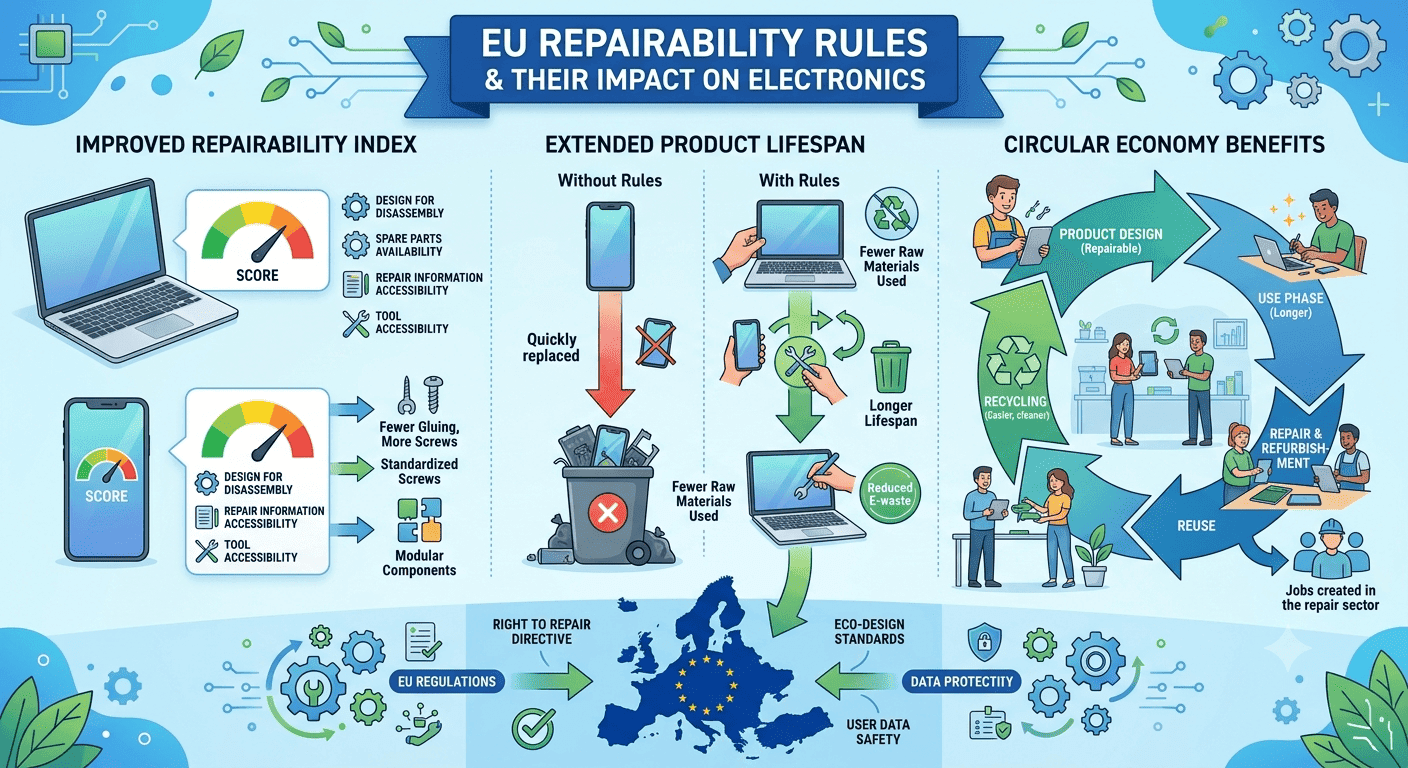
TL;DR The EU repairability law gives consumers a 12-month legal guarantee extension after repair and improves access to spare parts, repair services, and repair information for laptops and smartphones.
Understanding the EU Repairability Law
The EU repairability law is a major step toward making repairs a legal expectation instead of a nice extra. It applies to consumer goods such as laptops, smartphones, washing machines, refrigerators, vacuum cleaners, tablets, and servers, so the scope is wider than many people expect. The directive is built around common rules, ecodesign, and the circular economy, which means the EU wants products that last longer and are easier to fix.
This legislation was adopted on 13 June 2024, published in the Official Journal of the European Union on 30 July 2024, and entered into force on 30 July 2024. Member States must transpose it into national law by 31 July 2026, so the legal framework is already active even if every national rule is not identical yet. The table below shows the key dates at a glance.
| Milestone | Date | Meaning |
|---|---|---|
| Adoption | 13 June 2024 | The directive was formally approved |
| Publication | 30 July 2024 | The text appeared in the Official Journal |
| Entry into force | 30 July 2024 | The directive became legally active |
| Transposition deadline | 31 July 2026 | Member States must implement it nationally |
How Is the EU Repairability Law Relevant in India?
Although the EU Repairability Law applies only to European Union Member States, its impact extends beyond Europe because many global electronics manufacturers sell the same products in multiple markets, including India. Companies often redesign devices, improve repair documentation, and expand spare-parts availability across several regions instead of maintaining completely different standards for each market. As a result, Indian consumers may indirectly benefit from products that are easier to repair and service.
The law is also relevant because India has been exploring its own Right to Repair framework. The Indian government has introduced initiatives encouraging manufacturers to provide repair information, spare parts, and service manuals across sectors such as consumer electronics, mobile phones, automobiles, agricultural equipment, and household appliances. While India's regulations are still evolving and differ from the EU's legally binding directive, both aim to reduce electronic waste, extend product lifespans, and promote sustainable consumption.
For Indian consumers purchasing laptops and smartphones from international brands, the EU's repair-focused policies may encourage manufacturers to improve repairability standards globally. However, repair rights, warranty terms, spare parts availability, and service obligations in India continue to depend on Indian laws, manufacturer policies, and local service networks rather than the EU directive itself.
What Manufacturers Must Provide Under the Directive?
Manufacturers must provide repair services even after the legal guarantee period ends. They also have to make spare parts available for at least seven years after a product is discontinued, which is a major shift for products that normally become difficult to service once sales stop. These measures help keep repairs available for longer and support common rules promoting repair across the market.
The directive also prohibits software or hardware that obstructs repairs. In plain terms, a manufacturer cannot create a dead end by locking out diagnostics, blocking access to parts, or using design choices that make a repair pointless. That matters for products like smartphones and laptops, where a battery swap or port repair can fail if the right guide or tool is missing.
Manufacturers must also provide repair manuals and diagnostic tools, and they must make repair information available so repairers can work efficiently. For a technician working on a Windows laptop, access to diagnostic software can save hours of guesswork. The directive also requires manufacturers to provide information about repair services and indicative prices, which helps consumers compare options more clearly.
What the EU Repairability Law Means for Consumers and Repair Shops?
For consumers, the most immediate benefit is that repair becomes easier to choose and easier to trust. The directive gives people stronger access to repair services, spare parts, and repair information, which can reduce the friction that often pushes a household toward replacement. It also matters that the law applies to products such as laptops and smartphones, because those are devices many people rely on every day.
The 12-month legal guarantee extension after repair is another practical incentive, since it makes a repaired product feel less risky to keep using. If a laptop or phone is fixed, that extra year of legal protection can make the decision to repair more comfortable. This is especially useful when the repair involves a key part like a battery, screen, or charging port.
For the repair market, the directive creates a clearer path for independent repairers and service providers. A seven-year spare-parts availability period after discontinuation gives repair businesses more room to plan and serve customers over time. The rules also support a more transparent market by requiring indicative prices and repair-service information.
How the Directive Affects Laptops and Smartphones?
Laptops and smartphones sit at the center of the directive because they are high-use devices that people replace too quickly. The law supports repairs that would otherwise be blocked by missing parts, missing manuals, or limited access to diagnostics. That makes common fixes, such as battery replacement or port repair, more realistic for both service centers and independent technicians.
The directive also helps when a device is still useful but one component has failed. Instead of treating the whole product as disposable, the repair framework encourages keeping the device in service longer. For households, that can mean less disruption and a better return on the money already spent on the device.
This matters most for users who depend on a laptop for work or a smartphone for daily communication. When repair is easier to arrange and easier to understand, replacement is no longer the default answer. That shift is central to the EU repairability law and to the broader move toward a circular economy.
What to Expect by 31 July 2026?
The transposition deadline is 31 July 2026, and that date matters because Member States must turn the directive into national law by then. Until those national rules are fully in place, the overall direction is already clear, but details can still vary from one country to another. Consumers should expect repair rights to become more visible and more structured as national implementation moves forward.
Manufacturers and repair providers also have time to prepare their processes, parts supply, and service information. That preparation period is important because the directive is not just about one repair, it is about making repair easier across product categories. By the time national rules are fully implemented, the market should be better aligned with the new repair expectations.
For buyers, the practical takeaway is simple. If you are choosing between replacing a device and repairing it, the legal environment is moving in favor of repair. The law does not remove every obstacle overnight, but it gives consumers a stronger basis for asking for parts, information, and service.
Frequently Asked Questions
Q. What is the most important consumer benefit in the EU repairability law?
The biggest consumer benefit is the 12-month legal guarantee extension after repair. That extra year makes a repaired laptop or smartphone less risky to keep using, especially when the fix involves a battery, screen, or charging port. It also comes with stronger access to spare parts, repair services, and repair information.
Q. How long must spare parts stay available?
Manufacturers must make spare parts available for at least seven years after a product is discontinued. That seven-year period gives repairers and consumers a much better chance of keeping devices in service after sales end. It is especially important for laptops and smartphones, which often need parts long after purchase.
Q. When did the directive become active?
The directive entered into force on 30 July 2024. It was adopted on 13 June 2024 and published in the Official Journal of the European Union on 30 July 2024. Member States then have until 31 July 2026 to transpose it into national law.
Q. Which products are covered by the directive?
The directive applies to consumer goods such as laptops, smartphones, washing machines, refrigerators, vacuum cleaners, tablets, and servers. That wide scope shows that the EU repairability law is not limited to one device category. It is meant to support repair across many everyday products.
Q. Why do repair manuals and diagnostic tools matter?
Repair manuals and diagnostic tools help technicians complete repairs efficiently and accurately. For a Windows laptop, diagnostic software can save hours of guesswork, and the same idea applies to other devices that need precise troubleshooting. Without those tools, even a simple repair can become much harder.
Q. What should consumers watch for while national rules are still being implemented?
Consumers should watch for how each Member State turns the directive into national law by 31 July 2026. The overall direction is already set, but local implementation can affect how repair services, spare parts, and information are accessed. That means the repair experience may improve at different speeds depending on the country.
Why the EU Repairability Law Matters for Long-Term Device Use?
The EU repairability law makes repair more practical by combining a 12-month legal guarantee extension with stronger access to spare parts, repair services, and repair information. It also requires manufacturers to keep spare parts available for at least seven years after discontinuation, which supports longer device life and better service planning. For consumers, those rules repair a more realistic option than replacement.
If you own a laptop or smartphone, the law is especially relevant because those devices are used every day and often fail in just one component. Buyers who want lower hassle after a repair should pay attention to the guarantee extension, while people who rely on older devices should value the seven-year parts requirement. Repair shops and independent technicians also stand to benefit from clearer access to manuals, diagnostics, and service information.
The best next step is to treat repair as a normal part of ownership, not a last resort. If your device can be fixed, the directive gives you stronger reasons to ask for that repair and to compare service options carefully. As national rules are implemented by 31 July 2026, consumers should expect repair to become easier to request and harder to ignore.