
Can AI Replace Search Engines on Phones and PCs?
AI search and traditional search serve different purposes in 2026. Traditional search excels at finding sources and exact information, while AI search delivers context, summaries, and conversational answers. The most effective workflows combine both for speed, accuracy, and deeper insights.

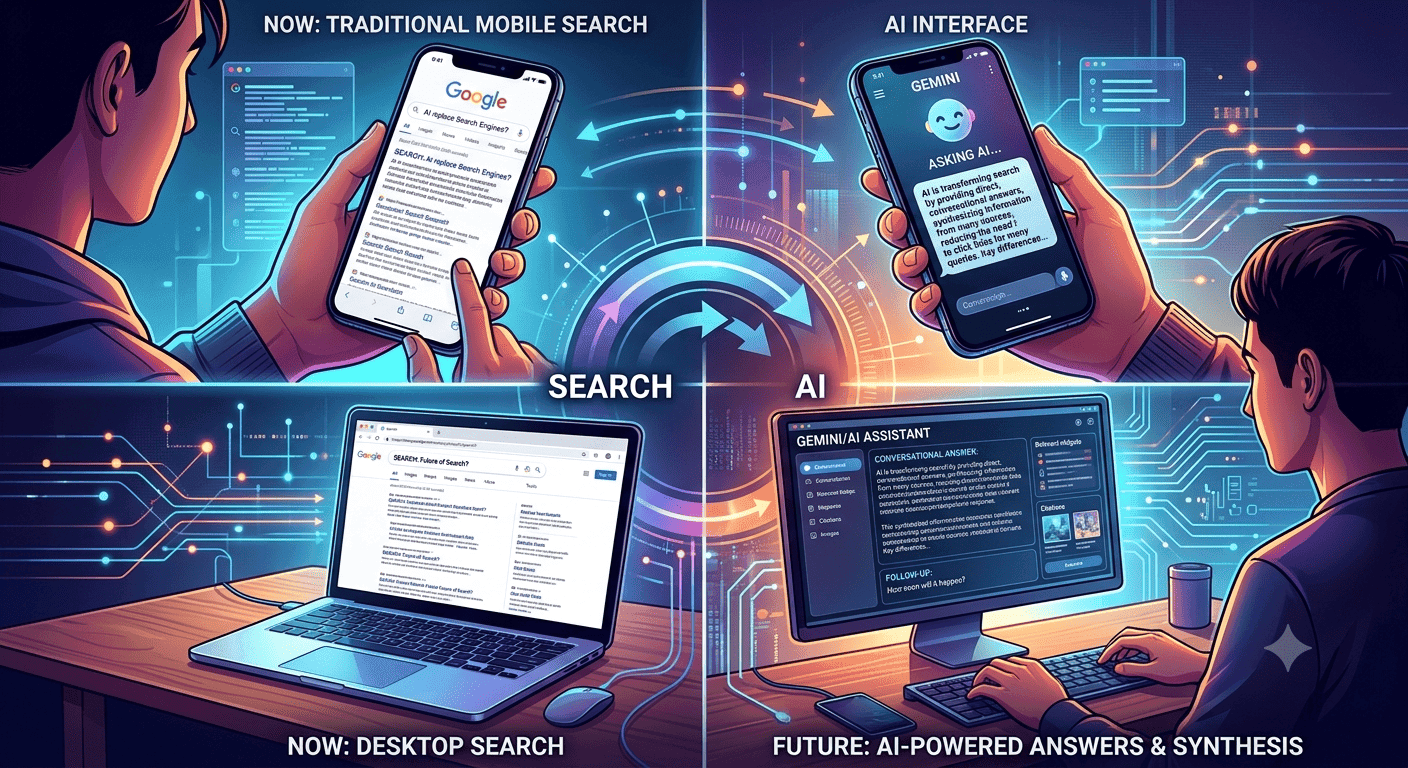
TL;DR AI vs Search Engines in 2026 is really about choosing between exact retrieval and context-driven answers. Traditional search engines are faster for known terms and source discovery, while AI search works better for summaries, follow-up questions, and complex intent.
Understanding How Traditional Search and AI Search Work
Traditional search engines like Google and Bing still start with keywords. You type a query, they match it against indexed pages, and you get a list of results. That model works well when you already know the phrase, the product, or the page you want.
AI search engines work differently because they read context, intent, and semantics. They use artificial intelligence, natural language processing, and machine learning to infer what you mean, not just what you typed. That is why AI vs Search Engines has become a practical question, not a marketing slogan.
The difference shows up fast in real use. If you are checking a known term in Google Docs, a policy title in Notion, or a product name in Chrome, traditional search is usually faster.
Keyword matching versus intent matching
Keyword matching is still the backbone of classic search. It is reliable when the query is specific and the web already contains the exact wording. That is why a search engine remains strong for source discovery, page-level access, and broad web coverage.
AI search engines prioritize intent. They can connect related terms, interpret a longer question, and return relevant results even when the wording is messy. For anyone working through research notes, customer questions, or a long email thread, that matters because the tool can understand the question instead of forcing you to rewrite it.
In other words, the best results are often based on meaning, not just exact wording.
What this means in daily use?
A student looking for a journal title in Google Scholar will usually prefer a traditional search engine. A project manager summarizing a meeting in Microsoft Copilot or ChatGPT will usually prefer an AI search engine. The first is about finding a page, the second is about finding information.
That split is why the use of AI in search engines keeps growing. People do not want one system for every task. They want the right set of tools for the kind of query they are asking, especially when automation can save time.
The choice is often based on whether the goal is exact retrieval or a more context-driven answer.
| Feature | Traditional Search Engines | AI Search Engines |
|---|---|---|
| Primary method | Keyword matching | Context and semantics |
| Input style | Short queries | Natural language and follow-up questions |
| Output style | Links and pages | Tailored responses and summaries |
| Best for | Exact matches and broad web browsing | Complex queries and intent-heavy questions |
| Query handling | One search at a time | Multi-turn, conversational responses |
| Understanding | Text similarity | Meaning and context |
| Personalization | Limited | More personalized and relevant |
| Search behavior | Index-driven | AI powered search with semantic interpretation |
Why Hybrid Search Models Matter in 2026?
The most important change in this space is not replacement. It is blending. Google is integrating Gemini into its platform, and that has pushed search toward a hybrid model where keyword searches and AI-driven responses sit side by side.
That shift matters because not every query needs generative AI or other AI tools. A source check in Chrome, a citation lookup for a research paper, or a product comparison in Excel still benefits from classic search results. But when you want a summary, a definition, or a quick explanation, AI can save time by doing the first pass for you.
This hybrid model also changes how users think about access and management. Instead of treating search as one box and one result style, people now move between links, summaries, and conversational responses. The best workflow is the one that matches the task, not the one that blindly favours one engine.
Why is Google changing the default experience?
When Google adds AI overviews and Gemini-powered features, those changes reach far more users than a niche app ever could. That is why the engine results page now feels more layered than it did a few years ago.
AI overviews change the first screen of search. Instead of a simple list of links, users often see an AI overview, then supporting sources underneath it. That gives faster access to information, but it also changes how people judge relevance, because the answer is already partially summarized before they click anything.
It also affects the management of attention, since the first screen now does more of the sorting for the user.
Where does the hybrid model help most?
The hybrid approach is strongest when you need both speed and verification. A marketer comparing campaign ideas in Google Sheets, a developer checking an API error in VS Code, or a finance analyst reading market data all benefit from a mix of summaries and source pages.
It also works well for questions with multiple layers. If you ask about pricing, implementation, and timing in one query, AI search can organize the response while traditional search engine results still provide the underlying pages. That combination is more useful than either model alone.
The use of AI tools in search engines is now visible in ordinary searches, not just experimental products. Traditional search is not disappearing; it is being wrapped in a smarter interface.
Advanced Features That Set AI Search Engines Apart
Generative AI changes search because it can create text, images, audio, video, and code. Traditional search engines do not do that. They retrieve existing pages, while AI search engines can synthesize a new answer from data.
That difference matters in practical work. It is useful in healthcare, finance, and retail, where the information is messy and spread across different sources. The better the system is at connecting data, the faster it can surface relevant results.
It can also improve indexing so the right information is easier to retrieve.
Direct answers instead of link lists
One of the clearest advantages is the output format. AI search engines can generate direct, summarized answers instead of a long list of links. That saves time when the question is simple enough to answer from a few trusted sources.
This matters in research-heavy work. A legal assistant checking a clause, a sales team pulling product details, or a student reviewing a topic in Google Search all benefit when the engine gives a short answer first and sources second.
The result is less tab-hopping and less manual synthesis.
Real-time data and complex queries
AI search engines can also process real-time data and use it to shape responses. That makes them more useful for current events, live market monitoring, and fast-moving operational questions. In those situations, the tool is not just finding pages; it is organizing information.
They are also better with complex queries and follow-up questions. If you ask one question in Slack, then refine it in a second prompt, the system can keep context across both. That is a big reason conversational search feels more natural than traditional search.
Where generative AI is strongest?
Generative AI is strongest when the task is synthesis. It can summarize a report, compare options, or explain a technical topic without making you read every source first. That is especially useful when the goal is understanding, not just retrieval.
It is also useful when you need different forms of output. A product manager might ask for text, a support team might want a response template, and a developer might want code. One set of tools can cover all three, while indexing helps keep the underlying information organized.
| Capability | AI Search Engines | Traditional Search Engines |
|---|---|---|
| Output type | Direct answers and summaries | Lists of links |
| Content generation | Text, images, audio, video, code | No generation |
| Data handling | Structured and unstructured data | Primarily indexed web pages |
| Query style | Conversational and layered | Keyword-driven |
| Speed to insight | Faster for synthesis | Faster for source discovery |
Statistics and Market Shift in 2026
The numbers show why this debate is moving so quickly. By 2026, traditional search volume is shifting as AI search becomes the preferred source of insight for more users.
| Metric | AI Search / AI Powered | Traditional Search |
|---|---|---|
| Primary and preferred source of insight | 44% | 31% |
| User preference over traditional Googling | 83% | Lower than AI preference |
| AI summaries in Google searches | 50% already | Traditional link-first results share is shrinking |
| AI summary share by 2028 | More than 75% | Continued decline in visibility |
These figures point to a clear trend. AI summaries are already present in half of Google searches, and preference for AI-powered search is higher than traditional Googling for insight. That does not remove the need for classic search, but it does change how users start their research.
The shift also explains why hybrid search keeps expanding. People still want links when they need proof, but they want summaries when they need speed. In 2026, that balance matters more than choosing one side permanently.
Which Search Approach Fits Your Task Best?
AI vs Search Engines becomes easier to understand when you match the tool to the task. Traditional search is still the better choice for exact lookups, source discovery, and broad web browsing. AI search is better when you need context, synthesis, or a conversational follow-up.
If you are checking a known term in Google Docs, a policy title in Notion, or a product name in Chrome, classic search usually wins on speed. If you are summarizing a meeting, comparing options, or asking a layered question, AI search can save time and reduce manual work. The strongest workflows use both.
The practical rule is simple. Use AI for understanding, then use traditional search for verification when the answer needs a source trail.
Frequently Asked Questions
Q. What is the main difference between AI search and traditional search?
AI search uses context, intent, and semantics, while traditional search relies on keyword matching and indexed pages. That difference shows up in the output, since AI search can give direct answers and summaries, while classic search usually returns links. The article also shows that AI search is better for complex queries, while traditional search is faster for exact lookups.
Q. When should I use traditional search instead of AI search?
Use traditional search when you already know the phrase, product, or page you want. It works well for source discovery, page-level access, and broad web coverage, especially in tools like Google Docs, Notion, and Chrome. The article also notes that students looking for a journal title in Google Scholar usually benefit from classic search.
Q. Why are hybrid search models becoming more common in 2026?
Hybrid search is growing because Google is integrating Gemini and AI overviews into the search experience. That means users can see summaries and supporting sources on the same results page. The article says this model helps when you need both speed and verification, such as in Google Sheets, VS Code, or market research.
Q. What kinds of tasks are AI search engines strongest at?
AI search engines are strongest at synthesis, summaries, and follow-up questions. They can handle complex queries, real-time data, and multi-turn conversations better than keyword-only search. The article also says they can generate text, images, audio, video, and code, which makes them useful across different workflows.
Q. What do the 2026 numbers say about AI search adoption?
The article says 44% already prefer AI-powered search for insight, while 31% still rely on traditional search. It also says AI summaries already appear in 50% of Google searches, and that share could rise to more than 75% by 2028. Those numbers show a clear move toward AI-assisted search, not a full replacement.
Q. Is traditional search disappearing?
No, traditional search is not disappearing. The article explains that it still matters for exact lookups, source discovery, and verification. What is changing is that search is becoming a smarter interface, where links, summaries, and conversational responses work together.
What AI vs Search Engines Means for Your Workflow in 2026?
AI vs Search Engines in 2026 is not a winner-takes-all decision. Traditional search engines still deliver the fastest path to exact terms, source pages, and broad web coverage, while AI search engines are better for summaries, context, and layered questions. The article's numbers support that split, with 44% already preferring AI-powered search for insight and 50% of Google searches already showing AI summaries.
If you are a student, researcher, or anyone who needs citations and source discovery, traditional search should stay in your toolkit. If you are a manager, analyst, or creator who needs quick synthesis, AI search can save time and reduce manual work. The hybrid model is the safest long-term bet because it combines both strengths without forcing a false choice.
Start by using AI for understanding, then switch to traditional search when you need proof, links, or a deeper source trail. That approach fits the current market shift and gives you the most practical results in 2026. If you want the best workflow, use the tool that matches the task, then verify when accuracy matters most.





