
Bluetooth LE Audio Explained: Benefits, Devices, and Compatibility
Learn what Bluetooth LE Audio is, how LC3, Auracast, and multi-stream audio improve wireless listening, and what Bluetooth 5.2 or 5.3 devices you need. Discover the benefits, compatibility requirements, supported devices, and whether LE Audio is worth buying today.

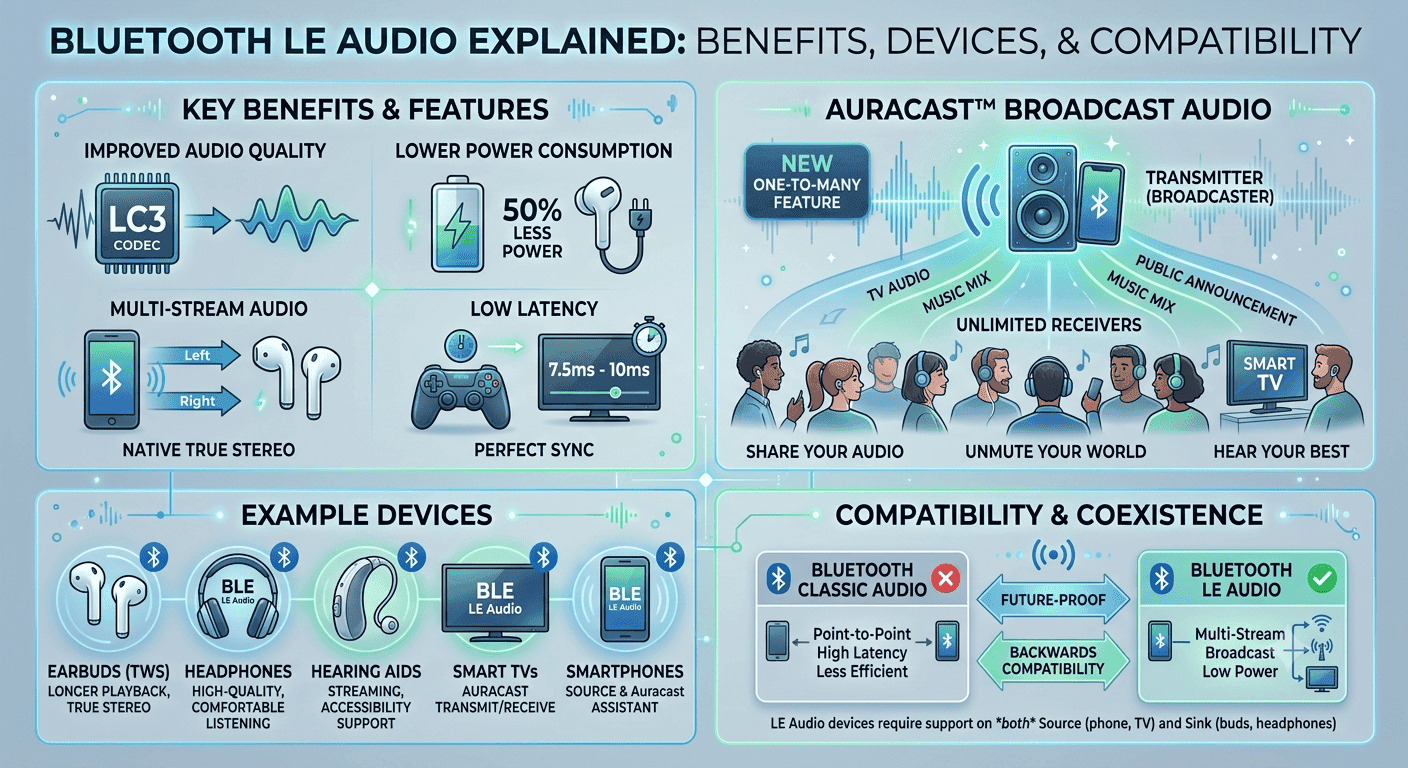
TL;DR Bluetooth LE Audio is a low energy wireless audio standard built on Bluetooth 5.2 or 5.3 that adds LC3, multi-stream audio, and Auracast to supported devices. It can improve battery life, voice calls, and latency, and it is already showing up in phones, earbuds, hearing products, and lower-cost cases.
Bluetooth LE Audio is not a cosmetic update to Bluetooth Classic. It is a different audio path built on the Bluetooth Low Energy radio, and that shift changes how devices handle power, data, and synchronized playback. The biggest technical change is LC3, the Low Complexity Communications Codec. LC3 delivers high-quality audio at lower bit rates, so the connection can use less bandwidth without sounding thin or brittle. In real use, that helps compact wireless earbuds and over-ear headphones hold quality while spending less power. Bluetooth SIG calls LE Audio the largest specification development project in its history, and that scale is not marketing fluff. It tells you the standard is meant to become a core layer of future wireless audio, including hearing support and broadcast features. For buyers, the point is simple, this is the start of a new baseline for wireless audio, and it should provide a more efficient foundation for devices that need to balance quality and battery life.
Bluetooth Low Energy versus Bluetooth Classic
Bluetooth LE Audio runs on Bluetooth Low Energy, while Bluetooth Classic Audio runs on the Bluetooth Classic radio. That split matters because low energy radio design is built to move less data for the same listening task. The result is lower power consumption, which helps longer battery life in phones, earbuds, and headphones. Classic audio still works fine for basic playback, but it does not offer the same flexibility. That is why the standard is being treated as a real platform change rather than another codec swap.
Why LC3 matters more than the logo?
LC3 is the part most buyers never see, but it does the heavy lifting. The codec lets Bluetooth SIG and device makers keep audio quality respectable while lowering bit rates, which helps preserve battery and radio headroom. If you take calls in Microsoft Teams or listen to podcasts for hours, that balance matters more than a flashy feature name. LC3 also gives manufacturers more room to create smaller products without making them feel compromised. That is useful for true wireless earbuds, because tiny cases and tiny batteries leave little margin for waste. A better codec can make the difference between a pair of earbuds that lasts through a commute and one that dies halfway home.
Bluetooth LE Audio requirements and compatibility
The first rule is blunt: devices must support Bluetooth 5.2 or 5.3 to be compatible with Bluetooth LE Audio. Older Bluetooth versions may still connect for classic playback, but they will not unlock the new stack. If your phone, laptop, or earbuds only mention generic Bluetooth, treat that as a warning sign. The second rule is codec support. A device can advertise Bluetooth support and still miss LC3, which means it cannot deliver the core Bluetooth LE Audio benefits. That is why the spec sheet needs to mention LE Audio explicitly, not just Bluetooth branding. The third rule is radio support on both ends. If your source device supports the standard but your headphones do not, you will not get the full experience. The same is true in reverse, and that is where a lot of buyers get tripped up over the years.
What to check before you buy?
Look for Bluetooth 5.2 or 5.3 first, then confirm LC3 and multi-stream support. If the product page only says wireless audio, that tells you almost nothing about what the device can actually do. You want wording specific enough to tell the difference between classic audio and Bluetooth LE Audio. Hearing support is another useful clue. Bluetooth LE Audio includes support for hearing aids, which makes the standard more relevant for accessibility and assistive listening. If hearing is part of your decision, that feature should be on the shortlist from the start. A quick check of Bluetooth LE Audio requirements also helps you avoid mismatched purchases. Many buyers assume a new phone or new earbuds automatically support the latest standard, but that is not always true. The safest move is to verify the exact model and the exact Bluetooth version, then confirm LE Audio wording before you pay.
Supported devices that already matter
Some Bluetooth LE Audio supported devices are already mainstream, which makes the standard easier to understand in practice. Confirmed examples include the Google Pixel 7, Google Pixel 8, Samsung Galaxy S23, Samsung Galaxy Z Fold 4, and Samsung Galaxy Z Flip 4. That tells you adoption is real, not theoretical. These phones matter because the source device often decides whether you get the new audio stack or just classic playback. If your phone supports Bluetooth 5.2 or 5.3 and your wireless earbuds also support LE Audio, you are in the right lane. If either side falls back to classic, the feature set shrinks fast.
| Device | Bluetooth Version | LE Audio Support | Practical Note |
|---|---|---|---|
| Google Pixel 7 | Bluetooth 5.2 | Yes | Solid reference for modern Android audio |
| Google Pixel 8 | Bluetooth 5.3 | Yes | Newer platform support for LE Audio features |
| Samsung Galaxy S23 | Bluetooth 5.3 | Yes | Premium phone with current wireless audio support |
| Samsung Galaxy Z Fold 4 | Bluetooth 5.2 | Yes | Foldable phone with LE Audio compatibility |
| Samsung Galaxy Z Flip 4 | Bluetooth 5.2 | Yes | Compact foldable with LE Audio support |
Bluetooth LE Audio benefits in real use
Microsoft says the standard improves battery life, voice call quality, and device flexibility, and that lines up with how people actually use wireless audio. Low latency is a bigger deal than many buyers realize. It helps when you watch TV on a tablet, play games on a phone, or edit clips in Adobe Premiere Rush and want the audio to stay locked to the picture. If lip sync has ever annoyed you, LE Audio addresses that problem directly. Power efficiency matters in the boring but important moments. Fewer charging interruptions mean your earbuds, headphones, and even accessory cases can stretch farther between top-ups. For commuters and students, that is the difference between carrying a charger and ignoring one.
Battery life and power consumption
Bluetooth LE Audio is designed to be more power efficient than standard Bluetooth, and that lower power consumption can prolong battery life. The benefit shows up in long listening sessions, not just lab charts. If you use Spotify, Apple Music, or podcasts for several hours a day, the savings add up. The current battery in a small pair of wireless earbuds is always the bottleneck, so any reduction in energy use helps. The same logic applies to accessories and cases that recharge earbuds on the go. A more efficient radio stack means the charging case is not doing as much work as often. That can help the whole system feel less fragile across a full day.
Voice calls, hearing, and accessibility
Voice calls are one of the clearest places where the standard earns its keep. Bluetooth LE Audio improves call quality by handling audio more efficiently, which can make voices sound cleaner on both ends. If you take frequent WhatsApp calls, Microsoft Teams meetings, or conference calls, that is a real quality-of-life upgrade. Hearing support is equally important. Bluetooth LE Audio includes support for hearing aids, so it is not just about music and gaming. That broader scope makes the technology more useful in classrooms, offices, and public spaces where clear speech matters. The accessibility angle also explains why Bluetooth SIG pushed the specification so hard. A standard that can serve hearing products, earbuds, and broadcast audio has a much wider footprint than a music-only codec. That breadth is what gives the technology staying power.
Multi-stream audio and Auracast broadcast
Multi-stream audio is one of the features that makes Bluetooth LE Audio feel genuinely new. It allows multiple synchronized audio streams between a source device and multiple sink devices, which helps earbuds keep left and right channels aligned without awkward relay behavior. For true wireless earbuds, that means steadier playback and fewer odd sync issues. Auracast broadcast audio goes a step further. One audio source device can broadcast one or more streams to an unlimited number of sink devices, which opens the door to shared listening in airports, classrooms, gyms, and conference rooms. That is a very different model from the old one-to-one pairing approach. These features are also useful for developers building public audio systems. Bluetooth SIG built LE Audio so it could support more than private listening, and broadcasting is the clearest proof. Once a venue can create a shared stream, the same system can serve many listeners without juggling separate pairings.
Where multi-stream helps most?
Multi-stream is most noticeable with wireless earbuds and headphones. It keeps both sides of the connection synchronized, which matters when you switch between music, podcasts, and calls. If you have ever noticed a brief lag in one earbud, you already know why this matters. It also helps when you move between devices during the day. A phone call on one device, then a video on another, feels less clumsy when the stream handling is cleaner. That flexibility is one reason developers view the standard as more than a simple codec upgrade.
Why Auracast changes public listening?
Auracast is the part that can change how people listen in shared spaces. A single broadcast can reach many listeners at once, which is useful for presentations, travel hubs, and training rooms. Instead of pairing each headset manually, the source can create one stream and let compatible devices join it. That broadcast model is also useful for advertising and electronic signage in public spaces, where audio needs to reach many people at once. It can create a cleaner experience than a wall of separate speakers or repeated pairings. The technology is still young in consumer terms, but the use case is obvious.
Cost, market growth, and device value
Bluetooth LE Audio has no licensing fees, unlike rival wireless tech such as Qualcomm’s aptX. That does not guarantee cheap products, but it removes one cost layer from the design process. Over time, that can help lower prices for compatible devices and make the category easier to scale. The market outlook reflects that momentum.13 Mn by 2034. Those numbers suggest manufacturers see room for more phones, earbuds, headphones, and hearing products built around the standard. The pricing story is already moving beyond premium gear. A ₹4,000 eppfun example shows that the category is reaching lower price points, not just flagship launches. That matters because broader adoption usually starts when the technology stops feeling exclusive.
Why the Bluetooth SIG matters here>
Bluetooth SIG matters because it sets the direction for the whole ecosystem. When the group treats LE Audio as a major specification effort, chip makers and device brands tend to follow. That is how a standard moves from a feature list into everyday products. Scale also helps with compatibility. More Bluetooth SIG work means more devices, more chipsets, and more consistent support across brands. If you are buying wireless audio now, that ecosystem depth is what will decide how quickly LE Audio becomes normal.
Is Bluetooth good for audio compared with LE Audio?
Classic Bluetooth audio is still fine for basic listening, and many people will not notice a problem with music or calls. That makes the answer to is Bluetooth good for audio more nuanced than a simple yes or no. Bluetooth Classic Audio still has a place, especially in older laptops, older headphones, and legacy car systems. The catch is that classic support does not deliver the same low-energy behavior or broadcast features. If you want modern wireless earbuds that last longer and handle calls better, the newer stack is the one to look for. For everyday users, the biggest change is not raw sound quality alone. It is the combination of lower energy use, cleaner voice calls, and support for new workflows such as shared listening and hearing products. That is why the standard matters even if you are not chasing audiophile gear.
Where classic audio still shows up>
Classic audio is still everywhere in older accessories and budget devices. It is the default in many products that only need basic pairing and playback. If a product does not mention LC3, LE Audio, or Bluetooth 5.2 or 5.3, classic support is often what you are actually getting. That is not automatically bad, but it is less future-ready. Bluetooth SIG built LE Audio to replace that path where it makes sense.
Bluetooth LE Audio supported devices and buying mistakes
The easiest mistake is assuming any new phone supports the standard. It does not. A device needs Bluetooth 5.2 or 5.3, and it needs explicit LE Audio support before you can count on the new features. Another common mistake is buying earbuds that mention wireless audio but never name LC3 or multi-stream. That usually means classic behavior, not the new stack. If you want Bluetooth LE Audio-compatible devices, the spec sheet has to be specific enough to show it. The last mistake is ignoring the source device. A pair of wireless earbuds can only do so much if the phone, laptop, or tablet is still using classic audio. The full benefit comes from both sides supporting the same standard.
What to prioritize first>
Start with the source device, because that decides whether the rest of the chain can work. Then check the headphones or earbuds for LE Audio wording, LC3, and multi-stream support. If hearing support matters, make sure that is listed too. After that, think about your actual use case. Gaming, Netflix, Zoom, and Spotify all benefit in different ways, but they need the same underlying compatibility. A good purchase is the one that matches your real listening habits, not the one with the longest spec list.
Frequently Asked Questions
Q. What is Bluetooth LE Audio in simple terms?
Bluetooth LE Audio is a low-energy wireless audio standard that uses Bluetooth 5.2 or 5.3, LC3, and new stream handling to improve battery life, latency, and call quality. It is built to do more than classic playback, so it also supports features like multi-stream audio and Auracast. If you are comparing it with older Bluetooth audio, the main difference is efficiency and flexibility, not just sound quality.
Q. Which Bluetooth LE Audio-supported devices are confirmed?
Google Pixel 7, Google Pixel 8, Samsung Galaxy S23, Samsung Galaxy Z Fold 4, and Samsung Galaxy Z Flip 4 are confirmed Bluetooth LE Audio-supported devices. These examples show that the standard is already available on mainstream phones, not just niche hardware. That matters because the source device often decides whether you get the new audio stack or fall back to classic playback.
Q. What are the main Bluetooth LE Audio requirements?
Bluetooth LE Audio requirements start with Bluetooth 5.2 or 5.3 support, plus explicit LE Audio wording and LC3 support on both the source device and the audio device. If one side only supports generic Bluetooth, you will not get the full feature set. The article also shows that checking the exact model matters because Bluetooth branding alone is not enough.
Q. Is Bluetooth good for audio if I only use classic devices?
Bluetooth is still fine for basic audio on classic devices, but Bluetooth LE Audio is better for lower power use, lower latency, and newer features like Auracast. Classic audio still works well in older laptops, older headphones, and legacy car systems. The trade-off is that you miss the efficiency and broadcast features that make the newer standard more future-ready.
Q. Do wireless earbuds need LC3 to benefit from LE Audio?
Wireless earbuds need LC3 to get the core Bluetooth LE Audio experience, because LC3 is what gives the standard its quality and efficiency advantage. Without LC3, a device may still connect over Bluetooth, but it will not deliver the same low-energy audio path. That is why LC3 is one of the first things to check on a spec sheet.
Q. Does Bluetooth LE Audio help hearing products?
Bluetooth LE Audio includes support for hearing aids, so it is useful for hearing-focused products as well as music, calls, and broadcast listening. That support is one reason the standard matters beyond consumer earbuds. It gives the technology a broader role in classrooms, offices, and public spaces where clear speech matters.
Is Bluetooth LE Audio worth buying into now?
Bluetooth LE Audio is worth buying into if you want wireless earbuds, headphones, or hearing products that last longer between charges, handle calls more cleanly, and support modern features like multi-stream and Auracast. It is especially useful if your phone already supports Bluetooth 5.2 or 5.3, because that is where the standard starts to pay off. If your current device only offers classic Bluetooth, the newer standard will not deliver its full value yet. In that case, you can still use classic audio, but you should not expect the newer benefits to appear by magic.
The best fit is a buyer who is already shopping for a new phone, earbuds, or headphones and wants a more future-ready setup. The Google Pixel 7, Google Pixel 8, Samsung Galaxy S23, Samsung Galaxy Z Fold 4, and Samsung Galaxy Z Flip 4 show that support is already real on the source-device side. That makes it easier to build a complete setup around LE Audio instead of waiting for the ecosystem to catch up. If you care about battery life, call quality, and accessibility, this is the standard to watch first.
If you are buying today, check for Bluetooth 5.2 or 5.3, LC3, and explicit LE Audio wording before you pay. That simple checklist will keep you from buying a badge instead of the real feature set. It will also help you avoid mismatched gear, which is the most common reason people miss out on the benefits. Start with the source device, confirm the headphones or earbuds, and then choose the model that matches how you actually listen.





