
Best Camera to Buy for Food Photography and Content Creators
The right camera for food photography depends on more than megapixels. Compare full-frame and APS-C options, lenses, video features, autofocus, and practical creator needs.

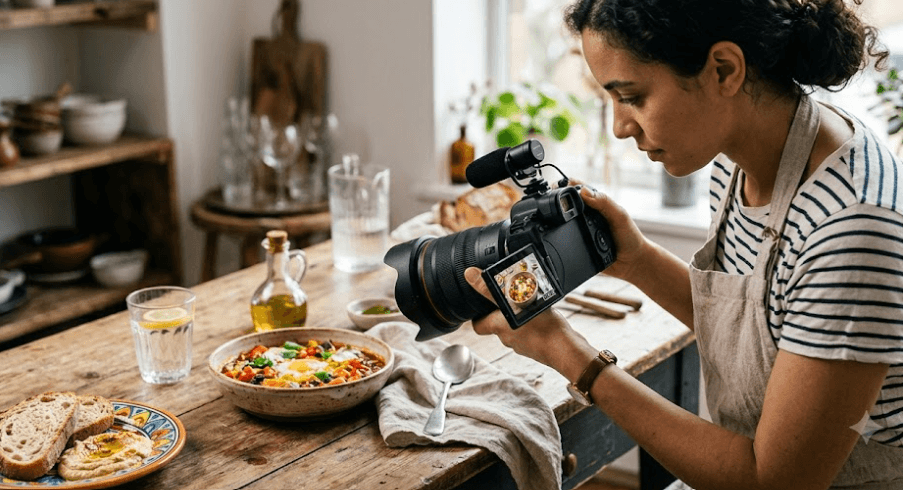
TL;DR The best camera for food photography and content creation should capture detailed still images while also making video production easy. The Sony A7 IV is a strong all-round option because its 33MP full-frame sensor gives you plenty of detail and cropping flexibility, while its RAW support and 4K video make it suitable for both photography and content creation. The Canon EOS R6 Mark II is another strong hybrid option, particularly for creators who value autofocus and video performance, while the Fujifilm X-S20 offers a smaller APS-C setup with 6.2K video and built-in five-axis image stabilization. For beginners and creators who are more video-focused, the Sony ZV-E10 II offers a lighter APS-C setup with 26MP stills and 4K recording. The most important point is that a camera should be chosen together with the right lens and lighting setup, because those factors have a major influence on how appetizing and professional food looks.
What Makes A Camera Good For Food Photography?
Food photography is less forgiving than it first appears. A plate can look completely different depending on the angle, light, colour temperature, texture, and depth of field. A good camera gives you enough control over these elements to reproduce the food naturally instead of simply making the image look bright or oversaturated. For still photography, RAW capture is particularly useful because it gives you more flexibility when adjusting exposure, white balance, highlights, shadows, and colour during editing. The Sony A7 IV, for example, supports 14-bit RAW still images and uses a 33MP full-frame sensor, giving creators considerable flexibility when they need to crop or adjust an image later.
Sensor size also affects how you approach food photography. A full-frame camera can make it easier to achieve shallow depth of field with suitable lenses, which is useful when you want the main dish to stand out against a softer background. However, a full-frame body is not automatically better for every creator. APS-C cameras can be smaller, lighter, and more affordable, while still producing high-resolution images that work very well for websites, social media, restaurant menus, and short-form content. The Fujifilm X-S20, for example, uses a 26.1MP APS-C sensor and includes five-axis in-body image stabilization, showing how much capability can be packed into a smaller camera body.
Video capability has also become an important part of food photography equipment because many creators now produce recipe videos, restaurant reels, cooking tutorials, and behind-the-scenes content alongside still photographs. This changes what you should look for in a camera. A fully articulating or vari-angle screen can make overhead shooting easier, while reliable autofocus and good audio connectivity can simplify solo production. The Fujifilm X-S20 offers a vari-angle touchscreen and 6.2K recording at 30p as well as 4K at 60p, while the Sony ZV-E10 II supports 4K recording up to 60p and provides a creator-focused APS-C platform.
Key Camera Features For Food Creators
| Feature | Why It Matters |
|---|---|
| RAW capture | Gives more flexibility during editing |
| Large sensor | Helps with detail, dynamic range, and depth of field |
| High resolution | Allows cropping and detailed food images |
| Reliable autofocus | Helps when shooting moving cooking scenes |
| 4K video | Useful for recipes, reels, and YouTube content |
| Vari-angle screen | Makes overhead and self-shooting easier |
| Lens availability | Lets you choose macro, prime, or zoom lenses |
| Image stabilization | Helps with handheld shooting and video |
Sony A7 IV For Food Photography And Content Creation
The Sony A7 IV is a particularly versatile choice if your work includes both professional food photography and regular content creation. Its 35mm full-frame sensor provides approximately 33 megapixels of effective resolution, which gives you plenty of detail for close-up food images and allows room for cropping. It also supports 14-bit RAW photography, which is valuable when you need to make precise adjustments during post-production.
For food photographers, the A7 IV's biggest advantage is flexibility rather than one specialised feature. You can pair it with a macro lens for detailed shots of ingredients, textures, sauces, desserts, and plated dishes, or use a wider lens for restaurant interiors and table scenes. Because the camera uses Sony's E-mount, creators have access to a large selection of native lenses and third-party options. That makes it easier to build the system gradually instead of buying every piece of equipment at once.
The camera is also capable of serious video work. Sony lists internal 4K recording options including 4K 60p in certain recording modes, along with 10-bit recording options. That gives creators room to produce recipe videos, restaurant walkthroughs, cooking demonstrations, and social-media content without needing a separate video camera.
Where The A7 IV Makes The Most Sense
The A7 IV is particularly suitable if food photography is part of a wider professional workload. A food photographer may eventually need to shoot restaurant interiors, chef portraits, product images, events, and social-media content, and a versatile full-frame body can cover those situations with the appropriate lens.
It also makes sense for creators who expect their equipment needs to grow. You can start with a general-purpose lens and later add a dedicated macro lens, a fast prime, or a wider lens. That flexibility is often more useful than buying a highly specialised camera that does one job extremely well but becomes limiting when your content expands.
The main consideration is size and cost. A full-frame camera with professional lenses can become a substantial setup, particularly if you add lighting, tripods, microphones, and other accessories. If you mainly create casual Instagram content and do not need the additional flexibility of a full-frame system, a smaller APS-C camera can be easier to manage.
Canon EOS R6 Mark II For Hybrid Creators
The Canon EOS R6 Mark II is another strong option for creators who want a camera that can handle both still photography and video. It uses a 24.2MP full-frame CMOS sensor and Canon's DIGIC X processor. Canon also provides Dual Pixel CMOS AF, with extensive autofocus coverage, making the camera suitable for creators who need dependable subject tracking during both photography and video work.
For food photography, the 24.2MP resolution is already more than sufficient for many commercial and online applications. Food images for websites, social media, digital menus, and marketing campaigns generally do not require extremely high megapixel counts. What matters more is whether the camera can consistently capture clean detail, accurate colour, and the desired depth of field under controlled lighting.
Video is another important strength. Canon specifies 4K recording at up to 59.94p without a crop using 6K oversampling, although continuous recording time can depend on temperature and shooting conditions. The camera also supports Canon Log 3 and 10-bit recording options, giving more flexibility to creators who want to colour-grade their footage.
When Canon Makes More Sense
The EOS R6 Mark II is worth considering if you want a full-frame hybrid camera with a strong autofocus system and substantial video capabilities. It can work particularly well for creators who move between food photography, recipe videos, interviews, restaurant content, and lifestyle work.
Its lower resolution compared with the A7 IV should not automatically be treated as a disadvantage. Twenty-four megapixels is still plenty for many professional food applications, and the final image quality depends on the lens, lighting, exposure, and editing workflow as well as the sensor resolution.
The larger question is the lens ecosystem you want to build. Canon's RF system gives you access to dedicated RF lenses, while compatible EF and EF-S lenses can also be used through an adapter, with compatibility limitations depending on the specific lens.
Fujifilm X-S20 For Smaller Creator Setups
The Fujifilm X-S20 is an appealing option for creators who want strong photography and video capabilities without moving into a larger full-frame setup. It uses a 26.1MP APS-C X-Trans CMOS 4 sensor and weighs approximately 491g for the body. It also includes five-axis in-body image stabilization and a 180-degree vari-angle touchscreen.
That combination is particularly useful for food creators who frequently move between locations. You may be shooting a restaurant one day, a home recipe setup the next, and a travel-food project later in the week. A smaller body can make the entire kit easier to carry, particularly when you also need lights, stands, microphones, reflectors, and food-prop equipment.
The X-S20 is also unusually capable for video at its size. Fujifilm lists 6K recording at 30p, 4K at 60p, and Full HD at up to 240p. The vari-angle screen is useful for overhead compositions and creator-facing videos, while the camera's USB-C, HDMI, microphone input, and hot shoe provide useful connectivity for a broader production setup.
Why APS-C Can Be Enough
A common mistake is assuming that professional food photography automatically requires a full-frame camera. That is not the case. An APS-C camera with a good lens and controlled lighting can produce excellent food images, particularly when the final destination is a website, Instagram, YouTube thumbnail, or digital advertisement.
The smaller sensor can also be useful when you want a little more depth of field at comparable framing, although the exact result depends on the lens, aperture, subject distance, and camera-to-subject relationship. For food, that can sometimes make it easier to keep more of a dish acceptably sharp.
The X-S20 therefore makes sense for creators who value portability and video features alongside still photography. It may be a more practical system if your camera needs to travel frequently rather than remain permanently mounted in a studio.
Sony ZV-E10 II For Video-First Food Creators
The Sony ZV-E10 II is designed with content creators in mind and uses a 26MP APS-C sensor for still images. Sony lists 4K recording up to 59.94p, including 10-bit recording options, and offers the camera both as a body-only model and with a 16-50mm power-zoom lens.
For food creators who primarily make recipe videos, restaurant reels, cooking demonstrations, and social-media content, this can be a sensible direction. Its interchangeable-lens design means you are not locked into the kit lens. You can later add a macro lens for close-up food details or a faster prime lens when you want more background separation.
The trade-off is that the ZV-E10 II is more video-oriented than a traditional professional stills body. That is not necessarily a problem. If your content calendar consists mainly of videos with occasional food photographs, spending more money on a higher-end full-frame body may not improve your workflow enough to justify the additional size and cost.
Best Use For The ZV-E10 II
The ZV-E10 II fits creators who want a relatively compact interchangeable-lens camera and plan to shoot a lot of video. It is especially relevant if your content is primarily published on Instagram, YouTube, TikTok, or similar platforms.
Sony's Indian specifications list the body-only MRP at ₹99,490 and the 16-50mm kit at ₹1,09,990, although actual retail prices can vary by seller and promotion.
For food photography itself, the lens remains critical. The included kit lens can cover general shooting, but creators who want close-up texture, controlled background blur, or more precise compositions should plan for a dedicated lens as their skills develop.
Camera Comparison For Food Photography
The cameras below cover different creator requirements rather than representing one universal specification hierarchy. The Sony A7 IV and Canon EOS R6 Mark II are full-frame hybrids, while the Fujifilm X-S20 and Sony ZV-E10 II use APS-C sensors. Their specifications show why choosing a camera should begin with the type of content you create rather than simply comparing megapixels.
| Camera | Sensor | Resolution | Video Capability | Best Suited To |
|---|---|---|---|---|
| Sony A7 IV | Full-frame | 33MP | Up to 4K 60p | Professional hybrid creators |
| Canon EOS R6 Mark II | Full-frame | 24.2MP | Up to 4K 60p | Photo and video creators |
| Fujifilm X-S20 | APS-C | 26.1MP | 6.2K 30p, 4K 60p | Portable hybrid creators |
| Sony ZV-E10 II | APS-C | 26MP | Up to 4K 60p | Video-first creators |
The Sony A7 IV offers the highest still-image resolution among these four and provides 14-bit RAW capture, making it particularly attractive when still photography is a major part of your work. The Canon EOS R6 Mark II offers a lower 24.2MP resolution but combines that with strong autofocus and substantial video functionality.
The Fujifilm X-S20 shifts the balance toward portability and video flexibility. Its 26.1MP APS-C sensor, five-axis stabilization, vari-angle screen, 6K recording, and 4K 60p capability make it well suited to creators who work outside a dedicated studio.
The Sony ZV-E10 II is the most creator-focused option of the group. Its 26MP APS-C sensor and 4K 60p recording provide enough capability for serious social-media and video work, while its interchangeable-lens design gives creators room to improve their photography setup over time.
Choosing The Right Lens For Food Photography
The camera body is only one half of the equation. A good food-photography lens can make a bigger practical difference than moving from one capable camera body to another. A macro lens is particularly useful when you want to photograph details such as the texture of bread, individual ingredients, chocolate, sauces, coffee crema, or the surface of a dessert. A standard prime lens can also work extremely well when you want a natural perspective and attractive background separation.
For overhead food photography, the working distance and focal length matter because you need enough room to position the camera without blocking your lighting. Wider lenses can be useful for larger table scenes and restaurant interiors, while moderate focal lengths are often easier for individual plates and close-up compositions. The right focal length ultimately depends on your shooting space, the size of the dish, and the look you want.
Lighting should also be treated as part of the camera setup. A highly expensive camera cannot compensate for harsh, uncontrolled light or poor white balance. A simple diffused light source, reflector, tripod, and consistent shooting position can produce a bigger improvement than upgrading between two already-capable camera bodies. This is why food photographers should budget for the complete system rather than spending the entire budget on the camera.
Camera And Lens Priorities
| Requirement | What To Prioritize |
|---|---|
| Close-up food details | Macro lens |
| Restaurant interiors | Wider lens |
| Recipe videos | Vari-angle screen and 4K video |
| Professional stills | RAW capture and suitable lens |
| Handheld content | Image stabilization |
| Social-media reels | 4K video and reliable autofocus |
| Overhead photography | Tripod and suitable focal length |
| Consistent colour | Controlled lighting and accurate white balance |
Which Camera Should Content Creators Buy?
If food photography is your primary work and you also create professional video content, the Sony A7 IV is a strong all-round option. Its 33MP full-frame sensor, 14-bit RAW capability, extensive lens ecosystem, and advanced 4K recording make it flexible enough for both commercial food photography and content creation.
If you are more focused on video and want a lighter setup, the Fujifilm X-S20 or Sony ZV-E10 II can make more sense. The X-S20 offers 6K recording, 4K 60p, IBIS, and a vari-angle screen, while the ZV-E10 II combines a 26MP APS-C sensor with 4K 60p recording and a creator-focused design.
For creators who want a full-frame Canon system, the EOS R6 Mark II is another capable choice. Its 24.2MP sensor is sufficient for many professional food applications, while its autofocus and video features make it a versatile hybrid camera.
Frequently Asked Questions
Q. What is the best camera for food photography?
The Sony A7 IV is a strong all-round choice for food photographers who also create video. Its 33MP full-frame sensor, 14-bit RAW support, and 4K video capabilities give it enough flexibility for professional still photography and content creation.
Q. Do I need a full-frame camera for food photography?
No. APS-C cameras can produce excellent food photos when paired with the right lens and controlled lighting. The Fujifilm X-S20 and Sony ZV-E10 II are examples of APS-C cameras that offer substantial resolution and video capabilities.
Q. Is a macro lens necessary for food photography?
Not always. A macro lens becomes particularly useful when you want extreme close-ups of ingredients, textures, desserts, sauces, and other fine details. For wider food scenes, a standard prime or zoom lens may be more practical.
Q. Is megapixel count important for food photography?
Megapixels matter, particularly when you need to crop images or produce large files, but they are not the only consideration. Lighting, lens quality, focus, exposure, colour, and editing have a major influence on the final photograph.
Q. Which camera is better for food videos and reels?
Several cameras can work well. The Fujifilm X-S20 offers 6K recording and 4K at 60p, while the Sony ZV-E10 II supports 4K at up to 60p and is specifically designed around creator workflows.
Q. Is the Sony A7 IV good for content creation?
Yes. The A7 IV is designed as a hybrid stills and video camera, with 33MP full-frame stills, RAW support, 4K recording, and a large selection of compatible E-mount lenses.
Q. Is the Canon EOS R6 Mark II good for food photography?
Yes. Its 24.2MP full-frame sensor provides enough resolution for many food-photography applications, while Canon's autofocus system and video capabilities make it useful for creators who produce both photographs and videos.
Q. Is the Fujifilm X-S20 good for food photography?
Yes. Its 26.1MP APS-C sensor, five-axis image stabilization, vari-angle screen, and strong video capabilities make it a flexible option for food photographers who also create content.
Q. What matters more, the camera or the lens?
Both matter, but upgrading the lens and improving lighting can make a major difference even with a capable camera body. Food photography depends heavily on perspective, depth of field, focus, light quality, and colour.
Q. What should I buy first for food photography?
Start with a capable interchangeable-lens camera, a suitable lens, a stable tripod, and controlled lighting. Once you understand your preferred shooting style, you can add a macro lens, additional lights, reflectors, microphones, or other accessories according to your workflow.
Final Recommendation
The Sony A7 IV is the camera I would place at the centre of a professional food photography and content-creation setup because it balances high-resolution still photography with serious video capabilities. Its 33MP full-frame sensor and 14-bit RAW support provide useful flexibility for commercial images, while its 4K recording options make it suitable for recipe videos, restaurant reels, and broader creator work.
That does not mean every creator needs to spend more on a full-frame system. The Fujifilm X-S20 is a compelling alternative for someone who values a smaller body, stabilization, a vari-angle screen, and strong video features. The Sony ZV-E10 II is particularly relevant to video-first creators, while the Canon EOS R6 Mark II provides another full-frame option for creators who want Canon's autofocus and RF lens ecosystem.
Ultimately, the best camera for food photography is the one that fits your complete shooting setup. A capable camera paired with the right lens, soft and controlled lighting, a stable tripod, and a consistent editing workflow will usually produce better results than an expensive camera used with poor lighting and an unsuitable lens. For a creator who wants one system to grow from food photography into broader commercial and social-media content, the Sony A7 IV provides the most complete starting point in this comparison.






