Best Camera to Buy for Astrophotography on a Budget
You do not need an expensive full-frame camera to start astrophotography. Affordable APS-C cameras can produce excellent night-sky images when paired with the right lens, tripod, and shooting settings.

TL;DR You do not need to spend over ₹1 lakh on a camera body to start astrophotography. A good APS-C mirrorless camera such as the Canon EOS R50 can give beginners a strong starting point, but the kit lens is not ideal for serious night-sky photography because its maximum aperture is relatively slow. For better results, put part of your budget into a fast wide-angle lens, a sturdy tripod, and a remote or timed shutter setup. The Sony a6400 remains a useful option if you find a good deal on the body and a compatible fast lens, while the Nikon Z50II offers strong low-light controls and RAW shooting but costs more. For most beginners on a budget, the smartest purchase is not simply the cheapest camera. It is the camera and lens combination that gives you enough light-gathering ability, manual control, RAW files, and a practical upgrade path.
What Makes A Camera Good For Astrophotography?
Astrophotography puts very different demands on a camera compared with daytime photography. Instead of having plenty of available light, you are trying to record extremely faint stars and details in the Milky Way while keeping noise under control. This is why sensor size, RAW support, manual exposure controls, and lens aperture matter more than features such as extremely fast autofocus or high burst rates. A camera that gives you full control over shutter speed, aperture, ISO, and focus gives you much more flexibility when you are shooting under a dark sky.
Sensor size also deserves attention, but it should not be treated as the only deciding factor. APS-C cameras are attractive for budget astrophotography because they generally cost less than full-frame models while still offering a relatively large sensor compared with smartphones and many compact cameras. The Canon EOS R50, for example, uses a 24.2MP APS-C CMOS sensor, while the Sony a6400 uses a 24.2MP APS-C sensor. Nikon's Z50II uses a 20.9MP DX-format sensor. All three can record RAW files, giving you much more flexibility when you process shadows, contrast, color, and noise later.
The lens is where many first-time buyers make an expensive mistake. A camera with excellent low-light capability can still struggle if it is paired with a slow kit lens. For photographing a wide section of the Milky Way, a wide-angle lens with a bright maximum aperture is usually much more useful than a general-purpose zoom with a narrow maximum aperture. A fast lens allows more light to reach the sensor during the exposure, which can help you record more stars without relying entirely on extremely high ISO settings.
Why RAW Support Matters
RAW shooting is particularly useful for astrophotography because night-sky images often need substantial editing. JPEG files are processed inside the camera and compressed, while RAW files retain substantially more original image data for later processing. This gives you more room to adjust exposure, white balance, highlights, shadows, and color while trying to preserve faint stars.
That does not mean RAW automatically makes an image better. You still need correct exposure, accurate focus, a suitable lens, and a steady camera. It simply gives you more information to work with after the photograph has been captured. The Sony a6400 supports 14-bit RAW, while the Nikon Z50II supports 14-bit NEF RAW files. The Canon EOS R50 also supports RAW and C-RAW recording, making all three suitable for a workflow where editing is part of the final result.
| Camera | Sensor | RAW Support | Standard ISO Range | Body Type |
|---|---|---|---|---|
| Canon EOS R50 | 24.2MP APS-C | RAW/C-RAW | ISO 100–32,000 | Mirrorless |
| Sony a6400 | 24.2MP APS-C | 14-bit RAW | ISO 100–32,000 | Mirrorless |
| Nikon Z50II | 20.9MP DX | 14-bit NEF RAW | ISO 100–51,200 | Mirrorless |
Best Budget Cameras For Astrophotography
The Canon EOS R50 is one of the easiest cameras to consider when your budget needs to remain controlled. Canon India currently lists the EOS R50 with its RF-S 18-45mm f/4.5-6.3 IS STM lens at an MRP of ₹75,995. The camera itself uses a 24.2MP APS-C sensor and supports manual exposure, RAW shooting, and shutter speeds suitable for long exposures. Its compact 375g body also makes it easy to carry to a dark-sky location. The important catch is the kit lens. Its maximum aperture of f/4.5 at the wide end is not especially bright for astrophotography, so serious night-sky shooters may eventually want a faster lens.
The Sony a6400 is another strong option, particularly if you find a competitively priced body or a good used unit. Its 24.2MP APS-C sensor supports 14-bit RAW files, with a standard still-image ISO range of 100 to 32,000. Sony also gives you full manual exposure control, making the camera suitable for experimenting with long-exposure night photography. The body does not have in-body image stabilisation, but that is not a major disadvantage for tripod-mounted astrophotography because the camera should be locked down during long exposures anyway. Its larger E-mount lens ecosystem also gives buyers plenty of ways to build a dedicated astrophotography setup over time.
The Nikon Z50II moves into a higher price category but offers a compelling set of controls for photographers who want a camera that can grow with them. Nikon India currently lists the Z50II with the NIKKOR Z DX 16-50mm f/3.5-6.3 VR lens at ₹98,945. It uses a 20.9MP DX-format sensor, supports 14-bit RAW files, and has a standard ISO range of 100 to 51,200. Nikon also specifies long-exposure noise reduction and extended shutter-speed options. It is therefore a capable camera for night photography, although the standard 16-50mm kit lens is still not the ideal choice for capturing the Milky Way because its maximum aperture is relatively slow.
Camera Comparison For Budget Astrophotography
There is no single specification that determines whether a camera will be good for astrophotography. A useful comparison should look at the sensor, RAW capability, manual exposure controls, lens ecosystem, body price, and the amount of money left for the rest of the setup. A cheaper camera paired with a fast lens can make more sense than an expensive body paired with a slow kit lens.
The Canon EOS R50 has a particularly attractive starting point because its official kit price is below the Nikon Z50II's current listed kit price. The Sony a6400 becomes more interesting when you consider the availability of E-mount lenses, including third-party options. The Nikon Z50II is technically strong, but its higher price means you need to budget carefully if astrophotography is your main reason for buying the camera.
| Camera | Sensor Resolution | RAW | Stabilisation | Current India Reference |
|---|---|---|---|---|
| Canon EOS R50 | 24.2MP APS-C | RAW/C-RAW | No IBIS | ₹75,995 kit MRP |
| Sony a6400 | 24.2MP APS-C | 14-bit RAW | No IBIS | Check current retailer pricing |
| Nikon Z50II | 20.9MP DX | 14-bit RAW | No IBIS | ₹98,945 kit MRP |
Why The Lens Matters More Than You Think
A fast wide-angle lens is one of the most important purchases for Milky Way photography. The reason is simple: stars are faint, and you need to collect as much light as practical during each exposure. A lens with an aperture such as f/1.4, f/1.8, or f/2 can give you considerably more light than a kit lens operating at f/4.5 or f/5.6. That does not automatically guarantee a better image, but it gives you more exposure flexibility.
Focal length also affects the type of astrophotography you can create. A wide lens lets you include more of the sky while also fitting foreground elements such as mountains, buildings, trees, or landscapes into the frame. This is useful for classic Milky Way compositions. Longer focal lengths can be useful for the Moon or more specialised deep-sky work, but they generally require different techniques and often tracking equipment because the Earth's rotation becomes more obvious during longer exposures.
This is why spending your entire budget on the camera body can be counterproductive. If you buy a ₹90,000 body and then use a slow kit lens, you may get less practical improvement than if you bought a more affordable APS-C body and allocated the remaining budget toward a bright wide-angle lens and a stable tripod. The camera records the light, but the lens determines how much light can reach the sensor in the first place.
The Kit Lens Problem
Kit lenses are designed to be versatile, compact, and affordable. Those are useful qualities for everyday photography, but astrophotography has different priorities. A typical 18-45mm or 16-50mm kit zoom is convenient for landscapes and travel, yet its maximum aperture becomes relatively narrow compared with a dedicated fast prime.
That does not make a kit lens useless. You can still photograph the Moon, star trails, bright constellations, and night landscapes with one. It can also be useful when you are learning composition and exposure. The limitation becomes more noticeable when your goal is a detailed Milky Way photograph with a relatively low-noise foreground and plenty of visible stars.
For a beginner, the sensible approach is to start with the kit lens if it is already included in the camera package, learn manual exposure and focusing, and then upgrade the lens once you know which type of astrophotography you enjoy. This avoids spending heavily on equipment before you understand your shooting style.
What Else Do You Need For Astrophotography?
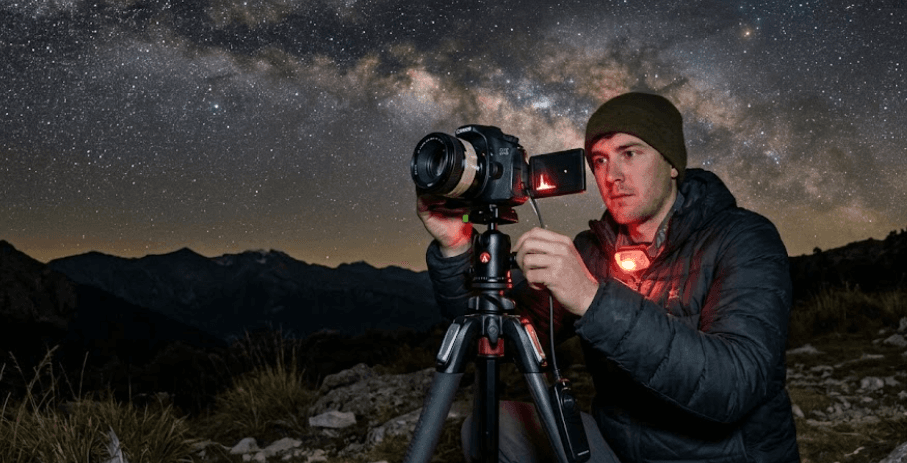
A tripod is not optional for serious long-exposure astrophotography. Even a small amount of camera movement can turn stars into blurred points or short trails. A solid tripod lets you keep the camera stationary while the shutter remains open. It also makes composition easier because you can carefully frame the foreground and sky before taking the photograph.
You should also use a self-timer or a remote shutter method where practical. The purpose is to prevent your hand from physically moving the camera when you press the shutter button. Depending on the camera and shooting situation, a two-second or longer delay can be enough to let vibrations settle. Electronic shutter options can also be useful in some situations, although the specific behaviour depends on the camera.
Finally, location matters enormously. A very expensive camera cannot completely overcome severe light pollution. Getting away from bright city centres can reveal far more stars than simply increasing ISO. For Indian photographers, this can mean travelling outside major urban areas and checking weather, cloud cover, moon phase, and local conditions before planning a shoot. Astrophotography is therefore partly a camera exercise and partly a location-planning exercise.
| Equipment | Why It Matters | Budget Priority |
|---|---|---|
| Camera body | RAW files and manual exposure | High |
| Fast wide-angle lens | Collects more light | Very high |
| Stable tripod | Prevents camera movement | Very high |
| Remote or self-timer | Reduces vibration | Medium |
| Spare battery | Useful during long sessions | Medium |
| Memory card | Stores RAW files | Medium |
| Dark-sky location | Reduces light pollution | Very high |
Common Astrophotography Mistakes To Avoid
One common mistake is assuming that a higher ISO automatically produces more stars. ISO increases the signal amplification, but it does not magically collect more light. If the lens is too slow or the location is heavily polluted by artificial light, simply increasing ISO can produce a brighter but noisier image. Exposure should instead be balanced using aperture, shutter speed, ISO, and the scene you are photographing.
Another mistake is relying on autofocus at night. Autofocus can struggle when there is very little light or when the subject is effectively an extremely distant point of light. Manual focus is often more practical for stars. A useful approach is to magnify a bright star or distant light in live view and carefully adjust focus until it appears as sharp as possible. Once focus is set, you should avoid accidentally changing it while composing additional frames.
A third mistake is buying equipment based entirely on megapixels. More megapixels can provide additional cropping flexibility, but they do not automatically make a camera better for astrophotography. Sensor performance, lens quality, exposure control, noise behaviour, and the ability to process RAW files are all important. A well-exposed 20MP or 24MP image from a good APS-C setup can be far more useful than a poorly exposed high-resolution photograph.
Avoid Overspending On The Body
If your total budget is limited, think about the complete system instead of the camera alone. A camera body, fast lens, tripod, memory card, and spare battery form the actual shooting setup. Buying the most expensive body you can afford and leaving no money for the lens can create a system that looks impressive on paper but performs below its potential.
This is particularly relevant for beginners because astrophotography has a learning curve. You need to learn manual focus, exposure, composition, RAW processing, and often image stacking before expensive equipment starts making a major difference. A sensible APS-C camera can teach you those skills without requiring a professional-level investment.
Used equipment can also change the equation. A clean, properly functioning older mirrorless camera can be a practical starting point if it has a suitable sensor, RAW support, manual controls, and a compatible lens ecosystem. However, buyers should check shutter condition, sensor cleanliness, battery health, lens condition, and seller reliability before purchasing used gear.
How To Choose The Right Camera For Your Budget
If your budget is around ₹75,000 to ₹80,000 for the camera and kit lens, the Canon EOS R50 is a sensible starting point. Canon's official India listing places the RF-S 18-45mm kit at ₹75,995 MRP. The camera has the important fundamentals for astrophotography, including an APS-C sensor, RAW recording, manual exposure and a compact body. Just remember that the included lens is not the strongest part of this setup for Milky Way photography.
If you can stretch your budget and find a good deal on the body, the Sony a6400 becomes attractive because of its APS-C sensor, 14-bit RAW support and broad E-mount lens ecosystem. Its lack of in-body stabilisation is less important for tripod-based astrophotography, where the camera should remain stationary. The bigger consideration is the cost of adding a genuinely fast wide-angle lens.
The Nikon Z50II is a strong option if you want a more modern Nikon APS-C body and are comfortable spending more. Its 20.9MP DX sensor, 14-bit RAW support, ISO range up to 51,200, long-exposure noise reduction, and manual controls give it a solid technical foundation. However, at ₹98,945 for the 16-50mm kit on Nikon India's current listing, it leaves less of the budget available for a dedicated astrophotography lens.
| Budget Approach | Camera To Consider | What To Prioritise Next |
|---|---|---|
| Lower budget | Canon EOS R50 | Fast wide-angle lens |
| Flexible used-market budget | Sony a6400 | Fast E-mount lens and tripod |
| Around ₹1 lakh | Nikon Z50II | Dedicated wide, bright lens |
| Any budget | APS-C mirrorless | Lens and tripod before unnecessary accessories |
Frequently Asked Questions
Q. What is the best budget camera for astrophotography?
For a beginner who wants to keep the initial camera-and-kit cost controlled, the Canon EOS R50 is a practical starting point. Its 24.2MP APS-C sensor, RAW support, manual exposure controls, and compact body give you the fundamentals required for night-sky photography. The bigger limitation is the standard RF-S 18-45mm kit lens, which is relatively slow for serious Milky Way work. A faster wide-angle lens should therefore be your next upgrade.
Q. Is an APS-C camera good enough for astrophotography?
Yes. APS-C cameras can produce excellent astrophotography images, particularly when paired with a fast lens and used under a dark sky. You do not need a full-frame camera simply because you are photographing stars. Full-frame models can offer advantages in some low-light situations, but they also cost more. For someone learning astrophotography, APS-C can provide a much more accessible starting point.
Q. Is the Canon EOS R50 good for astrophotography?
The EOS R50 has the core features needed for astrophotography, including a 24.2MP APS-C sensor, RAW recording and manual exposure controls. Its compact 375g body is also convenient for travelling to dark-sky locations. The main limitation is the included RF-S 18-45mm f/4.5-6.3 lens, which is not especially fast. The camera becomes more capable for Milky Way photography when paired with a faster compatible lens.
Q. Is the Sony a6400 good for night photography?
The Sony a6400 is a capable APS-C camera for night photography. It has a 24.2MP sensor, 14-bit RAW recording, manual exposure controls and a standard ISO range of 100 to 32,000. It does not have in-body image stabilisation, but that is not a major problem when the camera is mounted on a tripod for astrophotography. Lens selection is an important part of getting the most from the camera.
Q. Is the Nikon Z50II worth buying for astrophotography?
The Nikon Z50II is technically well suited to night photography, with a 20.9MP DX sensor, 14-bit RAW files, manual exposure, long-exposure noise reduction and a standard ISO range of 100 to 51,200. The main consideration is price. Nikon India's current listing for the 16-50mm kit is ₹98,945, so you need to budget for a faster lens if astrophotography is your main purpose.
Q. Do I need a full-frame camera for the Milky Way?
No. A full-frame camera is not essential for Milky Way photography. A good APS-C camera can capture detailed Milky Way images when used with an appropriate wide and fast lens. Full-frame cameras can provide additional low-light advantages, but the total system cost is usually higher. Beginners should consider the complete camera, lens and tripod setup rather than assuming full-frame is mandatory.
Q. What lens is best for budget astrophotography?
A wide-angle lens with a bright maximum aperture is generally a strong choice for Milky Way landscapes. Apertures around f/1.4, f/1.8 or f/2 allow more light to reach the sensor than many standard kit lenses. The exact focal length depends on your sensor and composition preferences. Before buying, check that the lens is compatible with your camera mount.
Q. Is high ISO important for astrophotography?
High ISO capability is useful, but the maximum ISO number printed on a specification sheet should not be treated as a quality score. Increasing ISO amplifies the recorded signal and noise. A fast lens, dark location, appropriate shutter speed and good exposure technique can often matter more than simply selecting an extremely high ISO setting.
Q. Do I need a tripod for astrophotography?
Yes, a stable tripod is strongly recommended for long-exposure astrophotography. The camera needs to remain stationary while the shutter is open, otherwise stars and foreground objects can become blurred by camera movement. A self-timer or remote shutter method can further reduce vibration when you take the photograph.
Q. Can I do astrophotography with a kit lens?
Yes, but there are limitations. A kit lens can be useful for learning, photographing the Moon, capturing star trails and experimenting with night landscapes. For detailed Milky Way photography, however, its relatively narrow maximum aperture can make it harder to gather enough light. Once you understand the basics, upgrading to a faster wide-angle lens can make a more noticeable difference than immediately replacing the camera body.
Final Recommendation
For someone starting astrophotography on a budget, the Canon EOS R50 is a sensible entry point because it combines a 24.2MP APS-C sensor, RAW shooting, manual exposure controls and a relatively accessible official kit price. It is not the perfect astrophotography setup straight out of the box, because the RF-S 18-45mm kit lens is relatively slow. That is an important distinction: the camera is capable, but the complete kit should eventually include a faster wide-angle lens.
The Sony a6400 is worth considering when you find a good body price, especially if you want access to a broad range of E-mount lenses and third-party options. The Nikon Z50II is the more expensive route, but its 20.9MP DX sensor, 14-bit RAW files and strong manual controls make it a capable long-term camera for photographers who also want a modern all-purpose APS-C system.
The most important buying decision, however, is not simply choosing between Canon, Sony, and Nikon. For budget astrophotography, put serious thought into the lens and tripod. A capable APS-C camera paired with a fast wide-angle lens, stable support and a genuinely dark location can produce impressive night-sky photographs without requiring a professional full-frame setup. If the goal is to start learning without overspending, buy the camera that leaves enough room in the budget for the rest of the system.