Best Use Of Refurbished Tablets
Discover how refurbished tablets are making education more accessible, affordable, and sustainable to Children. Learn about their benefits, real-world impact, and how they bridge the digital divide in schools and colleges

TL;DR Refurbished tablets have become one of the most powerful enablers of digital education in India in 2025 because they combine affordability, scalability, app compatibility, and sustainability into a classroom-ready technology solution. For schools, colleges, edtech programs, rural learning initiatives, and students with budget constraints, they help bridge the digital divide while delivering the same core learning outcomes as new tablets at a fraction of the cost.
Why Refurbished Tablets Have Become Critical to Modern Education
The role of tablets in education has evolved from being a “nice-to-have” digital aid to a core learning infrastructure layer in India’s 2025 education ecosystem. As schools, colleges, coaching institutes, and hybrid learning programs increasingly depend on e-books, LMS portals, digital assignments, live classes, and collaborative tools, access to reliable hardware has become a foundational requirement rather than an optional upgrade. This is where refurbished tablets have emerged as one of the most impactful solutions because they make large-scale technology deployment financially practical.
The strongest reason refurbished tablets matter is budget efficiency. Educational institutions often work within fixed annual allocations, and purchasing new tablets at scale can severely limit rollout size. Refurbished tablets solve this by allowing schools to deploy more devices per classroom, more tablets per grade level, and better student-to-device ratios without compromising access to modern educational tools. This directly improves classroom inclusion, digital literacy exposure, and continuity of learning.
The relevance becomes even stronger in India’s 2025 context, where digital education is no longer limited to metro cities. Tier 2, Tier 3, and rural schools increasingly rely on blended learning models, recorded lessons, digital homework systems, and state-backed online learning programs. Refurbished tablets allow institutions to participate in this shift without making technology access dependent on premium budgets, which is exactly why they have become critical to education transformation.
The Biggest Benefits of Refurbished Tablets for Schools and Students
The most immediate advantage of refurbished tablets is cost-effectiveness, but their real educational value goes much deeper. Lower hardware costs allow institutions to expand deployment beyond pilot classrooms into full-grade implementations. Instead of restricting device access to computer labs, schools can create device-enabled learning ecosystems where students regularly use tablets for notes, assignments, reading, assessments, and collaborative work. This dramatically improves the consistency of digital learning.
Sustainability is another major advantage that aligns strongly with modern institutional priorities. Educational organizations today are increasingly evaluated not only on learning outcomes but also on responsible infrastructure choices. By choosing refurbished tablets, schools directly contribute to reducing electronic waste and extending the lifecycle of premium hardware. This creates a strong sustainability narrative while also improving budget efficiency, making it one of the few decisions that is both financially and environmentally superior.
Accessibility remains perhaps the most transformative impact. Refurbished tablets make it possible for underserved schools, NGO-backed education programs, scholarship initiatives, and rural institutions to give students access to the same educational apps, virtual classrooms, and digital content ecosystems used by premium urban schools. This directly supports educational equity and helps reduce the technology gap that still exists across different socioeconomic segments in India.
| Benefit | Educational Impact | Why It Matters in 2025 |
|---|---|---|
| Lower cost | More devices per classroom | Better student-device ratio |
| Sustainability | Reduced e-waste | Supports green campus goals |
| Accessibility | Reaches underserved students | Bridges digital divide |
| Bulk deployment | Faster institutional rollout | Better scaling across grades |
| App compatibility | LMS + e-book support | Supports hybrid education |
Real-World Use Cases: How Tablets Improve Learning Outcomes
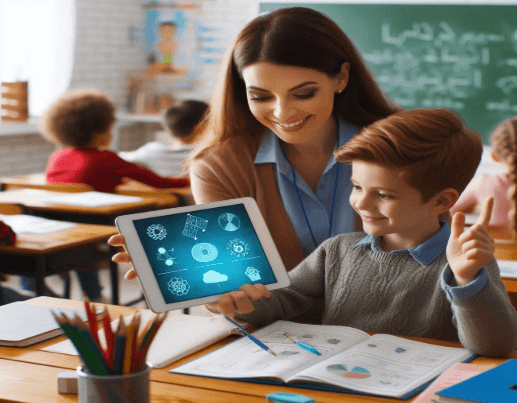
The strongest practical use case for tablets in education remains interactive learning. Subjects like mathematics, science, coding, design, and language learning become significantly more engaging when students can interact with simulations, whiteboard apps, live quizzes, and multimedia lessons. Refurbished tablets allow these experiences to scale across classrooms without forcing schools into unsustainable hardware budgets.
Digital libraries are another transformational use case. Instead of relying entirely on printed textbooks, schools can now provide students with access to e-books, recorded lectures, reference PDFs, research material, and revision notes in one portable device. This reduces physical textbook dependency, improves content accessibility, and allows real-time content updates, which is especially useful in fast-evolving curricula and competitive exam ecosystems.
The role of refurbished tablets in remote learning and hybrid education remains equally important. Even after the acceleration of online education, institutions continue to use recorded lessons, digital assignments, and remote doubt-clearing systems. Tablets make these workflows more accessible for students who may not own laptops. For higher education, they also support presentations, collaborative note-sharing, group assignments, and research-heavy reading workflows, making them especially practical for college and university students.
Why Refurbished Tablets Are Especially Powerful for Rural and Inclusive Education
The most meaningful impact of refurbished tablets can be seen in rural education and inclusive learning environments. In many underserved regions, access to modern computing devices is still one of the biggest barriers to educational progress. Refurbished tablets solve this by lowering deployment costs enough for NGOs, state-backed initiatives, and budget-sensitive schools to provide classroom-ready devices at scale.
For rural schools, this directly improves access to digital teaching tools, recorded lessons, STEM simulations, government education portals, and exam-preparation content. In 2025, where blended learning is becoming increasingly normalized, this access can materially improve attendance, student engagement, and concept retention. The technology no longer remains restricted to urban private institutions.
Refurbished tablets are also highly effective in special education environments. Their compatibility with assistive technologies such as text-to-speech, visual aids, communication boards, handwriting tools, and interactive exercises makes learning significantly more inclusive. This is one of the strongest long-term reasons tablets continue to reshape education infrastructure.
How Schools Should Choose the Right Refurbished Tablets
The smartest deployment decision begins with defining the learning workload. Tablets intended for preschool and primary education may prioritize durability, screen quality, battery life, and protective accessories. Devices for higher classes and colleges may need stylus support, better processors, larger storage, and stronger multitasking capability for LMS systems, video calls, and research workflows.
Battery health and software support should be treated as the highest procurement priorities. A device with poor battery retention or outdated OS compatibility can quickly disrupt classroom continuity. Institutions should also prioritize storage capacity, Wi-Fi stability, app ecosystem compatibility, and protective case readiness to reduce maintenance costs over time.
Bulk procurement strategies become especially important for schools and colleges. The best institutional purchases are those that combine warranty-backed refurbished tablets, preloaded educational software, standardized accessories, and centralized IT support. This dramatically reduces rollout friction and ensures teachers can focus on pedagogy instead of technical setup.
Why Refurbished Tablets Remain One of the Smartest Investments in Education
The strongest long-term takeaway is simple: refurbished tablets are no longer just an affordable alternative to new devices, but one of the most scalable tools for improving educational access, engagement, and continuity in India’s 2025 learning ecosystem. Their ability to combine lower cost, sustainability, digital accessibility, and classroom-ready functionality makes them uniquely powerful in education.
What makes the investment even smarter is how well it aligns with institutional realities. Schools need budget discipline, colleges need scalable digital infrastructure, NGOs need wider access, and students need reliable hardware for learning continuity. Refurbished tablets solve all four problems simultaneously while still supporting the same educational apps, portals, and content workflows as new devices.
For institutions, educators, and policymakers looking to expand technology-led learning without stretching budgets, refurbished tablets remain one of the safest and highest-impact investments heading into 2027.
Frequently Asked Questions
Q. Are refurbished tablets good for students in 2025?
Yes, they are excellent for students because they support e-books, learning apps, video classes, note-taking, and LMS platforms at significantly lower cost than new tablets.
Q. Can schools buy refurbished tablets in bulk?
Yes, bulk procurement is one of the biggest advantages because it allows schools to scale digital learning programs while staying within budget.
Q. Are refurbished tablets compatible with educational apps?
Absolutely. Most certified refurbished tablets comfortably support e-books, virtual classroom apps, LMS systems, coding tools, and digital assessment platforms.
Q. Why are refurbished tablets useful in rural schools?
They reduce the cost barrier to digital learning, making it easier for rural schools to deploy classroom technology, recorded lessons, and online educational resources.
Q. Are refurbished tablets good for special education?
Yes, they work very well with assistive learning tools such as text-to-speech, visual communication aids, and adaptive educational apps.
Q. Is buying refurbished tablets also sustainable?
Yes, it reduces e-waste, extends hardware life cycles, and supports environmentally responsible education infrastructure planning.
Ready to upgrade your tech?
Browse our collection of quality refurbished products at unbeatable prices.